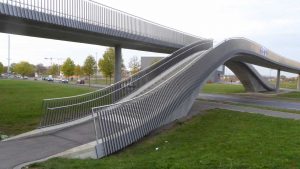
The new article on Generic Tasks is dedicated to tasks in the category “Volume and Weight”. As always, you can create these tasks in no time using the task wizard, and you will find the corresponding objects everywhere in your surroundings. The first article on Generic Tasks, which also tells you how to get to the task wizard and what Generic Tasks are, can be found here.

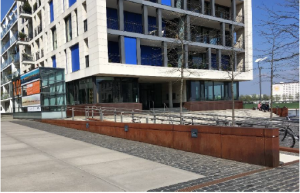
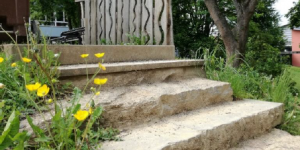
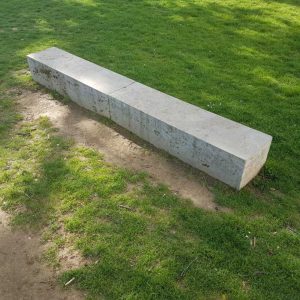
First, we would like to look at the object category of cuboids. Especially in public places or near buildings you can find stones or stone seats that can be approximated as cuboids. In the first picture of this article such a seat is shown as an example. The task, which is available in the task wizard, reads:

“How much does the stone weigh? 1m³ weighs 2600kg. Give the result in kg.”

Required for creating the task are the length, width and height, and optionally the density of the stone. If you do not have the density of the material, the wizard will give you an average value for the weight of a cubic meter of stone. Based on the entered data, the wizard fills in the rest of the task form and only a picture needs to be added to complete the task.
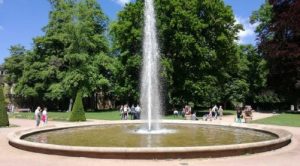


Another object that can be found in many cities is the fountain, with a fountain basin that can be modeled as a cylinder. The focus of this task is on determining the capacity of the fountain basin in liters, which is why the corresponding problem definition of the Generic Task, which is created by the Wizard, is as follows:

“How many liters of water are in the fountain?”

The data needed to create the task in this case are the radius of the fountain basin, which in practice can be easily determined by the circumference of the fountain, and the height of the basin.

In the next article on the topic of Generic Taks, we will turn to a classic wizard task. The focus will be on the growth rate of trees. Until then, we hope you have fun and save time when creating MCM tasks with the Task Wizard!

 

In this article on Generic Tasks, we would like to introduce you to two tasks from the “Number” category. As always, you can find the corresponding objects everywhere and the tasks can be created in no time using the task wizard. The first article on Generic Tasks, which also tells you how to get to the Task Wizard and what Generic Tasks are, can be found here.

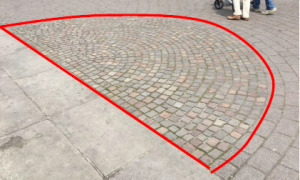
The first object category we want to talk about here are paved areas or walls. Especially in city centers or public places you can often find areas that are paved with stones. In the picture below you can see an example of a semicircular area, which was laid out with paving stones. The task, which is provided for this in the task wizard, reads:

“With how many paving stones was the area shown laid out?”.

The values needed to create the task with the wizard are only the size of the total area and the average number of stones on a square meter. Starting from this data, the wizard fills in the complete task form and only a picture needs to be added to complete the task. Similarly, there is a task in the wizard that asks for the number of bricks that make up a wall.


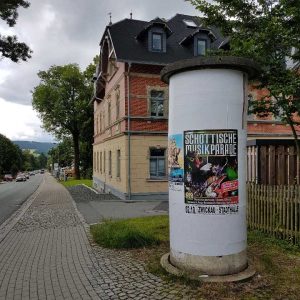
Another object for which a Generic Task can be created in the Wizard is the typical advertising pillar. After manually entering the circumference and height of the area that can be placarded, the task here is:

“How many DIN A0 posters can be placed on the advertisement pillar without overlapping? DIN A0: length = 84cm; height = 119cm.”.

An interesting aspect of this problem is that it can only be solved correctly if the condition of not overlapping, which is necessary in reality, is taken into account. If you divide the surface of the cylindrical column by the surface of a poster, you get a result which is mathematically reasonable, but which turns out to be wrong in the validation on the real situation.

In the next article about Generic Taks we will have a look at the tasks in the wizard, which are available for the topic “Volume and Weight”. Until then, we hope you have fun and save time when creating MCM tasks with the task wizard!


In the last article on Generic Tasks, which you can read here, we already showed you how you can use Generic Tasks to save time when creating tasks in your surroundings. In this context we showed you the Generic Tasks implemented in the system for the topic Combinatorics. Another theme that the task wizard can help with is slopes.

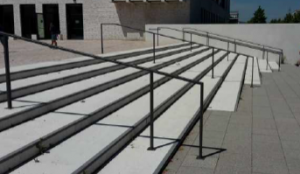
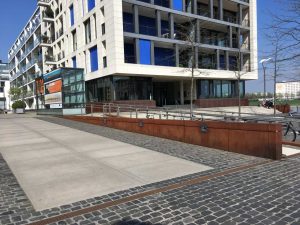
The objects for which Generic Tasks were created and which can also be found almost everywhere are ramps and handrails of staircases. Since, for example, ramps are not allowed to have a slope greater than six percent for use by wheelchairs, it makes sense to design an MCM task that asks exactly what the slope is.

To create the task, you only have to insert the data measured at the ramp into the task wizard and specify whether the result of the task is to be determined in percent or in degrees. The resulting task text is quite simple: “Determine the slope of the ramp in percent (degrees).


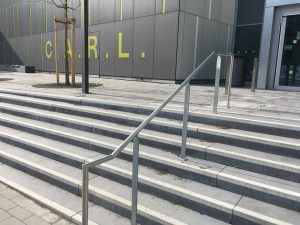
The creation of tasks with the wizard for handrails works in the same way. The sample solution and the hints are again created in a suitable way and only the task image has to be inserted.

In the next article on Generic Tasks we will deal with the creation of tasks on the topic “Number”. Until then, we wish you again a lot of fun and success in creating new tasks with MathCityMap!


The so-called Generic Tasks offer a significant simplification when creating MathCityMap tasks. Generic tasks are tasks for objects that can be found, in a slightly modified form, in any place in the world. They are therefore tasks that can be implemented almost anywhere. Within the MoMaTrE project, several Generic Tasks, covering different topics, have been developed and implemented in the MCM web portal. You create a Generic Task by activating the so-called Task Wizard via the magic wand icon in the “Create task” section. Here you select the desired topic and object and enter only the data collected from your own object. The wizard then automatically creates a completely filled out task form with a ready-made sample solution, a suitable task text and appropriate hints. After inserting a task image, the task is thus ready for publication and can be used within a very short time.


In this and the following articles, we would like to introduce the various topics and objects for which Generic Tasks are currently available in the Task Wizard. First, we will take a look at the topic of combinatorics.

An object that can be found almost everywhere are stairs. Of course, a staircase can be used to design a wide variety of tasks. However, one combinatorial task that can be applied to any staircase is the following generic task:

“How many possibilities exist to go upstairs if one can take one or two steps within each move? The step sequences can be combined.”

There are several approaches to solving this task:
One approach is to write down the possibilities systematically.

Another approach to solving the problem is to use the Fibonacci series:

(1) 1 2 3 5 8 13 21 34 55 89 etc.

When creating the task, you only have to specify how many steps the staircase consists of on which you want to create this task. Everything else will be filled in automatically by the task wizard.


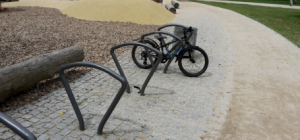
Another object for which a Generic Task from the combinatorics section was created and which can be found quickly is a bicycle stand. Here, the following task is generated by entering the number of existing bicycle racks and a quantity x of bicycles that you specify.

“x bikes should be locked at the stand. Each bike can be locked at the left or right. How many possibilities exist to lock the x bikes at the stand? It does not matter whether the bikes are locked “forwards” or “backwards”. You can assume that the stand is completely empty.”

Again, suitable sample solutions and hints are created by the wizard without any action on your part.

In the next article on Generic Tasks we will show you which possibilities for tasks regarding the topic “Slope” are already available in the task wizard of MathCityMap. Until then, we wish you a lot of fun and saved time when creating your own tasks!


Today we would like to introduce you to our generic tasks concerning the height of buildings. This topic offers the opportunity to do math for different grades.

The height of buildings can already be determined with grade 5 students if regularities and patterns are identified: https://mathcitymap.eu/en/portal-en/?show=task&id=2045

These may e.g. be bricks, glass panes or plates, of which one or more can be measured to determine the total height by means of the total number.

Such a question thus trains the mathematical view on regularities and patterns in the environment.

The difficulty of the task increases as soon as the building has no regularities. The height can then be determined with the help of the intercept theorems.

https://mathcitymap.eu/en/portal-en/?show=task&id=3171

There are various possible solutions for this, for example using the sun’s position in suitable weather conditions, using smaller objects (such as lanterns) or using the folding rule. In this case, it is particularly helpful to make a preliminary sketch of the situation in order to facilitate the application of the intercept theorems.

Important in both cases is a marking in the task or image, which makes it clear to what point the height should be determined, for example, if you want to ignore a front building.

The document Height of Buildings contains our detailed description of both types of tasks.

Determine quantities and numbers – an issue that is already relevant at primary level. For getting started in determining numbers, one should use regularly arranged objects like windows on a (high-rise) building, paving stones on a sideway or stones at a wall.     

Determine the number of windows on the house

When determining windows on houses, in many cases you can count the number of windows per row and the number of rows and get the result by multiplication. It is important to make clear whether you ask for windows or window panes, and whether all the windows of the building are relevant or, for example, only windows on the southern front.     

Determine number of bricks

For walls and rectangular pavings there are several possibilities:    

1. One determines the number n of the stones per 1m² and projects that to the total area A.     

2. The length and height of the wall are determined in “stone units” and one counts the number of stones in length l and in width b.     

Circular arranged stones with a gap

The level of difficulty increases when deviating from rectangular areas and e.g. asking for circular arranged stones. In addition, it can be difficult to determine the number of objects in which the regularity is interrupted in some places and one is forced to choose special solution methods.

You will find a detailed overview of our generic tasks on Determining quantities in the deposited PDF document.

Our first focus on generic tasks, meaning tasks that can be created in any location with similar objects, is on the subject of slopes. This topic has relevance for math lessons in different grades up to the upper secondary level.

In particular, the slope of a straight line or linear function makes it possible to determine the slope of various objects, such as ramps or handrails, with mathematics from lower secondary school. The result can be expressed either in percent or in degrees, including trigonometric relationships.

The mathematical basis is the definition of the slope as a quotient of vertical and horizontal difference, or in practical terms: the use of a gradient triangle. This can e.g. be implemented on ramps, especially if the horizontal length is easy to measure:  

Example of a ramp where both, horizontal and vertical changes are easy to detect.

More difficult is the calculation of the slope of handrails, where one should use a water level for the difference in horizontal and vertical change:

Example of a handrail, where the result without a level can be inaccurate.

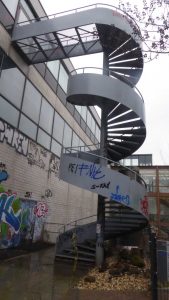
Even more complex is the slope on the railing of a spiral staircase or on objects that do not rise linearly:  

The spiral staircase takes the topic of slopes to a more complex level and requires imagination and transfer knowledge.

For non-linearly rising objects, one may ask for the maximum slope or the slope at a particular point, e.g. as a preparation for the concept of tangent.

Attached you will find our extensive collection of frequently occurring generic tasks on the subject of slopes, the mathematical background as well as hints, compiled by Matthias Ludwig: 

Icon

Slope 373.45 KB 45 downloads

...

By the way: With our Task Wizard you can create the tasks for ramps and handrails with just a few clicks and transfer them to suitable objects in your area!

MathCityMap stands for outdoor mathematics, authentic tasks, physical activity, new technologies and teamwork. And we assert: The combination of these aspects works (almost) everywhere and just like magic …

… because in every city there are stairs, buildings, parking lots, ramps, signs and many other recurring objects where you can  do math actively. These objects offer the chance to easily and quickly transfer existing tasks to other locations. We call these tasks generic tasks. The idea behind is thus a finished question in which only the object is exchanged and the measuring values ​​are collected.

Very frequent generic tasks can already be created using the Task Wizard. This makes it possible to create complete tasks with just a few clicks, because sample solution and hints are generated automatically and inserted by the wizard.

In the following months, we will present a variety of topics from our catalog, which can be realized through generic tasks, e.g. slope, determine and estimate numbers, combinatorics and probability, speed, areas, volume and weight. It is an open and always growing fund. We are therefore pleased about your ideas for generic tasks!