While searching for suitable MathCityMap tasks, creativity and a focus for mathematics in the environment are required. This is also shown by the current Task of the Week, created by Stefan Rieger, in which a climbing frame is converted into a math task.


Task: Spider web (task number: 1662)

How many meters of rope does this spider web consist of?
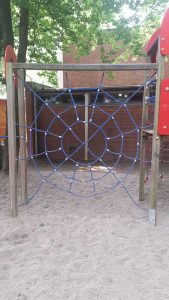

Thankfully Mr. Rieger was available for a short interview, so he could give an insight into the idea behind the task.

How did you get the idea to create this task for MathCityMap?

Three of us were walking around the schoolyard, looking for interesting tasks. This task offered itself directly, because it is challenging and can be solved by younger students.

What competencies and topics play a role in the problem solving?

Here, it will be important that the group works together when it tries to solve the task. There are several people needed for measuring and recording. Accurate measurement and safe handling of the measuring tape will be necessary to solve the problem. Since it is intended as a task for the grades 5/6, the measuring (here non-straight lines) will be relevant. Of course, older students can use knowledge from the circle calculation.

Have you tested the task with students or received other feedback on the task?

No. The task will be tested in the next school year with grade 5 as well as in the course of a further teacher training with colleagues. However, he climbing children had a lot of fun to help me as a climber for checking the measurements.  

We are pleased that MathCityMap finds more and more task authors from different regions and the task portal is expanded by a variety of tasks!

On 28.09.17, Daniel Birnbaum, Martin Lipinski and Simone Jablonski presented MathCityMap as part of an internal teacher training at the Johanneum Gymnasium in Herborn. First, the theoretical basis for Math Trails as well as the MCM concept were presented to the participants. With the help of the criteria for good MCM tasks, the participants were then themselves active and searched for possible tasks at the schoolyard. After a change of perspective, the participants learned about the app by means of a trail in the schoolyard, consisting of combinatorial and geometrical problems.

We would like to thank the participants for their cooperation and feedback and look forward to numerous MCM tasks in and around Herborn. Are you interested in teacher training on MCM? Feel free to contact us!

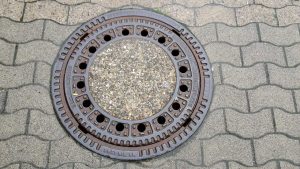
The current Task of the Week is about an everyday object, which is suitable for various tasks around the circle and can be used due to its frequent occurrence in almost every trail. More specifically, it is about the shaft cover of a canal and its dimensions and weight.


Task: Shaft Cover (task number: 1804)

In the center of the shaft cover, concrete is given. 12 liters of concrete are used per lid. What is the height of the concrete cylinder? Give the result rounded to one decimal place in cm.


To solve the problem, it is first necessary to recognize that the volume of the center of the shaft cover is given. In addition, the shaft cover has to be recognized as a cylinder apart from minor inaccuracies. Using the formula for the volume of a cylinder and the measured radius, the students can identify the required height. In general, the modeling competence and handling of mathematical objects in reality is trained. In addition, the flexible handling of formulas and the choice of suitable units play an important role in order to solve the problem. The problem can be grouped into the complex circle and cylinder and thus plays a role in geometric questions. The task can be used from class 9 onwards.

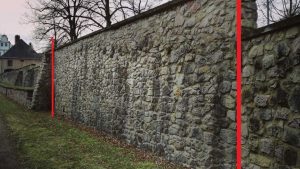
Today’s Task of the Week is an example of a task that you can create with minimal effort using the Task Wizard. It is about determining the number of stones in a given rectangular area. The object here is a wall, but similar objects can also be pavements.


Task: The Wall (task number: 1077)

Determine the number of stones of the wall front in the marked area.


In order to solve the problem, the students can proceed in various ways. On the one hand, it is possible to determine the number of stones in one square meter and to measure the length and height of the rectangular wall. In this solution, the accuracy can be increased by counting several square meters and then taking the mean value. On the other hand, the students can count the stones in terms of length and height and approximate the total number by means of a multiplication.

When you create such a task with the Task Wizard, you only have to enter the length and height and the number of stones in a square meter as well as add a photo and the location. The Task Wizard then automatically creates notes and a sample solution.

The task requires knowledge about the rectangle. It can be classified in the field of geometry and can be used from class 6 onwards.

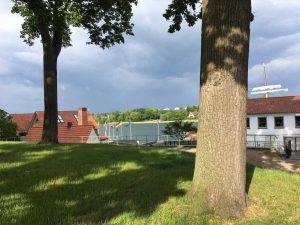
How can the age of a tree be approached using mathematics? This question addresses the current Task of the Week. It is placed in this form in Kappeln, but can be easily and quickly transferred to other places.


Task: Old Oak Tree (issue number: 1473)

How old is this oak tree? It is known that an oak with a diameter (in breast height) of 50 cm is about 110 years old.


In order to solve the problem, it is assumed that the growth of the oak is linear. This means that the average growth per year can be determined using the information in the text. Subsequently, the circumference in the height of the chest is measured and the diameter is determined by means of the relationship between the circumference and the diameter of a circle. This then leads to the age of the tree.

On the one hand, the problem can be classified in the geometric topic of the circle and, on the other hand, proportionality. If the relationship between the diameter and the circumference is already discussed at this time, the task can be used from class 6 onwards.

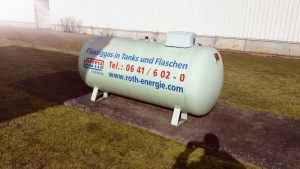
In today’s Task of the Week everything focuses on the geometrical body of a cylinder as well as the activities of measuring and modeling. The task is included in the Dillfeld Trail in Wetzlar.


Task: Tank Filling (task number: 1098)

Determine the capacity of the tank in liters.


First of all, it is necessary to recognize the object as a cylinder and to ignore minor deviations from the idealized body. The students then measure the necessary length. Since the result is to be expressed in liters, it is sufficient to record the data already at this point in decimetres. Subsequently, the capacity is determined by means of the volume formula for cylinders.

For the task, the students must have already gained experience with the geometrical body cylinder and its volume. The task is assigned to the spatial geometry and can be used from class 9 onwards.

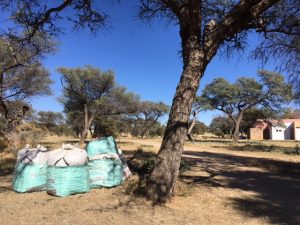
From 17th July to 22nd July 2017, MathCityMap was presented at the National Institute for Educational Development in Okahandja to a select group of postgraduates and students from all over Namibia. Of course, we searched for special tasks. One of them focuses on the Camel Thorn Tree

…and another on the Namibian Desert Cactus

The interest in the mobile mathtrails was very high and tasks were found and created diligently. We are looking forward to seeing more tasks in whole Namibia.

Today’s Task of the Week focuses a geometric question at the Aasee in Münster. More specifically, the surface content of a hemisphere is calculated by the students.


Task: Mushroom (task number: 1400)

Determine the area of ​​the mushroom. Give the result in dm². Round to one decimal.


In order to solve the problem, the students have to approach and recognize the shape as a hemisphere. They then need the formula for the calculation of the spherical surface or here the hemispherical surface. For the determination, only the radius of the hemispheres is required. Since it can not be measured directly, this can be determined with help of the circumference.

The task requires knowledge of the circle and of the sphere and can therefore be applied from class 9 onwards.

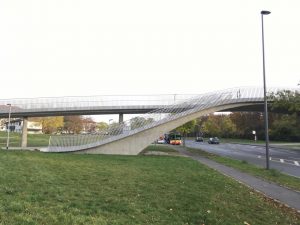
 Many of the tasks in the MCM portal are based on mathematical knowledge from secondary level I. Today’s Task of the Week shows that knowledge of secondary level II can be integrated in tasks as well. The task “Hubland Bridge I” is about the inflection point of a function as well as its properties.


Task: Hubland Bridge I (task number 684)

At which stair (counted from below) is the inflection point?


First, the bridge must be modeled as a function. For the visual determination of the inflection point, the students use the characteristics of the inflection point. In this case, the property can help to describe the inflection point here as the point with maximum slope and without curvature. In the presence of the device, the maximum slope can also be determined using a gradiometer (see Hubland Bridge II). The point of inflection as a point without curvature can be determined optically by looking for the point at which the graph resembles a straight line. After the turning point has been determined, the students have to count the steps up to the point. Ideally, this is done several times and the mean value is formed.

The task can be assigned to the topic of analysis, more precisely the differential calculus. With the development of the characteristics of the turning point of a function, the task can be used from class 11 onwards.

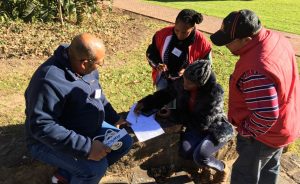
After all teachers had learned about the system, and the registration problems had been solved, the participants were able to create tasks by themselves. They found good objects to experience mathematics.

The problems came later back in the classroom. Again, it was experienced that a precise formulation, the creation of hints and sample solutions are not formulated easily. Of course, there were also technical problems since not all teachers had the appropriate IT knowledge to exchange images between two devices or to edit them (for example a 90° rotation). Nevertheless, each group was able to integrate a task into the system.

We, the MCM project team, are a little proud that our idea and system also works in South Africa! But the participants enjoyed it as well as the final photo shows. MCM says thanks to RUMEP (Rhodes University Math Education Project).