Determine quantities and numbers – an issue that is already relevant at primary level. For getting started in determining numbers, one should use regularly arranged objects like windows on a (high-rise) building, paving stones on a sideway or stones at a wall.     

Determine the number of windows on the house

When determining windows on houses, in many cases you can count the number of windows per row and the number of rows and get the result by multiplication. It is important to make clear whether you ask for windows or window panes, and whether all the windows of the building are relevant or, for example, only windows on the southern front.     

Determine number of bricks

For walls and rectangular pavings there are several possibilities:    

1. One determines the number n of the stones per 1m² and projects that to the total area A.     

2. The length and height of the wall are determined in “stone units” and one counts the number of stones in length l and in width b.     

Circular arranged stones with a gap

The level of difficulty increases when deviating from rectangular areas and e.g. asking for circular arranged stones. In addition, it can be difficult to determine the number of objects in which the regularity is interrupted in some places and one is forced to choose special solution methods.

You will find a detailed overview of our generic tasks on Determining quantities in the deposited PDF document.

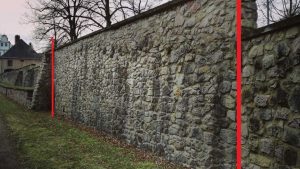
Today’s Task of the Week is an example of a task that you can create with minimal effort using the Task Wizard. It is about determining the number of stones in a given rectangular area. The object here is a wall, but similar objects can also be pavements.


Task: The Wall (task number: 1077)

Determine the number of stones of the wall front in the marked area.


In order to solve the problem, the students can proceed in various ways. On the one hand, it is possible to determine the number of stones in one square meter and to measure the length and height of the rectangular wall. In this solution, the accuracy can be increased by counting several square meters and then taking the mean value. On the other hand, the students can count the stones in terms of length and height and approximate the total number by means of a multiplication.

When you create such a task with the Task Wizard, you only have to enter the length and height and the number of stones in a square meter as well as add a photo and the location. The Task Wizard then automatically creates notes and a sample solution.

The task requires knowledge about the rectangle. It can be classified in the field of geometry and can be used from class 6 onwards.