What better way to start the new year than with another milestone achieved for MathCityMap. We celebrate the year 2022 and the 30.000th task in the web portal! Our users were very active over the holidays and we can now be delighted with exactly 32.307 tasks in the portal.

Our anniversary task, which cracked the 30.000 mark, was created by Muhamad Rif’an in Jakarta and asks for the area of a rectangular platform. Click here to go to the task.

We look forward to many more MathCityMap tasks and wish you all a happy, prosperous and healthy New Year 2022!

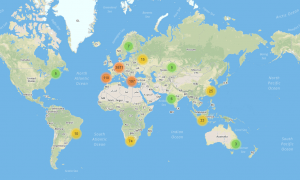
With this great summer weather, it is no wonder that the math trailers move outside. We are very pleased that this week the 4000 task border was reached in the portal.

Outdoor mathematics with MathCityMap around the globe is achieved with help of currently about 1500 users. Together, over 600 routes were created in 17 different countries. Significant actors are next to our international cooperation partners of MoMaTrE and the MOOC of the University of Turin of course the many motivated task creators who use MathCityMap at their school, university or in their free time. Thanks a lot!

As a result, we can observe a great development of the project and are already making future plans!

During May, the MathCityMap Team created a trail in Zaryadye Parc in Moscow – in good time for the start of FIFA World Cup in June!

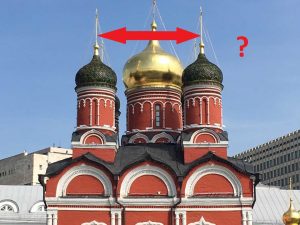
One of the included tasks is in the focus of the “Task of the Week”, not at the latest through the object’s impressive architecture.


Task: Distance (Aufgabennummer 3761)

Calculate the distance between the crosses at the top of the towers! Give the result in meters.


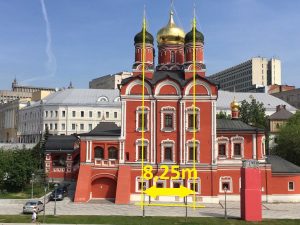
Already in the picture, it becomes obvious that the distance cannot be measured directly. Without the use of special measuring equipment, the task solvers have to develop a creative idea: The distance in the height can be projected on the ground.

This happens best through marked points at the building, or as shown in the picture from a certain distance. With this idea, the beginning problem of the height of the building can be avoided and the task can be solved easily.

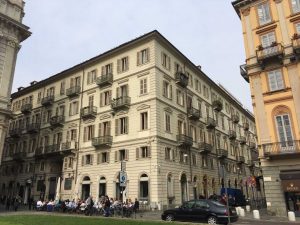
Through cooperation with the MOOC Working Group of the University of Turin, we are looking forward to the first MCM tasks in Italy, which is part of today’s Task of the Week.


Task: Height of the Building (task number: 2045)

Determine the height of the building. Give the result in meters.


The height can be approximated in various ways, e.g. by estimation or the intercept theorems. The task can be solved elegantly by looking for structures and patterns in the building facade. In this building, the horizontal strips, which can be found up to the roof, are noticed directly. For the total height, it is therefore only necessary to determine the height of a horizontal strip, as well as to count the number of strips. Minor deviations from the pattern can be approximated using estimates.

With this method, the task can already be solved by class 6 students. In the case of older pupils, the different solutions can be discussed and assessed with regard to simplicity and accuracy.

The determination of the weight of an object has often been part of a Task of the Week. However, today’s task is a particular challenge because the object consists of different materials with different densities.


Task: Bench (task number: 1803)

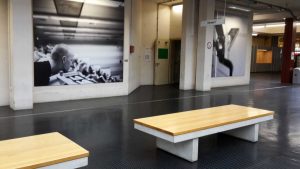
There are benches in front of the H7. How much does a bench seat weigh when the wood weighs 690 kg per m³ and the concrete weighs 2400 kg per m³? Give the result in kg.


The best way to solve this problem is by dividing the bench into three parts: the two concrete feet, the concrete seat and the wooden seat. A cuboid can be used as a model for all parts. Then the students take the necessary measurements and calculate the weight of concrete and wood first separately. The total weight of the bench is then calculated by addition.

The task requires knowledge about the cuboid as well as its volume. In addition, the concept of density should be known to the pupils. Within solving this task, this can be sharpened. The task is recommended from class 7.

The current Task of the Week deals with one of the many landmarks of Frankfurt: the Europe tower, also known as “asparagus”. The related task is to estimate the own distance to the tower using the intercept theorems.


Task: Europe Tower (task number: 1595)

Determine the distance from your location to the Europe Tower. Give the result in meters. Info: the pulpit has a diameter of 59 m.


The first challenge is to find a suitable solution. With the aid of the intercept theorems, the task can be solved with the use of one’s own body. The arm and thumbs are streched so that the pulpit of the tower is covered with one eye opened. Afterwards the distance to the tower can be calculated with help of the thumb width and the arm length or distance from thumb to eye.

The task is a successful example of “outdoor mathematics” by using the theoretical formulas (here: intercept theorems) in an authentic application in the environment. To solve the problem, the students need knowledge about the intercept theorems. The task can thus be assigned to geometry and can be solved from class 9 onwards.

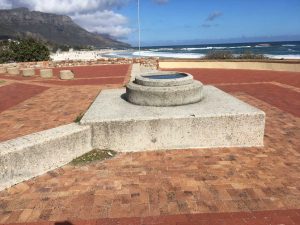
The current “Task of the Week” is about determining the mass of a concrete sculpture in Camps Bay near Cape Town, the capital of South Africa. The special feature of this sculpture is that it is a composite geometric figure whose components are modeled and calculated individually.


Task: Block of concrete at Camps Bay (task number: 1811)

Calculate the mass of this concrete sculpture. 1cm³ weighs about 2.8g. Enter the result in tons!


In order to solve the problem, it is necessary to divide the sculpture into three basic parts: a cuboid and two cylinders. Then, the necessary lengths are measured and the volumes of the bodies are calculated and added. In the last step, the total volume of the sculpture is multiplied with the density of concrete, which leads to the total weight of the sculpture.

This kind of task can easily be transferred to similar objects, whereby the degree of difficulty can be varied according to the composition of the figure. This type of task teaches the geometric view and understanding of composite bodies.

In today’s Task of the Week, we would like to present a task from a MathTrail, which was developed within a project for talented students by the University of Paderborn in cooperation with the Paderborner Pelizaeus-Gymnasium. You can find more information here. We would like to present the selected task in a short interview with Max Hoffmann, member of the project. At this point, we would like to thank for the cooperation and the interview.


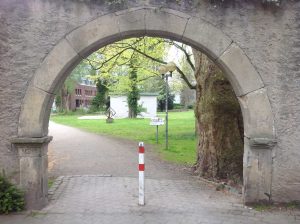
Task: Archway (task number: 1303)

Calculate the volume of the stones that create the archway! Give the solution in cubic meters. (Only the round part of the arc is meant).


How did you get the idea of ​​using this object in a task?

While searching for tasks for a mathematical walking tour through the beautiful Paderborn inner city, the students independently selected this archway near the Paderquelle. The first idea was to calculate the area of ​​the stones around the archway. I had the feeling that this kind of questioning was a typical task the students knew from their math books. After some thought, the suggestion came to modify the task so that the volume of the stones from which the archway is formed should be calculated.

What kind of mathematical activities and competences do you want to promote?

The task addresses modeling competencies (representation of the situation through two semicircles) and requires the selection and determination of appropriate measured variables. In terms of content, the known formulas for the circle are necessary for solving the problem.

Have you already processed the task with pupils or received feedback in other forms?

The task was developed by a small group and the other students of the project also solved the problem and liked it. The results of the first group were confirmed. In addition, the group presented the task at the final project event at the University of Paderborn and received positive feedback.

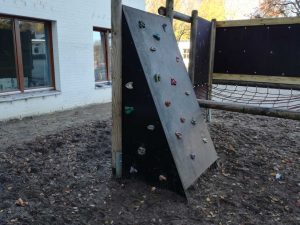
Today’s “Task of the Week” leads to Hamburg, more precisely to the school Am Heidpark. Here, one can find the trail “Am Heidpark” which is a good example to show that already a schoolyard can be made for a MathCityMap trail. The selected “Task of the Week” is called “Climbing Wall” with task number 668.


Task: Climbing Wall

Determine the slope of the climbing wall in percent.


The task enables a suitable embedding of the topic slope of linear functions. The slope of the climbing wall can be determined by recourse of the gradient triangle. In the coordinate system, the slope of a linear function can be calculated with help of two points on it. It is necessary to determine the difference of the y-coordinates (dy) and the difference of the x-coordinates (dx) and divide them afterwards. Corresponding in the real context, it is necessary to measure the height difference (dy) as well as the difference in length (vertical; dx). Afterwards, the slope can be calculated with help of a division and the conversion into percent. The task can be used from grade 8 and supports a basic understanding of the slope of a linear function and its determination with help of a gradient triangle. The task is especially suitable in the beginning of the topic as it already “predefines” a right-angled gradient triangle. Further tasks could for example involve the slope of a stair handrail. The task is a connection of algebra and geometry and can be related to the branches measuring and functional correlation.