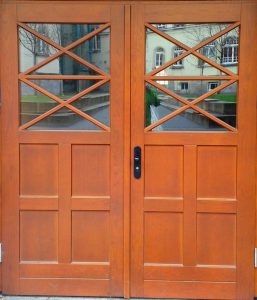
Todays´ task of the week was created in Druskininkai, Lithuania, by our MoMaTrE project partner Sona Ceretkova. The aim of the task is to explore a flower frame and to calculate the missing percentage of the frame. Sona Ceretkova gave us an interview about this interesting task.
What´s the topic of the task?
The frame for the task is situated in Lithuania, spa town Druskininkai, which is flowers paradise itself. It is quite common gardening practice to frame a piece of lawn by stones or bricks and plant some nice composition of flowers inside the area of the frame. The flower frame chosen for the task is an interesting geometrical shape. rectangle with shorten sides cut.
Several mathematics calculations can be presented of the flower frame:
- Calculate the inner area of the complete frame (without cuts).
- Calculate the area of cut parts.
- Calculate the difference between the area of the whole frame and cut parts.
- Calculate the ratio of whole frame and cut parts.
- Calculate the ratio of the cut frame and cut parts.
- Calculate the missing percentage of the whole frame.
This is the given task in Druskininkai.
How could you solve this problem?
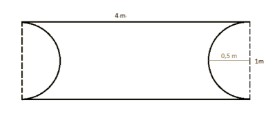
The original frame has “mathematically friendly” measures with a length of 4 metres and a width of 1 meter. The cut parts are two identical semi-discs, which create one whole disc (in calculation). This information is given by a hint. The geometrical situation of the task is quite simple (see figure).
Another hint declares that the area of the whole rectangle is 100%. This hint is an important note for correct calculation of the percentages. Since the exact percentage calculation gives 19,625%, rounding of this number was other mathematical skill required by solvers.
The multiple choice is the most suitable alternative as the answer. It´s an interesting game to ask solvers about their estimation of the tasks` solution. The 20% (one fifth) is a quite large number, quite large part, which is cut of the whole area of the flower frame. It is not so obvious when observing and measuring the real object.
What´s the didactic aim of the task?
We want to stimulate the following didactics aims through the task.
- Measure precisely.
- Imagine, draw or describe an ideal geometrical situation: rectangle, semi-circle (semi-disc).
- Calculate areas of two basic geometric shapes: rectangle and circle (disc).
- Use units in correct way; square meters are recommended.
- Calculate number of percentages when knowing the base and the percentage part.
- Interdisciplinary approach: ecology & botany