Our new task of the week takes us to Michelstadt in the beautiful Odenwald, Germany. Here math teacher Alexander Strache created the task “Altes Michelstädter Rathaus” (engl.: “Old City Hall of Michelstadt”). In the interview he talks about his experiences with MathCityMap.

How did you get to know MathCityMap project? How do you use MCM?

I came across MCM during my studies at the Goethe University Frankfurt. At first through flyers and “advertising” for it in a lecture, then through attending a seminar on it. At the university I also created my first two assignments for MCM. At the moment I am a teacher in the preparatory service and start to build the first math trail for my school.

Describe your task. How can it be solved?

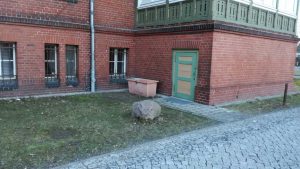
The task is to estimate the area of the roof of the historical Michelstadt town hall as good as possible. On the one hand, many sizes cannot be measured directly, because the roof hangs far above the heads of the students, on the other hand, the dimensions of the ground plan can be walked/measured and other sizes can be estimated well (advanced students can even determine certain vertical distances quite well using a ray set figure). The comparison with neighbouring buildings and counting the floors can be helpful for a rough approximation. For the creation of the sample solution I worked with a craft sheet and looked at the respective surfaces as exactly as possible – on site working with triangles and rectangles is fully sufficient.

What didactic goals do you pursue with this task?

On the one hand, it is about training an eye for simple geometric figures in architecture and, if necessary, to abstract them to even simpler ones: the surface area of many trapezoids, but also general polygons can be approximated by parallelograms or rectangles. Of course, many simplifications have to be made for the small-scale roof surface, but here the mathematical modelling is trained: What can I neglect and simplify without distorting the overall result too much? It is a matter of cleverly estimating non-measurable quantities by “educated guesses”: If I know that the depth of the building is about 10m, how high could the roof be? And of course, as always by using MCM, interdisciplinary skills such as teamwork are trained.

Further comments on MCM?

I think it’s great that a digital tool has been developed here that doesn’t lead to children sitting in front of the screen longer and longer, but that exercise, fresh air, training in local knowledge and an eye for mathematical phenomena in the “real world” play a major role. Furthermore, the competence of modelling is in the foreground, which is very important for me. Even if the development of a good task takes some time and work, it can be used again and again. MCM is therefore ideal for a student council that develops tasks cooperatively.

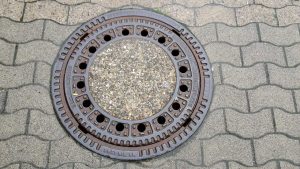
The current Task of the Week is about an everyday object, which is suitable for various tasks around the circle and can be used due to its frequent occurrence in almost every trail. More specifically, it is about the shaft cover of a canal and its dimensions and weight.


Task: Shaft Cover (task number: 1804)

In the center of the shaft cover, concrete is given. 12 liters of concrete are used per lid. What is the height of the concrete cylinder? Give the result rounded to one decimal place in cm.


To solve the problem, it is first necessary to recognize that the volume of the center of the shaft cover is given. In addition, the shaft cover has to be recognized as a cylinder apart from minor inaccuracies. Using the formula for the volume of a cylinder and the measured radius, the students can identify the required height. In general, the modeling competence and handling of mathematical objects in reality is trained. In addition, the flexible handling of formulas and the choice of suitable units play an important role in order to solve the problem. The problem can be grouped into the complex circle and cylinder and thus plays a role in geometric questions. The task can be used from class 9 onwards.

In today’s Task of the Week, we would like to present a task from a MathTrail, which was developed within a project for talented students by the University of Paderborn in cooperation with the Paderborner Pelizaeus-Gymnasium. You can find more information here. We would like to present the selected task in a short interview with Max Hoffmann, member of the project. At this point, we would like to thank for the cooperation and the interview.


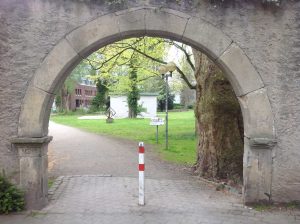
Task: Archway (task number: 1303)

Calculate the volume of the stones that create the archway! Give the solution in cubic meters. (Only the round part of the arc is meant).


How did you get the idea of ​​using this object in a task?

While searching for tasks for a mathematical walking tour through the beautiful Paderborn inner city, the students independently selected this archway near the Paderquelle. The first idea was to calculate the area of ​​the stones around the archway. I had the feeling that this kind of questioning was a typical task the students knew from their math books. After some thought, the suggestion came to modify the task so that the volume of the stones from which the archway is formed should be calculated.

What kind of mathematical activities and competences do you want to promote?

The task addresses modeling competencies (representation of the situation through two semicircles) and requires the selection and determination of appropriate measured variables. In terms of content, the known formulas for the circle are necessary for solving the problem.

Have you already processed the task with pupils or received feedback in other forms?

The task was developed by a small group and the other students of the project also solved the problem and liked it. The results of the first group were confirmed. In addition, the group presented the task at the final project event at the University of Paderborn and received positive feedback.

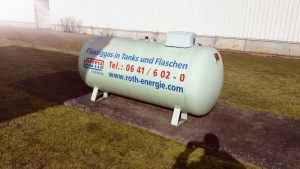
In today’s Task of the Week everything focuses on the geometrical body of a cylinder as well as the activities of measuring and modeling. The task is included in the Dillfeld Trail in Wetzlar.


Task: Tank Filling (task number: 1098)

Determine the capacity of the tank in liters.


First of all, it is necessary to recognize the object as a cylinder and to ignore minor deviations from the idealized body. The students then measure the necessary length. Since the result is to be expressed in liters, it is sufficient to record the data already at this point in decimetres. Subsequently, the capacity is determined by means of the volume formula for cylinders.

For the task, the students must have already gained experience with the geometrical body cylinder and its volume. The task is assigned to the spatial geometry and can be used from class 9 onwards.

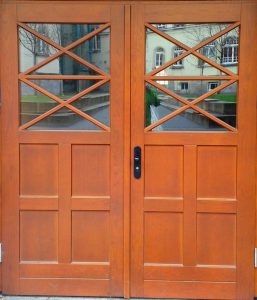
Today’s “Task of the Week” was created by Markus Heinze in the trail “Schillergymnasium” in Bautzen and combines percentage calculation with a geometric question.


Task: Percentage Calculation at the Entrance (task number: 1262)

Determine how many percent of the entrance doors are made of glass.


Mr. Heinze was kindly available for a short interview so that we can present his assessment and experience with the task. We would like to thank him very much!

How did you get the idea for this task?
I wanted to create different tasks for an 8th or 7th class. I had a free time but it rained right at that time. That’s why I stood at the entrance at first and thought about how to install the entrance door and so, the idea arose to connect triangular areas and percentage calculation.

Which mathematical skills and competencies should be addressed in the task?
On the one hand, of course, modeling and problem solving is of high importance, because I had noticed deficits in the competence test in this area among the students in the 8th class. But also the visual ability is strengthened, of course, since real objects are being worked with and the students receive an idea of ​​areas and percentages.

Has the task already been solved by pupils? If so, what feedback was given?
The task was solved by students of a 9th class and they found it relatively simple but interesting, but this is also because they had not worked with the app before and were generally enthusiastic about the matter. I think for a 7th or 8th class it is suitable.

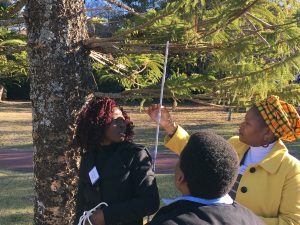
This week, we had the opportunity to present MathCityMap at a teacher training at Rhodes University in Grahamstown in South Africa.

Matthias Ludwig followed the invitation of Prof. Dr. Marc Schäfer (chair of mathematics education, Rhodes University) and accepted the challenge to present and test MCM in South Africa.

The area of ​​Rhodes University offers a variety of objects which are suitable for good MCM tasks. Three routes with 6-7 tasks could be created. On Monday, the theory of outdoor mathematics and the basic idea of ​​MCM were introduced. On Tuesday, almost all of the 50 teachers were able to install the MCM app on their Android smartphones. Some tried it with their Windows phones, but of course it did not work. None of the teachers owned an iPhone! Afterwards, it was time to solve the tasks, but it turned out that many participants were not able to navigate on a map at all. Some had not activated the GPS localization and searched the right direction. Thanks to the support of Clemens and Percy, we found the reason quickly.

It was a pleasure to observe the teachers during solving the tasks, and to see the joy when the MCM app rewarded a 100-point response and a green check. Overall, the concept of “doing mathematics outside” was completely new to the South Africans.

There was also a discussion about units, conversions and modeling. Especially the modeling process is relevant for MCM since one has to translate reality into a mathematical model to solve the tasks numerically.

This week’s Task of the Week addresses, in particular, the modeling competence of the students. It is a question of approximating the weight of a stone as closely as possible by approximating the stone through a known body.


Task: Stone (task number: 1048)

What is the weight of the stone? 1cm³ weighs 2.8g. Give the result in kg.


In order to approach the object by means of a geometrical basic body, the students must refrain from slight deviations of the real object and the ideal body. In particular, a prism with a trapezoidal base side is suitable. If this step is done, the students determine the pages relevant to this body through measurements and then calculate its volume. The last step is the calculation of the weight with the given density as well as the conversion in kilograms.

With this task, it is especially nice to see that there is not always one correct result for mathematical questions. Through different approaches and measurements the pupils receive different results. In order to obtain the most accurate result as possible, the determined values ​​must be within a defined interval. Translating from reality into the “mathematical world” also plays a decisive role here in the sense of modeling competence.

The task requires knowledge about the basic geometrical bodies and in particular about the prism with a trapezoidal base surface. It is therefore to be classified in spatial geometry and can be solved from class 7.