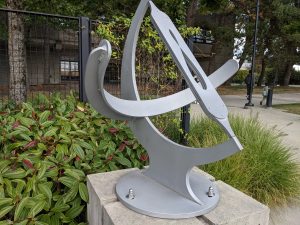
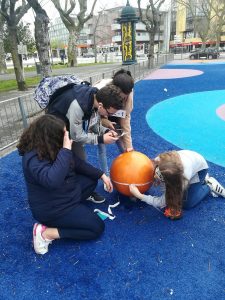
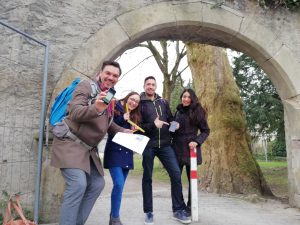
At the beginning of April, a MathCityMap advanced training course was held in Ober-Ramstadt as part of a project day for the more than 30 students of the advanced mathematics courses at the Georg-Christoph Lichtenbergschool.

The students first learned how to use MCM and then developed creative MCM tasks on the school campus for the lower and middle school. In total, the math teachers can now draw on about 50 new tasks and develop trails for their classes.

An overview of the different tasks created by the students* can be found in the trails sorted by grade level with codes 489376 for 5th/6th grade, 569374 for 7th/8th grade, and 199375 for 9th/10th grade.

The students were happy that they could create math tasks for current and future students in the spirit of sustainability. This project day showed that students can also create meaningful MCM tasks for the school community.

The project day was led by our team members Melanie Schubert and Rebecca Stäter and was carried out at the direct request of the Georg-Christoph Lichtenbergschool Ober-Ramstadt, whose teachers had already attended a MathCityMap training course in advance. If you would like to learn more about MathCityMap in the context of a teacher or student training, perhaps even directly at your school, please contact us at any time at info@mathcitymap.eu .


November’s Trail of the Month comes from the capital of the German state of Lower Saxony. The trainee teacher Franziska Hormann created the trail “Circles and bodies on the trail in Hanover”, which can be accessed in the MCM app under the code 386349. It is available in the web portal here.

On this mathtrail you will find a total of nine tasks implemented on the buildings and artistic sculptures of Hanover’s city center.


How did you come across the MathCityMap project?

As a former student at Goethe University, I was already able to get to know MCM during my studies in the module Upper School Didactics, where I also designed my first tasks. In Frankfurt, the app is widely used, so I was surprised that in Hanover, where I am currently completing my traineeship, there are only a few MCM trails and the project was hardly known among teachers or at our study seminar. However, my interest in sharing and spreading it in my home region was correspondingly great, especially since the beautiful old town of Hanover offers ample opportunities to apply mathematics…


Please describe your Mathtrail.

The Mathtrail is specially designed for the topic of circle and solid calculation, which is taught in the 10th grade in Lower Saxony. On a circular route through the old town past well-known places such as the New Town Hall, the Market Hall and Church or the Ballhof, students can apply their knowledge of the circumference and area of circles, surface area and volume of cylinders and spheres and test it on authentic problems.
The trail is particularly suitable at the end of the unit, when all the formulas are already known and the constructed tasks from the textbook have had their day. I myself tried it out as part of a project day with a 10th grade class, and since the topic is usually taught at the end of the school year in Lower Saxony, such a project day before the vacations is particularly worthwhile, on the one hand to do mathematics in the world around us at an extracurricular learning site, and on the other hand to offer an alternative to the annual movie watching in the last few weeks.


How do you use MCM and why?

Since I am still at the beginning of my professional life, I have so far only used MCM for this specific trail in the said 10th grade. In my opinion, MCM is especially (but not only) suitable for geometry topics, in which I will gladly use it again in other grades. On the one hand, as a teacher myself, it is a pleasure to design the tasks and to rediscover old familiar things with a different view. In addition, the possibility of publishing the paths means that other teachers can also benefit from the efforts. On the other hand, I feel it is important to experience mathematics in real-life contexts that are as authentic as possible, to become active myself and to have to puzzle. MCM can make all this possible with well-set tasks, where the groups have to coordinate and find heuristic strategies for calculating solutions together, which also promotes their ability to work in a team.
Last but not least, out-of-school learning venues are rare in the subject of mathematics. MCM makes it possible, regardless of the proximity to facilities such as the Mathematikum in Giessen, etc., to design an extracurricular learning venue that can be adapted to one’s own lessons with manageable effort and thus make mathematics experienceable in a different way.


Describe your favorite task of the trail. How can it be solved?

I believe that all tasks have their charm and sometimes require less and sometimes more modeling competence. I like the starting task of the trail with the Hase fountain, for example, because in the beautiful brick backdrop between the Old Town Hall and the Market Church, you first have to perceive this historic structure simplified as a cylinder and then come to the determination of the water volume via various paths, the circumference of the basin or the partly estimated radius, whereby the correct unit must not be neglected at the end. In this task you also have to have the courage to hold the folding rule properly in the water for once.
I like tasks where the solution is not immediately obvious and where you have to fiddle a bit without increasing frustration. That’s why the solution interval should not be too small, which I learned myself during the test.

From September 9 to October 8, we were able to collaborate with Simon Fraser University in Vancouver, Canada on a new project on outdoor mathematics and MathCityMap. Visiting the research group of Prof. Dr. Nathalie Sinclair, we dedicated ourselves to research on embodiment and gestures while walking a mathtrail: When students work on real objects, it seems natural that they interact with the object and describe mathematical concepts through gestures.


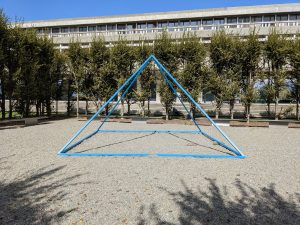
We started by looking at the SFU campus, and we didn’t have to search long for suitable tasks! Not only the pyramid seemed to be made for MCM! In the course of an advanced training with 20 teachers, the tasks could then be tested directly. Afterwards, five groups were filmed solving the tasks. In the evaluation, we will focus on when and with which function different gestures were used. We will submit these results at the next PME conference (2022 in Valencia).

Of course, we did not miss the opportunity to create some trails in downtown Vancouver – both the Waterfront Station and the Stanley Park were ideal addresses for our first “Canadian Math Trails”.


The study and the accompanying research stay are funded by the DAAD and the BMBF within the framework of the Project-related Exchange of Persons (PPP) Canada.

The MathCityMap team thanks our MoMaTrE partners from Portugal for a special outdoor event with MCM. Read their impressions in the following article by Amélia Caldeira and Ana Moura:

In the center of Matosinhos, a city in Porto’s metropolitan area, in Portugal, the mathematics was breathed with the event “Matemática vai ao Jardim” (Math goes to the Garden) on March 23rd. This event aims to celebrate mathematics and its relevance in everyday life, and in the progress of society. The main idea of this celebration was to use the students’ mathematical skills in the real world.

In a fun and innovative way, 170 students from Augusto Gomes Secondary School, equipped with a smartphone and the MathCityMap app (MCM app), answered several mathematical challenges, having as a backdrop the Garden Basílio Teles, in Matosinhos, and all its surroundings.

It was a competition between teams of three or four students.  All of them benefited from an outdoor activity: they left the school building, walked around and explorde the center of Matosinhos.

Using their mathematical knowledge, they solved the proposed tasks. All the tasks were in accordance with the knowledge level in which the team was in. Three math trails, with five tasks each, were designed: a route for 7th and 8th grade students, a route for 9th grade students, and another route for students from the 10th to the 12th grades.

Through the MCM app, students went on an outdoor walk along a route and solved math problems that were contextualized with the surrounding environment. The students passed through special places in Matosinhos, where math can be experienced in everyday situations. For example, a swing to calculate angles measures, lake bridge to calculate areas, garden benches to apply combinatorial calculus,…

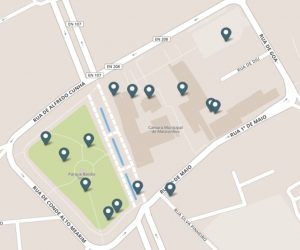
The map with the location of the fifteen tasks is showed in figure 1:

Fig.1 – location of the fifteen tasks

In the end, the best team was selected from each of the three routes. The criteria for choosing the best team was the highest number of correct answers. In case of equality, the team that answered in the minimum time.

Both students and teachers of Augusto Gomes enjoyed the event “Matemática vai ao Jardim”.

Fig.2 – students measure the circumference of a sphere

You can find a briefly video-report here (https://www.youtube.com/watch?v=Jr9XwMFfUnc&feature=youtu.be).

ISEP/P.Porto team who designed and invigorated the event:

Amélia Caldeira, Ana Moura, Ana Júlia Viamonte, Isabel Figueiredo, Helena Brás, Alexandra Gavina and Alzira Faria.

Doing outdoor mathmatics with MathCityMap works in any weather. Iwan Gurjanow and Matthias Ludwig visited the cathedral city Erfurt on Wednesday 21.03. and Thursday 22.03. On the 24th Days of the maths and science lessens of the ThiLLM, we were able to present MathCityMap. While the preparations on Wednesday took place in cold but sunny weather, there were some brave teachers who ignored the sleet and solved MCM tasks at the campus of the University of Erfurt and later created own MCM tasks in the portal. Of course, in such a beautiful city, we were also searching for tasks in the city center. The finished trail in Erfurt’s old town will be presented here in the next few days.

As part of the joint meeting of GDM and DMV in Paderborn from 05.03. – 09.03.2018, MathCityMap was presented in various ways. First of all, on 06.03. Matthias Ludwig spoke on the Erasmus + project MoMaTrE (Mobile Math Trails in Europe), in which the cooperation partners and goals were presented on an international level. On 08.03., Iwan Gurjanow presented his research results in the field of motivation and gamification (points and leaderboard) while running a math trail. In addition, Joerg Zender considered the Math Trail idea from the point of view of performance, which led to interesting discussions on 09.03.

A special highlight for the entire team is the prize which Daniel Birnbaum and Matthias Ludwig won at the poster session. On the poster, the future-oriented technology Augmented Reality was presented, as well as first ideas to use it in school and MCM.

During the entire conference, the participants had the opportunity to test a trail in the city center of Paderborn. Of course, we took the chance and ran the trail from the perspective of the task solver with lots of fun and ambition.

At this point, we want to thank Max Hoffmann and the students of the Pelizaeus-Gymnasium for creating the tasks! Likewise, we would like to thank all interested in the project for the exciting questions and discussions.

At the beginning of the year, MathCityMap and research results were presented at an international STEM conference in Mumbai, India. Matthias Ludwig spoke at the epiSTEME 7 on 7th January 2018 about the motivational effects of using MathCityMap. Further, he created a small trail together with Xenia Reit, which was enthusiastically tested by the participants of the conference. No wonder in this smartphone addicted country.

The MathCityMap idea lives from its active users and task creators in different places. Today, we would like to present a new trail at the University of Heidelberg that Mr. Niccolò Rigi-Luperti created there. In a short interview, for which he was thankfully available, we would like to let him speak for himself and give us an insight into the background to the trail creation.     

How did you hear about MathCityMap?

Through my job as a scientific assistant in the project “MINTmachen!”. There, we bring students closer to MINT subjects through e.g. holiday courses, workshops at the Girls-Day or possible BOGY-stays at the university (www.mintmachen.de). My boss (Dr. Michael Winckler) had learned from MathCityMap and asked me to get to know the app to see if and how we could integrate it into our work.   

How did you get the idea to create your own trail? Have you created this for a particular event or target group?

It seemed to me the best way to get a feeling for the app and the job. According the target group, I was thinking of math-physics-computer science first semesters, which should solve small group tasks in the introductory days for mutual learning. In my opinion, this is a very good way to do this, especially because they are doing maths together and seeing different campus locations.

What mathematical content and skills are required in your trail?

In the order of the four tasks: simple probability calculation, precise counting of objects, trigonometry and potential & kinetic energy, combinatorics.   

Which of the tasks is your “favorite task” and why?

The third task, “wheelchair“. I think it is nice to see the slope as a large acceleration ramp. It is the only physical task, and it can be solved in different ways, but they are of varying complexity. The easiest way to do this is to use energy conservation. Doing so, you solve the problem quite efficiently, it is only necessary to do a few line transformations as well as a single length measurement.