The Mathtrail of the month February comes from Indonesia, more precisely from the city of Makassar on the island of Sulawesi. Here, teacher Jamaluddin Tahuddin created the trail “Math Trail di Fort Rotterdam Makassar” a special math trail that leads through the historic fort of the city of Makassar with a total of six tasks. The trail can be accessed on the web portal and in the app under the code 157539.

You can find a short interview with the creator of the trail below. Have fun reading it!


How did you come across the MathCityMap project?

Every year, students go on a study tour in Fort Rotterdam. They work on a project assignment to make a report given by the Indonesian teacher. After attending training on how to strengthen numeracy skills through the MathCityMap application, I was interested in making a Math Trail in Fort Rotterdam. In addition to doing historical tours, students will also be able to do numeracy activities at Fort Rotterdam. Thus, this activity can involve many subjects, including Mathematics, Indonesian, English, History, and Science.


Please describe your Mathtrail.

Fort Rotterdam is one of the historical places in the city of Makassar. Everyone including students in Makassar know this place. So far, they have only seen Fort Rotterdam from a historical perspective. But now they will also be able to look at Fort Rotterdam from a numeracy point of view. Inside the fort, I’ve selected several objects that can serve as numeric contexts. So that people who visit Fort Rotterdam will not only do historical tours, but can also do numeracy tours.


How do you use MCM and why?

Students can use the MathCityMap application for activities to practice numeracy skills outside the classroom.
Students are organized into several groups and each group consists of 3-4 students. Each group only needs 1 smartphone so that all students can be involved even though not all have smartphones. The slow speed internet connection is also not a problem because every math trail that students will complete can be downloaded first so that it can be used offline. Teachers can also know how students solve each of the numeracy problems through a worksheet which can be downloaded through the MCM application.


Describe your favorite task of the trail. How can it be solved?

My favorite trail task is Gerbang Gereja on the Math Trail in Fort Rotterdam City of Makassar. In addition to its unique shape, at the Church Gate students can also learn from the context of numeracy. In this task, students will calculate the maximum height of a box car that will carry cultural heritage objects into the building, the car has a width of 167 cm. To solve this problem, students must know the relationship between the radius of the circle, the slope, and the distance of the circle from the center of the circle.
Where the width of the box car is the minimum segment length and the distance from the center of the circle is the maximum height of the box car. So, to solve it, students must measure the width of the gate which is the diameter of the semicircular gate first.

 

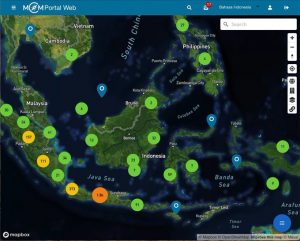
In 2014 MathCityMap was introduced to Indonesia with a pilot study conducted by Goethe University Frankfurt in collaboration with Universitas Negeri Semarang involving several schools in the city of Semarang. Just three years afterwards in 2017, the Mobile Math Trails Research Group was established to become a center for the study of math trails with digital technology in Indonesia. Since then MOOCs are offered and teacher trainings are organized in collaboration with teacher organizations and the Education Offices in several cities. At some universities, MathCityMap is part of the courses taught to prospective mathematics teachers and is a topic investigated in several theses.


At the end of 2021, the Ministry of Education, Culture, Research and Technology invited the Mobile Math Trail Research Group to collaborate in organizing a teacher training on strengthening literacy and numeracy skills using MathCityMap. The speaker in the training was Professor Matthias Ludwig as the founder of MathCityMap who explained the MathCityMap concept, and the technical details of the webportal and the app in collaboration with Dr Adi Nur Cahyono, the coordinator of MathCityMap in Indonesia, and his team.


Participants in this training were 240 teachers from 34 provinces in Indonesia. Primary and secondary school teachers who were selected from 6500 applicants to the teacher training. The training was conducted in four stages and each stage was carried out in 4 days in Jakarta and Bandung. The training was realized with offline sessions which consisted of  an indoor theory lesson and an outdoor practice in the famous city parks in the two cities, namely the Bogor Botanical Gardens, Jakarta Old Town, Banteng Field, Kencana Park.


As a follow-up, the trainees returned to their respective areas and held multiplier trainings for their colleagues. They also created a mathtrail in their area with the local cultural context and implement it with students and the public. Communication with the teachers is maintained to discuss and share implementation experiences through the MathCityMap Indonesia Community forum.


MathCityMap trails and users in Indonesia have increased significantly and continue to grow as a positive impact of dissemination through MOOCs, lectures at teacher education institutes, teacher trainings and communities. In 2022, the Directorate General of Higher Education of the Ministry of Education, Culture, Research and Technology of the Republic of Indonesia will provide training on numeracy and literacy skills using MathCityMap for 22,000 university students who will undertake internships in schools throughout Indonesia.

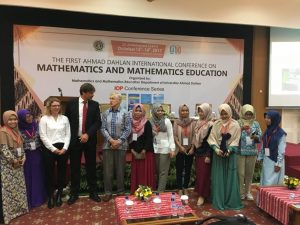
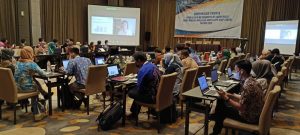
In Yogyakarta on Java, one of the main islands of Indonesia, Matthias Ludwig had the opportunity to introduce MathCityMap in form of a main lecture. Nearly 200 participants from neighboring Southeast Asian countries listened to the latest developments (GPS position tasks) and research results on MCM.

On the usual conference photos in the Asian area, further known faces can be observed. Dr. Xenia-Rosemarie Reit, former PhD student at the IDMI was invited to talk about modeling in mathematics lessons.

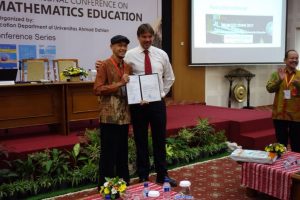
At the conference, Adi Nur Cahyono, who completed his dissertation on the aspects of mobile learning with the help of MCM, received his PhD certificate.