Melanie Schubert from Goethe University Frankfurt has created the task “The Dinosaur’s Suitcase” and reports in an interview about her experiences with MathCityMap.
Dear Melanie, how did you get to know MathCityMap project? How do you use MCM?
I got to know MCM while working at the Goethe University Frankfurt, where the system is developed. As part of our mathematical gifted students promotion program “Junge Mathe-Adler Frankfurt” I created the trail “Mathe-Adler Klasse 6” for SuS of the sixth grade as a kick-off event.
Describe your task. How can it be solved?
In my task the volume in liters of an oversized suitcase is to be determined. In front of the Senkenberg Museum in Frankfurt there is a large dinosaur figure with a suitcase standing in front of it. Within the task the SuS receive information about human suitcase sizes, if one would go on vacation for about 2 weeks. The SuS can calculate the volume of the suitcase by approximating the suitcase of the dinosaur as a cuboid and then convert the volume into dm³ to determine the number of liters. By specifying the liter sizes of our suitcases, the SuS have a possibility of self-control, in that the SuS can consider whether about 27 of our suitcases can fit into the suitcase of the dinosaur.
What didactic goals do you pursue through these tasks?
This task is intended to expand the spatial imagination, conversion skills, measuring skills and the competence of modeling.
Today we present again a trail in our section “Tested Trails in the Rhein-Main area”. The student Isabella Unkart created the math trail “Der Sinaipark” in the Frankfurt district Dornbusch as part of our mathtrail seminar at the Goethe University. All trails were tested by students on site and also passed our expert review. Two weeks ago, we presented the trail “Kurpark Bad Camberg” by Mara Deisel and Mustafa Cinar in this section.
This mathtrail leads the students of grades 7 and 8 through the Sinai Park in Frankfurt am Main. It comprises a total of 10 different tasks and is characterized above all by the fact that it focuses on the topic “Geometry”.
The individual tasks challenge the students to become active themselves on site. For example, by measuring, estimating and, above all, calculating, the pupils themselves determine how much material is needed to build a rain cover for a playground. To ensure that the mathtrail is nevertheless varied, there are two additional tasks in addition to the geometry tasks, which deal with other topics such as “proportional growth”.
In this task the students are asked to calculate the diameter of a cylindrical sandbox, which should have the same capacity and depth as the old sandbox.
The challenge here is that the students have to go through several steps until they reach the final result. On the other hand, they must first change the necessary formulas before they can continue to calculate with them.
The next trail in our section “Tested Trails in the Rhine-Main-Area” leads us to Gießen. There our student Iqra Shah has created the math trail “The World of Geometry”. The trail was created during our award-winning math trail seminar at the Goethe University Frankfurt. All trails have been tested by students on site and have also passed our expert review. Recently, in this section we presented the trail “Die Fasanerie in Groß-Gerau” by Martin Pusch.
Information about the trail: Name: The World of Geometry Code: 122924 Place: 65929 Frankfurt-Höchst Grade : 9 Topic: Geometry (volume and area calculation)
Geometric objects surround us in our environment in all possible forms and almost everywhere, be it at school, in the city, in nature or on the playground. The children should be able to recognize them here and analyze their function and meaning. The aim of the trail is to show the children that they are surrounded by mathematics, especially geometry. As they walk the trail, they will perceive other objects in the park in addition to the geometric objects that appear in the tasks. With the help of geometry, the children should learn how to think and work mathematically. They develop strategies to solve problems. In doing so, they develop their problem-solving skills. They analyze real situations and translate them into mathematical language.
In this task, the children have to calculate the percentage difference between the two surfaces under the gymnastic bar. This task combines two contents from the curriculum. Here the geometry is interlocked with the percentage calculation. This should show the children that mathematical content is not a separate drawer. The pupils measure and calculate on site. They are active and work in a team.
In Frankfurt’s Martin Luther King Park, our student Jolanta Zdyb created the maths trail “Math Kings & Math Queens”. The trail was created as part of our Mathtrail seminar at the Goethe University Frankfurt, which was awarded by the Stifterverband for excellent teaching. All trails were tested by students on site and also passed our expert review. Most recently, we presented the “Einstein Trail” by Daniel Tiedke in our section “Tested Trails in the Rhine-Main Area”.
Information about the trail: Name: Math Kings & Math Queens Code: 692949 Place: Martin-Luther-King-Park, Frankfurt Grade: 5th grade Topic: Introduction to the 5th grade
Welcome to the Ernst-Reuter-School! You are really lucky that your new school is located at the great Martin-Luther-King-Park. There is not only a lot of nature and fun, but also a lot of math to discover. So grab a measuring tape and start doing mathematics!
The Trail “Math Kings & Math Queens” is located in the Martin-Luther-King-Park, right in front of the entrance of the Ernst-Reuter-School. It is specially designed for the newly enrolled fifth graders to get to know the surroundings of their new school and to develop a joy for mathematics in everyday life. In the park, they can move around unsupervised and solve the tasks in a concentrated manner.
How long is the slide in total? Enter your result in km. In this task the children have to measure the length of the slide. This is not so easy, because it is quite long! Another difficulty is to convert the result into km. Fortunately, there are hints in the app that will certainly help.
On 24.05.2018, Martin Lipinski and Simone Jablonski presented the MathCityMap system und project during a teacher training at Campus Westend at Goethe University in Frankfurt. The event’s title “It’s time to go outside” was taken literally, so that the participants were able to test “outdoor mathematics” with help of the app.
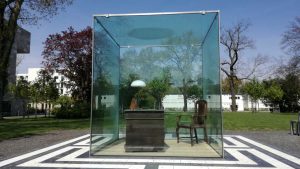
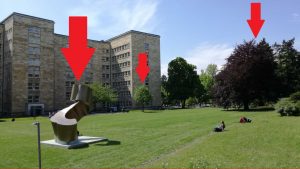
The trail showed not only the different mathematic opportunities with MathCityMap, but also led through interesting objects on the campus, such as the Body of Knowledge or Adorno’s memorial.
The tasks included combinatorics, cryptographic and geometric questions, as well as GPS tasks. For example, it was asked to find the point which has the same distance to each of the marked points. On the paper, it is quite easy to construate the circumcenter of the triangle, but in reality, it is a special challenge.
The feedback made clear: The participants had a lot of fun while solving the tasks and own ideas how to use MCM with their students. We are looking forward to first reports!
In the ongoing development and optimization of MathCityMap, the direct impressions and experiences of students and teachers with the project provide important feedback. Accordingly, the MCM team is very interested in a lively exchange and testing of tasks.
On Wednesday, 08.11.2017, the MCM team welcomed Mrs. Nazanin Roushanaei, a teacher at the Hessen-Homburg school center in Hanau, with her graduating class R10a at the Campus Westend. The students in the class will attend the Final Examinations for the secondary school certificate next spring and are currently reviewing relevant topics in math lessons, e.g. the subject of body calculations, which was compiled for the students in a diverse trail. In this context, Mrs. Roushanaei sees not only the chance to repeat exam relevant knowledge: “MCM offers the pupils the opportunity to get to know body computations in real places and in authentic situations.”
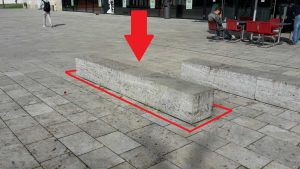
For example, the volume and weight of cuboids were discussed through benches in front of the lecture hall center. In addition to various geometric bodies, slopes and angles were calculated as well. To do this, the students had to model the selected objects with the help of familiar bodies and through flexible use of the acquired knowledge of formulas. Before the trip could start, necessary preparations were made. Due to the high number of Android devices in the class, the participants were able to agree on gamification elements, a tool that makes it possible to compete against each other and compare the results. At the moment, this tool is also planned for the iOS version. The app as well as the trail were downloaded from the class in advance, so that the actual run of the trail does not require internet connection. With the necessary materials (smartphone, pen, calculator and formulary) and the consent of the parents the trip could start.
Nazanin Roushanaei with the MCM App
On the day of the trip, the group was confronted with rainy weather, which however could not dampen the mood. The students were divided into groups of three. This group size has been proven as there are three main functions when running a trail: navigate, measure, and record. In particular, Mrs. Roushanaei noticed a group of three, which has made up of three boys with different migration backgrounds: “Each student from this group has been totally in his role in this trip. One of them always had an overview of the tasks and could link them directly with a mathematical formula. Another boy had a very good orientation in mind and worked as a very good navigator. The third boy was able to change the required formulas correctly. Together, the three boys were able to solve most of the tasks and thereby achieve the highest score in the competition. Since that excursion, I’ve noticed that these three guys are much more motivated in math class than they used to be. I have the impression that the use of MCM and this trail could arouse the interest of these guys in mathematics.” In particular, the used gamification elements motivated the students to solve as many tasks as possible.
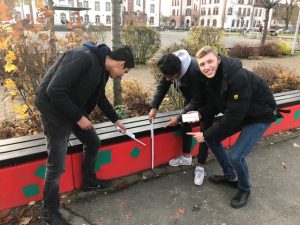
Measuring in the group
The feedback given by the students was very positive as well. One student with below-average mathematics performance stated: “This was the most enjoyable trip I’ve ever done with school.” Others said that through solving the tasks, they finally relate to the subject and understand what these formulas are all about. “It was fun for them. They would have liked to stay longer to solve all the tasks” says Mrs. Roushanaei.
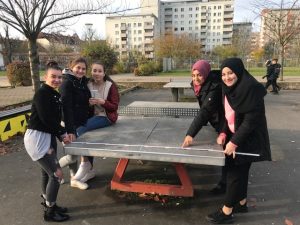
Calculations at the ping-pong table
In conclusion, Mrs. Roushanaei states: “MCM is great, not just for kids, but also for teachers. It offers the opportunity to experience mathematics outside and thereby make various calculations real. Although it is said that new textbooks have many authentic tasks; what is more authentic than having children measure real objects themselves? I can recommend any math teacher to use MCM for their own lessons and to make a project day or day trip for the class. I am convinced that, thanks to MCM, mathematics can be interesting for students even in tenth grade.”
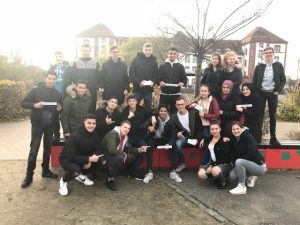
Group photo of the class
The MCM team is pleased to receive the helpful and positive feedback from the class and wishes them all the best for their further exam preparation and participation. At least in the topic of geometric bodies, nothing can go wrong now!
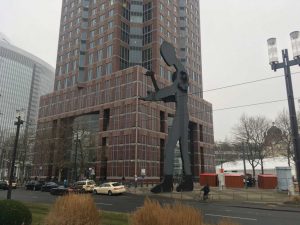
Today’s “Task of the Week” focuses on the “Hammering Man”, a symbol of Frankfurt’s fair. The “Hammering Man” comes to one’s attention through his continuous hammering motion. The task is part of the “Weihnachtstrail” with task number 784.
The “Hammering Man” hammers continuously. How many hammer blows does the “Hammering Man” carry out in the month December?
__
To solve this problem, it is necessary to observe the motion of the “Hammering Man” and measure the duration of a blow (in seconds). This can be done through measuring the time for 10 cycles. Afterwards, the number of seconds for one day and for the month December should be determined. With help of a division, the number of hammer blows can be calculated for the month December.
In this task, the main part is to determine the frequence of a periodic motion through measuring. Therefore, the task can be seen as an examplary task which can be adapted to further locations where things move periodically. The focus is especially on the time units second, day and month, as well as their conversion. Further, the arithmetic operations multiplication and division are included. Therefore, the task is in connection with school mathematics and can be used from grade 4.
The task is very suitable, because it requires the presence and activity (measuring of the duration of a blow) of the pupils. Further, it is a realistic problem, which can be solved without special aid. The task offers the possibility to differentiate as the pupils can ask for help if needed. The sample answers can be found with the task in the portal.