Dear users of MathCityMap,

we are very happy to present you the first official MathCityMap partner school! The Gymnasium Trudering has successfully applied and is now allowed to use the title MCM partner school!

The possibility to become an MCM partner school was introduced within the MaSCE³ project and the path to this title for interested schools is as follows:

Step 1: Visit www.mathcitymap.eu and get familiar with the MathCityMap system. If you like it, ask your colleagues to join you in your plans to become an MCM partner school!

Step 2: Create 15 tasks and 2 trails for different grades close to your school. The tasks and trails should be published in our system, peer-reviewed by your colleagues and downloaded at least 5 times by your students.

Step 3: Send your application to info@mathcitymap.eu including the trail numbers and your experiences with the trails. If you have met all the requirements, your school will be named an MCM partner school!

The students of the Gymnasium Trudering now receive measuring tools and materials from us to successfully work on Mathtrails in class. In addition, the Gymnasium will receive an official MCM partner school plaque for their main entrance and will always be informed about the latest developments of MathCityMap. As soon as the network of partner schools grows, we will provide for an international exchange between the different partner schools within the framework of the partner school project, from which all participating schools will benefit.

The whole process is completely free of charge for all schools and is co-funded by Erasmus+. You can find all further information here.

We are already looking forward to welcoming more schools as MCM partner schools! Below you will find a report about the journey of Gymnasium Trudering to become the first MCM partner school.


Our teacher was excited about the idea of using math in real and authentic situations. So were we when we heard about it. Therefore, we, the P-Seminar MathCityMap 2020/22, had set ourselves the goal of creating an interactive MathTrail directly in the natural environment. This trail should not be too difficult, but still challenging. But this was a long way.

At first we studied the already created trails and tasks in Munich. Afterwards, we and one of our Q11 courses ran the trail “Discovery trip in Riemer Park” by Mrs. Haupenthal and made experiences with the digital classroom on the student side. Our P seminar course participated in the MathCityMap MOOC (Massive Open Online Course) as part of the Erasmus+ project MaSCE. It was a special experience for us to participate in a MOOC training with more than 500 international guests. We enjoyed the course very much. Through video clips we learned how to use the program to create trails and learned some background information about the project.

Once the use of the MathCityMap software had become clear, the course set out to create creative tasks in nature. Riemer Park was determined as the place where the tasks were to be located. Everyone then independently created two tasks in Riemer Park that could only be solved on site and associated with an activity (measuring, counting). An MCM task includes a representative photo of the object, a title, a task description, the exact position, the task type (e.g. interval, exact value, multiple choice, etc.), a sample solution, hints, indication of the class, tools (e.g. folding rule, measuring tape, measuring jar, watch, calculator, etc.) and tags. In the context of the P-Seminar MathCityMap we have made it our goal to make mathematics fun for everyone in a modern and playful way. Especially finding and creating tasks was an exciting change in the homeschooling time. It is amazing to see where you can find mathematics on the street, if you just walk around with your eyes open. So you can find tasks for almost all topics, which create an interesting connection between school and reality. Even a simple tree can become a tricky task. Lower grades in particular often find it difficult to understand what they are learning and for what purpose. This is where we wanted to start with our seminar: To get students excited about mathematics in an interesting way.

Teams were formed to develop the outdoor tasks. The tasks were posted on the web portal Mebis for everyone involved to review. There was a correction team and a team for viewing the curriculum. From the individual tasks, the route of the trail was again jointly determined, which in times of distance learning also ran via the MS Teams conference software. It was jointly considered which tasks could be grouped into so-called trails based on the subject matter and location. In total, two trails were created, each with at least six tasks in Riemer Park. After the two trails had been created, the course also decided to create a trail around the school, designed for the fifth grade of the Trudering Gymnasium.

At the end of the project on 27/10/2021, a digital classroom and a walkthrough of the trail around the school were organized with the fifth grade. We evaluated the experiences made with the 5th grade. With the “Gamification” and “Narrative Pirates” settings in the MCM web portal, in our opinion, especially younger students are motivated and a competitive character is conveyed, which facilitates the achievement of learning goals and incidentally leads to the acquisition of competencies. We were particularly pleased with the positive feedback from the students after the trail was carried out with a 5th grade class. One planned trail turned into five in the end, and with Ms. Haupenthal’s trail developed during the MOOC, we created a total of 6 trails. 


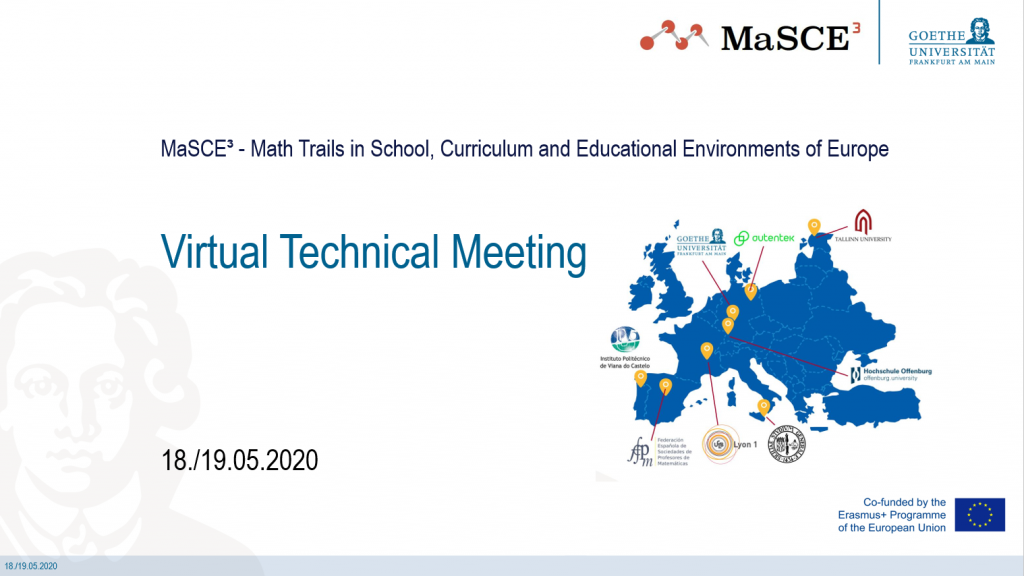
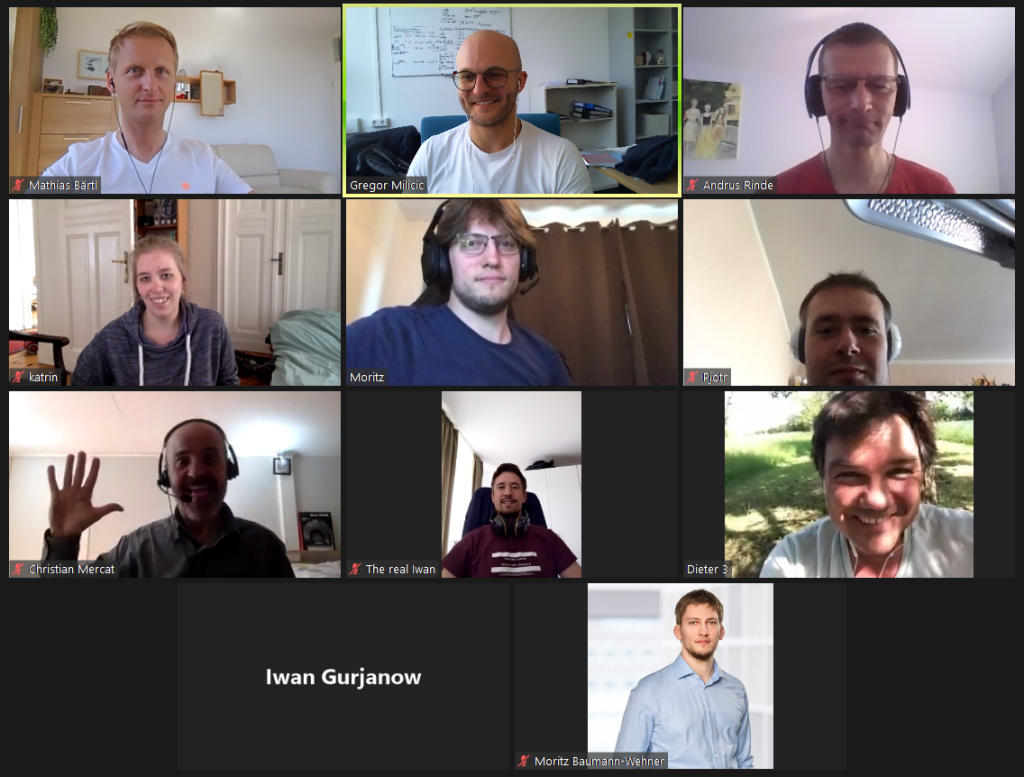
On the 18th and 19th of May we conducted our technical meeting of the MaSCE³ project. Unfortunately, due to the restrictions about personal contacts and international travelling, we had to more our meeting into the virtual space.

Apart from the MathCityMap team from Goethe University Frankfurt, our project partners from the universities of Lyon (France), Tallinn (Estonia) and the university of applied Sciences Offenburg (Baden-Wuerttemberg) also took part. Furthermore, we were actively supported by representatives of the the Berlin app developer from autentek.

 The development of the digital classroom as one of the intellectual outputs of the MaSCE³ project is nearly finished. The digital classroom provides the teachers with the possibility to create a time wise limited learning environment for their students. Apart from the e-portfolio, where all of the during the conduction of a math trail occurring events are stored and displayed, the chat functionality proofed to be a very useful tool for teachers. Especially during the corona crises and therefore the spatial separation of teachers and students, the digital classroom was often used for MathCityMap@home.

During the group works, we discussed the next steps of implementing also augmented elements into the MathCityMap system, as well as to define new task formats. By using augmented elemtns, it would be possible to pose completely new tasks and create problems for a variety of mathematical topics. For example, it could be possible for the teacher to attach virtual information to a real object. The students can discover and use that information by scanning the environment of the object with the camera of their smartphone inside the MathCityMap app. Furthermore, we also want to implement subtasks as a new format for tasks. Using subtasks, it would be possible to structure complex tasks and divide them into smaller, easier to solve problems. The students could then verify their solutions step by step.

The mandatory mathtrail had to be postponed. However, we hope to have soon the possibility to meet again face-to-face and will of course run again a mathtrail together!

We would like to thank all partners for the productive project meeting!

Within the Erasmus+ project „Mobile Math Trails in Europe“, 30 European university students met in Frankfurt for the two last weeks of March 2019. Their goal: Learn about math trails and MathCityMap, create own math trails, test them with students, and of course – make intercultural and international contacts.

The Intensive Study Programme took place at Goethe University Frankfurt from 18th till 30th March 2019. The participating students came from Nitra (Slovakia), Lyon (France), Porto (Portugal), Lisbon (Portugal) and Frankfurt (Germany).

Opening of the ISP

During the first days, the students received a lot of input from our project partners and invited experts in the field of outdoor education. The students heard different lectures on task design and outdoor research, ran a traditional math trail without technical equipment and a MathCityMap math trail around Campus Bockenheim. With nice weather, the students were very motivated in solving as many tasks as possible.

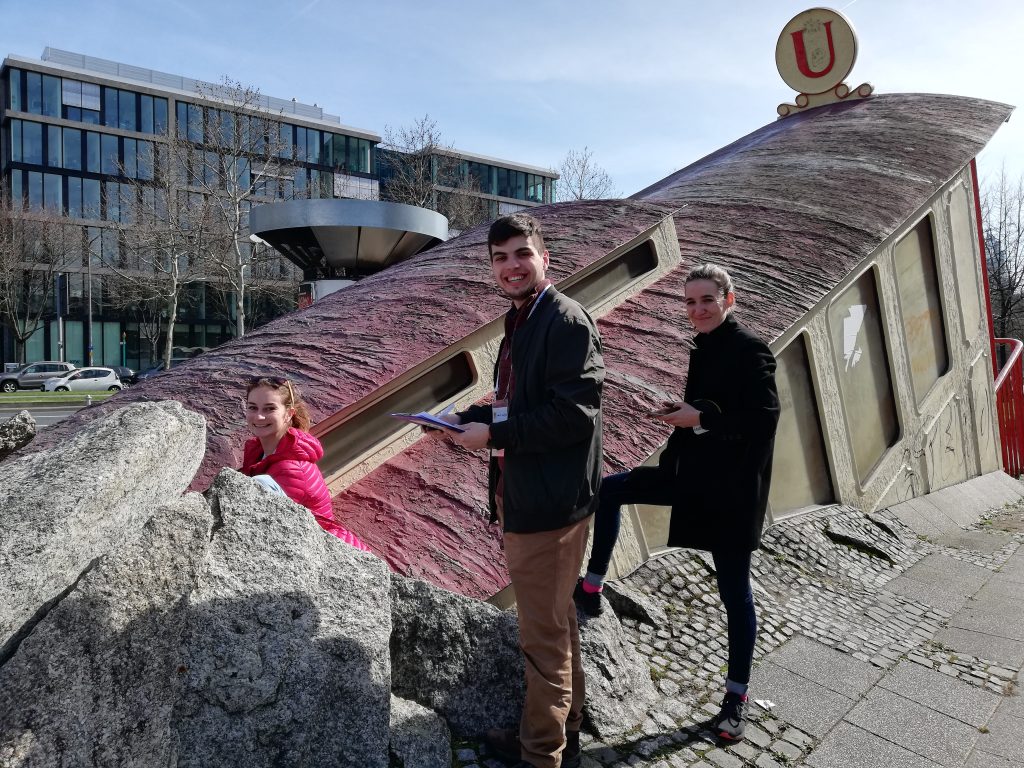
A group while running a MCM trail

After a change of perspective, the students became task creators on their own. In international groups they worked on tasks for school students on different levels. Firstly, they searched for tasks in Frankfurt’s New Old Town, conducted a peer review and feedback round and finally created a tested math trail. During the next week, school students arrived on two different days to run the math trails. Even though the tasks were of course in English, the school students had a lot of fun and success in solving the MCM tasks.

The students in Frankfurt’s New Old Town

Special highlights within the Intensive Study Programme were the excursion to the Mathematikum in Gießen with a lecture by Albrecht Beutelspacher, the visits of German math classes and the final math trail competition during the closing ceremony with awards and certificates.

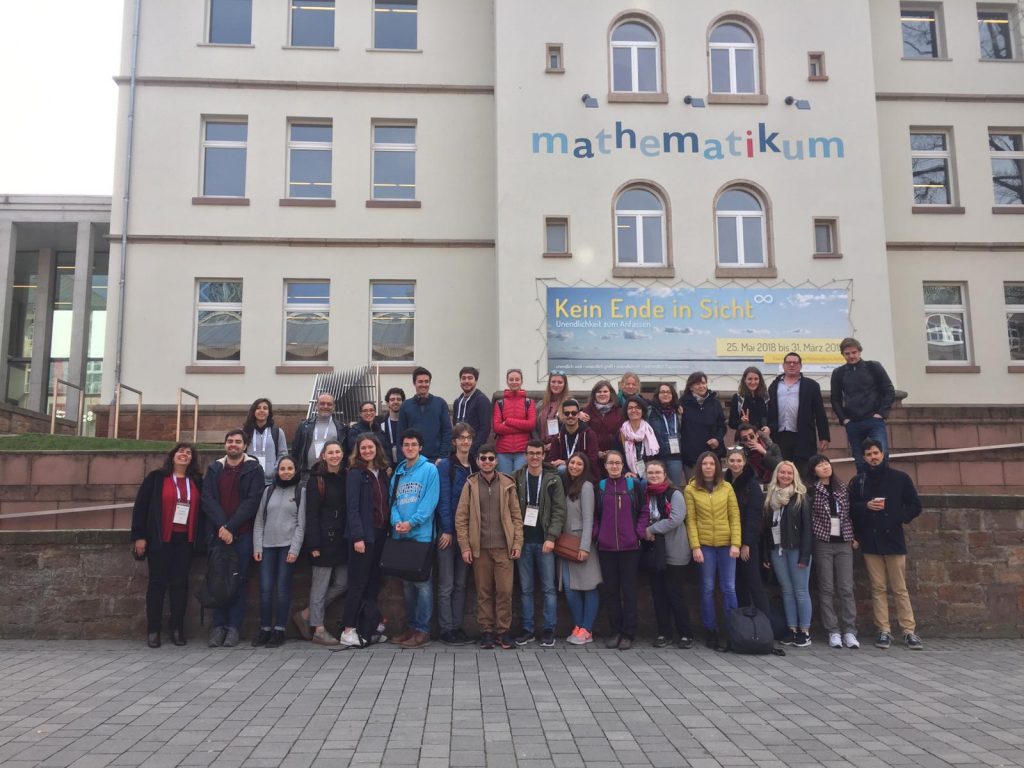
Visit of the Mathematikum

After the intense time we can conclude: The two weeks were a big success for the students and also for the whole MoMaTrE and MathCityMap project. Thank you to all participants and their contributions. We are looking forward to many new tasks designed by the students!

After one year of preparation we managed it: MathCityMap is the heart of the Strategic Partnership MoMaTrE. MoMaTrE is an acronym for Mobile Math Trails in Europe. The working group MATIS I led the application for this Erasmus + project. Currently, seven institutions from five countries are participating:

  •  Goethe University, Frankfurt
  • Univerzita Konstantina Filozofa, Nitra, Slovakia
  • Université Claude Bernard, Lyon, France
  • Instituto de Engenharia de Sistemas e Computadores, Investigação e Desenvolvimento, Lisbon, Portugal
  • Instituto Superior de Engenharia, Porto, Portugal
  • Autentek GmbH, Berlin (software company)
  • Federación Española de Sociedades de Profesores de Matemáticas, Santander, Spain  

Within the next three years, the project has the following aims

  • Spread of mobile Math Trails across Europe
  • Further development of MathCityMap (including Gamification, mobile authoring tools, new task formats, educational Math Trail features)
  • Database for generic Tasks
  • Development and implementation of (international) training modules (shortterm curriculum)
  • Development and implementation of accredited seminars on outdoor mathematics (longterm curriculum)
  • Explore the use of mobile math trails and present the results at congresses and publications

Apart from the contentual reasons, the many supporting letters of our associate partners were responsible for the award. For example, we were able to convince the MNU, the Media Office of the DMV, Mathe im Leben, the DZLM, and the Stiftung Rechnen. From France are supported by the IREM, from Spain the Royal Spanish Society of Mathematics, from Portugal the Mathematicial Society as well as the Mathematics Teaching Association, and from Slovakia the Association of Slovak mathematicians and physicists.