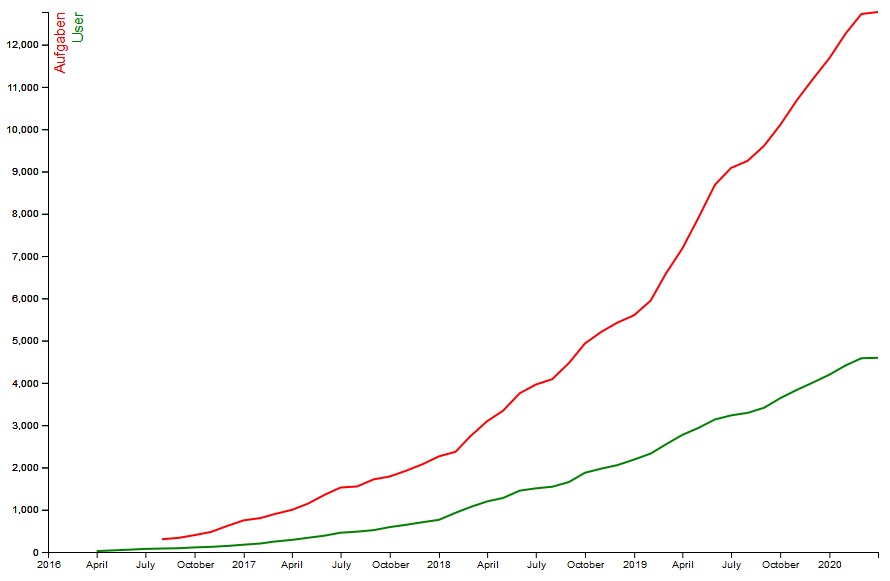
During the Corona crisis, exponential curves, e.g. infection rates, are presented daily in the media. Therefore, we want to show you one – very pleasing – exponential development about our MathCityMap system:

In April 2017, MathCityMap had around 300 registered Users, 1.000 tasks were created in the web portal. One year later MathCityMap provided 3.200 tasks for the 1.200 Users. In spring 2019, the MCM community already consisted of 2.700 users, who created 7.200 MathCityMap tasks.

Today MathCityMap has ca. 4.600 registered users. In total, 12.800 tasks and 2.050 math trails were created in many different languages all over the world. Our MCM video is now available in nine (!) different languages (click here to see the YouTube playlist).

Dear user,

MathCityMap owes this fantastic development in recent years to your interest and creativity. In the current situation, we are happy to see the creation of numerous MCM@Home tasks and trails. After the crisis, we are looking forward to many mathematical outdoor tasks.

We wish you and your families all the best. Stay healthy!
Your MathCityMap team

How learning can be organized in Europe during the Corona crisis, is one urgent question in these days.

MathCityMap provides several MCM@Home-Trails in different languages. Students can work on them at home. As usual, the learners get hints and can compare their own solution with a sample solution. The possibility to get both support and an immediate feedback, can structure students’ learning progress at home.

In the last days, those potentials of MathCityMap for learning at home were highlighted by the German institution Pädagogischer Austauschdienst (PAD) and by the initiative Land of Ideas. The first-mentioned PAD lists here several Erasmus+ projects which supply Open Educational Resources. According to the motto #beyondcrisis, the Land of Ideas promotes diverse projects which can help to handle the Corona crises.

Stay healthy!

Background information:
MathCityMap is very proud to be an award winners of the competion Land of Ideas 2019.

How does the MathCityMap app work? How it can be used by students?

To answer those questions, we shot a short video. Prof. Dr. Matthias Ludwig, head of the MathCityMap team Frankfurt, explains in the video how the app can be used. Thanks a lot to our three actors from the Junge Mathe-Adler Frankfurt!
Click here to watch the video on YouTube.

Notwithstanding, learning mathematics outdoors is hard to imagine at the moment. We want to enable learners and teachers to use the MathCityMap system for tasks which can be solved at home. Therefore, we created some MCM@Home trails.

During Corona pandemic it became apparent that learning at home has some inherent issues. Especially the lack of feedback by the teacher is a real challenge for the students. Therefore, we decided to make out MathCityMap system available for learning at home.

Following we list several trails which can be solved at home. They can be called up by students by entering the given code in the MathCityMap app.

Wie wish you a lot of fun and success!
Stay healthy!

Title

Grade

Language

Code

MCM@Home: Semarang

9

English

232525

MCM@Home: Berlin

10

English

052524

MathCity@Home 2º ESO

8

Spanish

562551

Actividades en casa

8

Spanish

062651

Campo de fútbol del Racing de Santander

9

Spanish

782526

MCM@Home: PT-Porto [7/8]

8

Portuguese

692543

MCM@Home: PT-Porto [9]

9

Portuguese

062544

MCM@Home: PT-Guimarães

12

Portuguese

022552

MCM@Home: Risnovce

8

Slovak

452545

Vratna@Home

8

Slovak

562529

Mathe-Adler: Folgen und Reihen

3

German

012519

Mathe-Adler: Kombinatorik

3

German

262518

Mathe-Adler: Zahlenrätsel

3

German

192515

MCM@Home: Lineare Funktionen

8

German

012514

MCM@Home: Quadratische Funktionen

9

German

682517

MCM@Home: Ffm a. M.

10

German

692521

Our current task of the week is located in the German Hanseatic city Lübeck. Yvonne Kaiser created the GPS task „Ein Platz für die Statue – Umkreismittelpunkt des Dreiecks“ [„A location for the statue – circumcentre of a triangle”]. In the following she answers us several questions about her task and MathCityMap. Information about the task type GPS task, which can be easily created by using the Task Wizard, can be found here.

How do you get in contact with MathCityMap?

At the moment, I participate in a further training as a mathematics teacher on secondary level. During the training, we should create a MathCityMap math trail about geometric objects.

Please describe your task. Where is it placed? What´s the topic of the task?

The task formulation is: The statue in front of the building in the Kalkbrenner street should be placed on the school yard, so that the statue has the equal distance to our three school buildings. Find the point, which has the same distance to the three marked points.

To solve this task, the students firstly have to walk to the three marked points. They recognize that those three points are the corner points of a triangle. By using tape measures and protractors the students can determine at least two perpendicular bisectors. The intersection of those two lines is the circumcentre of a triangle, which is the quested point.

Which didactic aims do you want to stimulate through this task?

The aim of the task is to practice the geometric construction of perpendicular bisectors not only on a sheet of paper in the classroom but outdoors on the school yard. As the building behind the statue will be teared down prospectively, the question raises, where the statue will be placed afterwards. Thus, the story in the task formulation awakes further motivation.

Do you have any other commentary on MathCityMap?

Until now, I’ve never used MathCityMap in class. Therefore, I’m really looking forward to try it out and to observe, how students will work on this problem.

Today is Pi Day! Therefore, we want to celebrate the mathematical constant Pi on todays 3/14. For all fans of Pi, we created a fantastic math Trail consisting of multfarious tasks about this amazing number: “Pi – An irrational good Trail”. In that trail you will find tasks about the area of an circle (segment), the volume of a cylinder and of a truncated cone as well as the number of posters on an advertisment pillar!

For all fans of Pi, we list the first 100 digits of Pi in the following:

3.14159 26535 89793 23846 26433 83279 50288 41971 69399 37510

58209 74944 59230 78164 06286 20899 8628 034825 34211 70679

Our new Trail of the Month, the math trail “Rund um Casio” [“Around Casio”], was created by Philipp Anders during his school internship at the Casio central in Norderstedt, Germany. The journalist Claudia Blume published an article about his trail in the newspaper Hamburger Abendblatt. In the following, Philipp Anders reports about his experiences with MathCityMap.

How do you want to use MathCityMap?

We created the trail in Norderstedt to enable students to work on math tasks outside while visiting the Casio central. Thereby, the students can discover that mathematics are deeply connected to their daily life. We are very proud to publish the first math trail in Norderstedt.

How do you perceive MathCityMap as a student?

I’m an eleventh grad student at the German Gymnasium. In my opinion, MathCityMap is a welcome change to ‘classic math class’. In addition, I really enjoyed creating my own MathCityMap tasks. It was really fun. By creating my own trail, I was really impressed that one can find mathematics nearly everywhere in everyday life.

Please describe your trail. What´s the topic of the task?

Our trail consists out of four tasks. The first one asks after the volume of a stone bench. Here it is possible to measure square stone slabs. Unfortunately, those slabs aren’t congruent. Therefore, we identified their average in order to calculate the volume of the bench. The second task deals with the street which leads to the Casio central. The street has the shape of a semicircle. We want to find out their length. To calculate the length, we measure the radius of the semicircle.

The third task is about the distance between a viewpoint and the runway of Hamburg airport. To calculate this distance, the students have to count the number of periodically attached lights between the viewpoint and the runway und multiply them with the estimated distance between two of the lights. Our final task is about area calculation: The students should calculate the area of the Casio parking garage minus the area of the driveway.

Our new Task of the Week was created by Angelica Benito Sualdea and Alvaro Benito Nolla de Celis in Madrid. In the following they will answer us some questions about their task “El volumen KIO” [engl. volume of one KIO tower].

How do you get in contact with MathCityMap?

We’ve been interested in Math Trails as an educational tool for the last recent years, and we discover MathCityMap during a talk in a conference. We really liked the idea and we immediately started to think in uploading some of our trails we had already created into the platform. It took us some time, but we finally did!

Please describe your task. Where is it placed? What´s the topic of the task?

The task is placed in a characteristic square in the north of Madrid. The square is dominated by two twin towers (the Puerta de Europa Towers, commonly known as the KIO Towers) which are oblique prisms bending one to each other with an angle of 14 degrees of inclination. Since 1996, they symbolise a picturesque “entrance” to the city. From a close look it realised that the towers are surrounded by a rectangular lattice, which divides each tower in a web of black aluminium windows.

Our task asks after the total volume of one of the KIO towers. It provides information about the dimensions of one of the windows: 1.20m x 1.34m. Since its volume is the same as the volume of a straight tower with the same base, to solve the task it is only needed to calculate the number of windows covering the base and the number of windows covering the height of the tower. By counting carefully, it can be checked that there are 30 windows along the base of the tower and 86 from the ground to the top, which implies that

Vol(KIO Tower) = A*h = (30*1.20)^2*(86*1.34) = 149.351 m^3

Which didactic aims do you want to stimulate through this task?

We would like to stimulate student’s ability of solving a complex problem (in this case, calculating the volume of a skyscraper) by just knowing the information of a small element of it (the dimensions of a window of the tower). We find very useful to teach that reducing problems to simpler ones is a powerful mathematical tool. Also, since the tower is an oblique prism, it’s volume is the same as the corresponding right prism, and this task is a stimulating real life example.

Do you have any other commentary on MathCityMap?

We love the app! we will continue creating trails and encourage our students to experience and design new trails.

From February 13 to 14 the “Forum des mathématiques” took place in Marseille. Christian Mercat, professor at the University of Lyon and one of our European project partners (MoMaTrE and MaSCE³), ran a very successful MathCityMap workshop at the Forum: During the congress, his great math trail “Forum 2020” was downloaded more than 400 times. In addition, more than 260 individuals or groups participated in the related Digital Classroom.

Thanks a lot, Christian, for this incredible MathCityMap workshop, which took Marseille by storm!

Christian reports on the form: This is the first time a MathCityMap trail was setup in this forum. Prizes were distributed but there was no need for that in order to motivate the participants, hundreds of participants played with the app and opened a scientific eye on the campus around them, figuring out the size of the letters on top of the building, the number of red tiles in a mosaic and so on.

Background information:

“Maths pour Tous” (“Math for All in French”) is an association based in Marseille, backed up by the Aix-Marseille University. They have organised for more than 10 years numerous forums where thousands of people flock to the university or other public venues to enjoy mathematics, accounting for the largest math events in France outside Paris. It consists in Math conferences, workshops, poster sessions, held by students themselves presenting their work during the year alongside top specialists in mathematics disseminating their work to the wider public.

Our Trail of the Month February is located in in Sicilian town Catania. The trail “Percorso in cittadella” [“Trail in the area ‘Cittadella’”] was created by Eugenia Taranto, who teaches mathematics education at the University of Catania. She also works on our European project MaSCE³ [Math Trails in School, Curriculum and Educational Environments of Europe], which promotes the further development of MathCityMap.

Please describe your trail. What differentiate your trail from others?

The trail is called “Percorso in cittadella”. In fact, “cittadella” stands for small town and is the area of the city of Catania where all the science departments are located. The special attribute of the trail is that it contains tasks designed by university students, together with me. In addition, it is located at an area of the city, where unfortunate no MathCityMap tasks had been created before. Having a trail in the university will allow experiencing MCM more easily with those who will attend the department (students and also teachers, who follow training courses). 

How do you use MathCityMap?

During a course of mathematics teaching, I dedicated three lessons on MathCityMap. In the first one, I let them try the app and we had our lesson in the city centre. I divided them into groups and they walked the trail “Palazzo degli Elefanti” [“Palace of the Elephants”]. In the second lesson I presented MCM from a theoretical point of view and I specified the technological functionalities of portal and app. I divided the students into groups and each one had the task of identifying a mathematical object on which to make a math trail task, at our department. Between the second and third lesson, they created their tasks on paper and explained them to me.

In the third lesson, they digitized the task and I created the path with their tasks. The students walked the trail, testing the tasks and writing down feedback which they then shared in class with the task designers. The tasks in the trail were reviewed again and the students walked the trail again. The educational goal I pursued was to make university students aware designers, who will be able to use MCM with their future students.