In a further article on our category Generic Tasks, we want to present you determinations of volume and mass. The focus will be on the bodies Cuboid and Cylinder. Further bodies will follow in future articles. We start with these forms as they occur in the environment very often and can be realised very quickly with our Task Wizard.

Objects that can be described with help of cuboids are for example concrete blocks or stones. Here, the difficulty varies according the unevennesses of the object, which can be balanced through averadged values. With benches, the difficulty can be increased as well, as they have to be described through different cuboids.

Cylinders are very suitbale to determine the volume of a tree trunk. Furthermore, many fountains are circular and therefore a good basis for calcualtions with the cylinder.


Especially with stones and tree trunks, the question of the object’s weight seems adequate through a given density. The mathematical background, as well as popular densities can be found in the following document Generic Tasks Volume 1.

Today’s Task of the Week will be presented in an interview with Virginia Alberti, who uses and supports MathCityMap in Italy. We say thank you for the interview and the numerous Italian tasks!


Task: Capacità per la fontana della Minerva – Capacity of the Minerva fountain (Task number: 2452)

How many liters fit into the Minerva fountain?
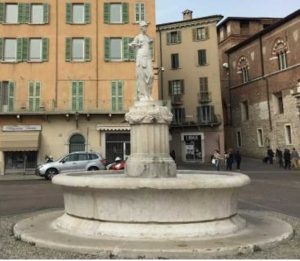

This task concerns the calculation of the capacity of a fountain tub placed in a square of my city center. To answer the question of the activity, the students have to model the fountain basin and calculate the volume.

At a first sight, the calculation could be trivial, but in reality, it requires observation, analysis and skill in the choice of the model to be applied with certain conditions and approximations related to:

  • the particularity of the shape of the tub (2 cone trunks),
  • the presence of a base in the center that supports the statue,
  • the choices on measurement methods not taken for granted.

I have thought, designed, and created this task to propose it in a collaborative learning mode for a small group, and I identified myself with the actions that my students could use their knowledge to estimate the capacity.

I found it intriguing that in the group the students could:

  • talk about math for creating the model,
  • activate and compare the skills for solving a real problem,
  • choose a shared solution strategy with different measurement opportunities,
  • make conjectures and then have different ways to verify them without finding ideas in the network.

I think MathCityMap is a tool that allows:

  • supporting the pursuit of mathematical and digital skills as well,
  • facilitating a conscious and educational use of mobile devices and recovering some skills and practices of use that millenials mature in informal learning,
  • supporting what is defined as laboratory teaching,
  • facilitating an active role of the student by stimulating creativity in the approach to the resolution strategy with respect to the questions of the task,
  • opening up the possibility of other methods of teaching approach such as the flipped lesson or PBL.

Furthermore, I think MathCityMap for teachers is:

  • a challenge to innovation towards an educational proposal that facilitates the social and collaborative learning of mathematics;
  • a reactivation of a new project towards those that are the learning requests of the 21st century (I am thinking of the STEM field);
  • an activation to a role of less transmissive teacher, but more as tutor, from facilitator, …


Our Task of the Week was created by Vanessa Präg, student at Goethe University Frankfurt, as part of a mathematics didactic course. In a short interview, she will tell us about her experiences.


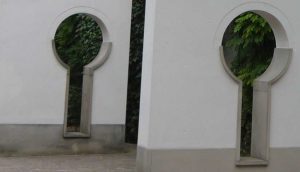
Task: Giant keyhole (Task number: 2550)

The city wants to close the keyholes. For this, the holes are filled with concrete up to the respective edges. How much does the concrete weigh in a keyhole when the density of the concrete is 2.1g/cm³? First estimate and then calculate the weight of the concrete in kg.


How did you come up with the idea to create this task for MathCityMap? How did you get to know MathCityMap?     

My lecturer, Mr. Zender, made me aware of MathCityMap. As part of a course, we as prospective teachers talked about what modeling in mathematics education means. For clarification, he let us run a small trail from MathCityMap and solve it, as well as create 2 tasks in MCM. I’ve been an avid geocacher for years and think it’s a good idea to set tasks which can be solved with mathematics at different places. If I have more time, I will certainly create more tasks.    

The task itself came to me as I walked through our city looking for unusual objects for MCM. The keyhole immediately jumped in my eye.

Which competencies and topics play a role in solving the task?

In this task, I see the competences “problem solving”, “modeling” and “working with mathematics symbols and techniques”. Communicating is also part of the task since on the one hand, the information from the task must be understood and implemented correctly, and on the other hand, the students should communicate with each other their solution proposals. Correct measurement of lengths, as well as the knowledge of the body and its volume play an important role. What surprised me was how heavy concrete is in a comparatively small volume. Therefore, I thought it would be interesting for the students, if they can assess the weight reasonably well.

A popular MathCityMap task is concerned with the volume of fountains and how many liters of water are contained. The question can be used for a wide range of geometric themes, depending on the shape of the selected fountain (rectangular, circular, …). The Task of the Week is a particular challenge because the fountain has to be modeled with help of different geometric bodies.


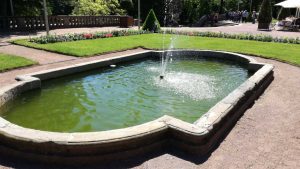
Task: Water in the Fountain (task number: 1420)

How many liters of water are in the illustrated fountain?


The illustrated fountain can be modeled using a cuboid and a cylinder (divided into two parts). If this has been recognized, the necessary quantities must be collected and the individual volumes calculated. Finally, the conversion in liters is required. The task with cylinders can be used from class 9 onwards; simpler fountain shapes are already possible from class 6 onwards.

Depending on the structure of the well, the collection of the data can be a challenge and the students have to become creative. For example, the circumference of a circle can be helpful for the determination of the diameter. Not at least through such considerations, a flexible handling of mathematical formulas and correlations is promoted.

The determination of the weight of an object has often been part of a Task of the Week. However, today’s task is a particular challenge because the object consists of different materials with different densities.


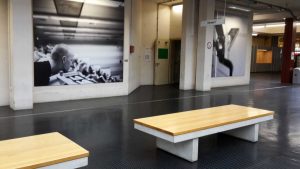
Task: Bench (task number: 1803)

There are benches in front of the H7. How much does a bench seat weigh when the wood weighs 690 kg per m³ and the concrete weighs 2400 kg per m³? Give the result in kg.


The best way to solve this problem is by dividing the bench into three parts: the two concrete feet, the concrete seat and the wooden seat. A cuboid can be used as a model for all parts. Then the students take the necessary measurements and calculate the weight of concrete and wood first separately. The total weight of the bench is then calculated by addition.

The task requires knowledge about the cuboid as well as its volume. In addition, the concept of density should be known to the pupils. Within solving this task, this can be sharpened. The task is recommended from class 7.

The current Task of the Week is about an everyday object, which is suitable for various tasks around the circle and can be used due to its frequent occurrence in almost every trail. More specifically, it is about the shaft cover of a canal and its dimensions and weight.


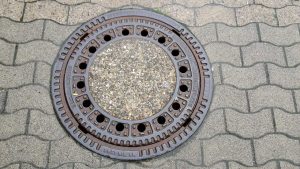
Task: Shaft Cover (task number: 1804)

In the center of the shaft cover, concrete is given. 12 liters of concrete are used per lid. What is the height of the concrete cylinder? Give the result rounded to one decimal place in cm.


To solve the problem, it is first necessary to recognize that the volume of the center of the shaft cover is given. In addition, the shaft cover has to be recognized as a cylinder apart from minor inaccuracies. Using the formula for the volume of a cylinder and the measured radius, the students can identify the required height. In general, the modeling competence and handling of mathematical objects in reality is trained. In addition, the flexible handling of formulas and the choice of suitable units play an important role in order to solve the problem. The problem can be grouped into the complex circle and cylinder and thus plays a role in geometric questions. The task can be used from class 9 onwards.

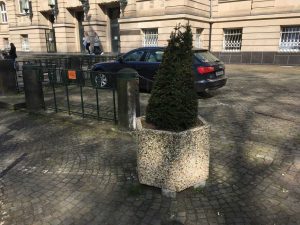
The present Task of the Week is about polygons and geometrical figures. In particular, the prism with a hexagonal base surface plays a role. The task can be found in this form in Cologne, but can be transferred to similar objects without problems.


Task: Flower Box (task number: 1189)

What is the volume of the flower box? You may assume that the floor is as thick as the edge of the box. Give the result in liters.


As already mentioned, the base area can be assumed to be a regular hexagon. To determine the area of ​​the base area, pupils can either use the formula for the area content of a regular hexagon or divide the area into suitable subspaces. They should note that the edge does not belong to the volume. The pupils then measure the height of the prism by subtracting the floor plate. Subsequently, the volume of the prism, which is converted into liters in the last step, is obtained by multiplication.

The task thus involves a geometric question, in which students can either apply their knowledge to regular polygons or to composite surfaces. In addition, spatial figures are discussed as well as the adaptation to real conditions by observing the edge. The task is recommended from grade 8 onwards.

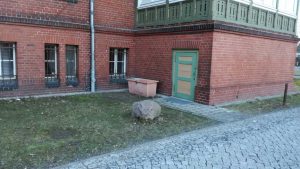
This week’s Task of the Week addresses, in particular, the modeling competence of the students. It is a question of approximating the weight of a stone as closely as possible by approximating the stone through a known body.


Task: Stone (task number: 1048)

What is the weight of the stone? 1cm³ weighs 2.8g. Give the result in kg.


In order to approach the object by means of a geometrical basic body, the students must refrain from slight deviations of the real object and the ideal body. In particular, a prism with a trapezoidal base side is suitable. If this step is done, the students determine the pages relevant to this body through measurements and then calculate its volume. The last step is the calculation of the weight with the given density as well as the conversion in kilograms.

With this task, it is especially nice to see that there is not always one correct result for mathematical questions. Through different approaches and measurements the pupils receive different results. In order to obtain the most accurate result as possible, the determined values ​​must be within a defined interval. Translating from reality into the “mathematical world” also plays a decisive role here in the sense of modeling competence.

The task requires knowledge about the basic geometrical bodies and in particular about the prism with a trapezoidal base surface. It is therefore to be classified in spatial geometry and can be solved from class 7.