Katalin Retterath is a mathematics teacher and consultant for teaching development in the German fedaral state Rhineland-Palatinate. In the following interview, she introduces us to a task that was created during an teacher training on outdoor mathematics teaching.


The task: Bulwark – Volume:

Task: “Go to the interior of the bulwark. Calculate the volume of the interior in m³ up to the capstones. Assume that the floor is level.”

The goal here is to calculate the volume of a cylinder, which the bulwark encloses with a circular base.

You describe in the category “About the object” that the task was created during an teacher training. How do you use MCM and why?

I am a consultant for instructional development at the pedagogical state institute in Rhineland-Palatinate, Germany. I don’t remember how I got to know MCM, probably at a conference. I have known MCM from the beginning and use it in my classes 1-2 times a year during virus-free times.

At the pedagogical state institute we offer advanced trainings also for the use of media in mathematics lessons, here MCM is a topic again and again. One of the most successful advanced trainings is “Outdoor Mathematics” – a two-day event, which we have offered so far alternately in Speyer, Bad Kreuznach and Andernach. The task “Bulwark – Volume” was created by a group of participants in Andernach – I just created it in the MCM system.

How do you plan to use MathCItyMap in the future? What ideas do you have for using MCM in math classes?

It’s a very great tool! I look forward to using it again. We consultants have also used MathCityMap in another way, including outdoor math: we created a series of surveying tasks around Speyer Cathedral (code: 031829) and entered them into MCM.

With the help of MCM we have been able to create very appealing booklets for the participants of the advanced training [also MathCityMap offers the possibility to download a trail guide as a companion booklet to the trail; editor]. These booklets help document the work so that the field trip can be better integrated into the classroom: In addition to entering results in the app, the notebooks are used anyway / in parallel. I would try it out like this in a 10th grade or high school class – if times allow and I have a suitable class.

Melanie Schubert from Goethe University Frankfurt has created the task “The Dinosaur’s Suitcase” and reports in an interview about her experiences with MathCityMap.


Dear Melanie, how did you get to know MathCityMap project? How do you use MCM?

I got to know MCM while working at the Goethe University Frankfurt, where the system is developed. As part of our mathematical gifted students promotion program “Junge Mathe-Adler Frankfurt” I created the trail “Mathe-Adler Klasse 6” for SuS of the sixth grade as a kick-off event.

Describe your task. How can it be solved?

In my task the volume in liters of an oversized suitcase is to be determined. In front of the Senkenberg Museum in Frankfurt there is a large dinosaur figure with a suitcase standing in front of it. Within the task the SuS receive information about human suitcase sizes, if one would go on vacation for about 2 weeks. The SuS can calculate the volume of the suitcase by approximating the suitcase of the dinosaur as a cuboid and then convert the volume into dm³ to determine the number of liters. By specifying the liter sizes of our suitcases, the SuS have a possibility of self-control, in that the SuS can consider whether about 27 of our suitcases can fit into the suitcase of the dinosaur.

What didactic goals do you pursue through these tasks?

This task is intended to expand the spatial imagination, conversion skills, measuring skills and the competence of modeling.

In Karlsruhe, Germany, we find our new task of the week. Here the student teachers Jessica Milde and Lea Berner have created the task „Volumen der Gründer-Schmiede“ (engl.: “Volume of the Founder’s Building”), in which the volume of a building is to be modelled by using two cuboids.

How did you discover the MathCityMap project?

We, Jessica Milde and Lea Berner, are studying high school teaching (mathematics) in the 6th semester at the Karlsruhe Institute of Technology (KIT). Last winter semester we visited the didactics seminar “Digital Tools for Mathematics Teaching”, where each student of the seminar was supposed to present a digital tool in their lecture.

In our double lecture we introduced the MathCityMap App and took a closer look at the background of the website and the App. In our internship our fellow students could create their own tasks and run the trail “Digital Tools WS 19/20” (available in the app via code: 562251).

Describe your task. How can it be solved?

The task is a composite body and the SuS should determine the volume of this body by means of modelling.

What didactic goals do you pursue with the task?

You have to realize that there are two cuboids and that the terrace is not part of the volume of the building. There are small pitfalls built in because the building has rounded corners.


More Math Trails in Karlsruhe, Germany:

The current task of the week is located in Lichtenfels, Germany. In this Franconian town the teacher Jörg Hartmann created the task “Der schöpfende Dümpfelschöpfer“ [engl. “The scooping ‘Dümpfelschöpfer’”] and answered several questions about it.

How did you get in contact with the MathCityMap project?

I first discovered the MathCityMap idea through a teacher training by Matthias Ludwig, head of the MCM team Frankfurt. During a project week at my school, the Meranier-Gymnasium in Lichtenfels, I offered a course on MCM trails.

Supported by six students of the nineth to the eleventh grade I created the math trail “Bergauf und Bergab, über Stock und Stein in Lichtenfels” [engl. “Uphill and downhill, over rough and smooth in Lichtenfels”], which contains the tasks “Der schöpfende Dümpfelschöpfer“. Subsequently I worked several times with different classes on the trail. A preparation of 20 minutes is suitable for this; the pupils then run the trail for two or three school lessons. The joy of the pupils is enormous, while the pupils experience mathematics in the open air – and the pupils learn an amazing amount.

Please describe your task. How can it be solved?

The famous sculpture in Lichtenfels, the so-called “Dümpfelschöpfer”, represent a man scooping water from an irregularly shaped pool. In the task I ask how often the man have to scope until the pool is empty. To solve the task, the students have to divide the problem into smaller subtasks, e.g. what the volume of the pool is or how units can be converted.

Which didactic goals do you want to promote?

I would like to encourage students which work on the math trail to perceive their environment from a mathematical perspective as well as to recognize the connection of school math and the real world. They might ask themselves which mathematical object has a similar shape to the bucket and how to convert a volume in m³ in litres.

Furthermore, I want students to do mental arithmetic and make rough estimation. By working on this task, they should realise how useful rough calculation is in everyday life.

Do you have any further commentary of MathCityMap?

I am enthusiastic about the idea of outdoor mathematics, and my students really enjoy to run a math trail. A lot of mathematical creativity is required to create a math trail. To be honest, at school the time to foster students’ mathematical creativity is limited – unfortunately I think the creation of a trail together with students is only possible during a project week.

Overall, the MathCityMap project is great! I really hope that some other users create trails around Lichtenfels, because I would definitely enjoy working on a “foreign” trail to get new ideas for math trail tasks.

Our new Task of the Week was created by Angelica Benito Sualdea and Alvaro Benito Nolla de Celis in Madrid. In the following they will answer us some questions about their task “El volumen KIO” [engl. volume of one KIO tower].

How do you get in contact with MathCityMap?

We’ve been interested in Math Trails as an educational tool for the last recent years, and we discover MathCityMap during a talk in a conference. We really liked the idea and we immediately started to think in uploading some of our trails we had already created into the platform. It took us some time, but we finally did!

Please describe your task. Where is it placed? What´s the topic of the task?

The task is placed in a characteristic square in the north of Madrid. The square is dominated by two twin towers (the Puerta de Europa Towers, commonly known as the KIO Towers) which are oblique prisms bending one to each other with an angle of 14 degrees of inclination. Since 1996, they symbolise a picturesque “entrance” to the city. From a close look it realised that the towers are surrounded by a rectangular lattice, which divides each tower in a web of black aluminium windows.

Our task asks after the total volume of one of the KIO towers. It provides information about the dimensions of one of the windows: 1.20m x 1.34m. Since its volume is the same as the volume of a straight tower with the same base, to solve the task it is only needed to calculate the number of windows covering the base and the number of windows covering the height of the tower. By counting carefully, it can be checked that there are 30 windows along the base of the tower and 86 from the ground to the top, which implies that

Vol(KIO Tower) = A*h = (30*1.20)^2*(86*1.34) = 149.351 m^3

Which didactic aims do you want to stimulate through this task?

We would like to stimulate student’s ability of solving a complex problem (in this case, calculating the volume of a skyscraper) by just knowing the information of a small element of it (the dimensions of a window of the tower). We find very useful to teach that reducing problems to simpler ones is a powerful mathematical tool. Also, since the tower is an oblique prism, it’s volume is the same as the corresponding right prism, and this task is a stimulating real life example.

Do you have any other commentary on MathCityMap?

We love the app! we will continue creating trails and encourage our students to experience and design new trails.

This week our presented task is located in Ireland. At the campus of the Dublin City University (DCU) our MoMaTrE partner Christian Mercat created the task “The weight of DCU” and gave us an interview about this task and the value of using the MathCityMap app.

What´s the topic of the task?

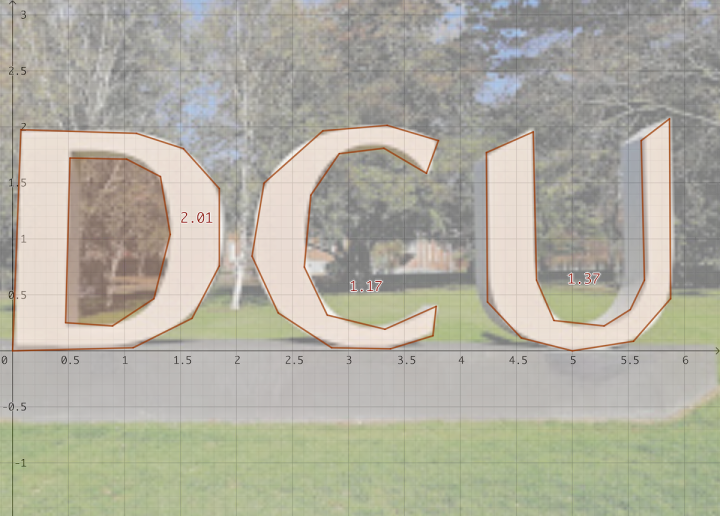
On the campus you can find a huge DCU solid rock sign. I really wondered how much that could weight! So I investigated and figured out that one could estimate the surface of the letters and the depth of the sculpture.

How could you solve this problem?

You have to estimate the average width of the letters and their lengths. For example, C is a 2/3 portion of a circle of diameter 2 m and average with 30 cm. So is has a surface of 1.2 m². The modelling of D and U happens equally. Totally the sculpture has a surface of 4.5 m². The depth of the stone is 50 cm, which leads to a total volume of 2.25 m³. The density of the stone being 2.4 (that’s given in the first hint), the total weight of the sculpture is around 5400 kg. The estimation of the surface being tricky, I actually checked again by taking a picture from a distance and estimating numerically the total surface with the help of my computer. 

Estimation of the sculptures` surface.

What´s the didactic aim of the task?

Clearly, I want here to get first the students to have a rough estimation of the degree of magnitude, is it around hundreds of kg, a few tons or tens of tons. I give a broad « orange » zone between 3000 and 7500 kg for those trying to figure out by simply bracing their arms around the sculpture to get a sense of the volume, which I find fair enough for an answer. But then, trying to model each letter as simpler geometric shapes is really the main focus of this task. It can not be done exactly, the average width of each letter is a matter of debate, which is good. The « green » zone might be a little bit too tight (between 5000 and 6000) which is only a 20% width around the expert estimation, but the depth is without any doubt 1/2 meter so the uncertainty really is on the surface estimation.

Why do you use MathCityMap?

I love taking the pretext of a MathCityMap trail in order to stroll around on a campus or in a park, appreciating the scenery from this very specific perspective of looking around for objects that tickle my mathematical inclination, keeping open the scientific eye in me.

The task of the week is back! Today we present you a task, which was developed during a teacher training at the Georg-Büchner-Gymnasium in Bad Vilbel near Frankfurt.

Next to the schoolyard we found this interesting sculpture of a water bottle. Immediately we wanted to ascertain, how many litres of water the bottle would contain. For the task “Volume of the bottle” we assume that the artwork has a wall thickness of 3 cm.

How the volume of the bottle can be ascertained?

For the modelling we divide the artwork in a frustum of a cone and a circular cylinder. We look on the object as compounded solid.

What´s the aim of the task?

The complexity of the task is to find a useful mathematic model for the object, which is a fitting transfer of the reality and is calculable with a manageable time exposure all at once. To solve the problem, you have to find a compromise between mathematical precision and practicability. Hence the task is a good example for a lot of modelling problems.

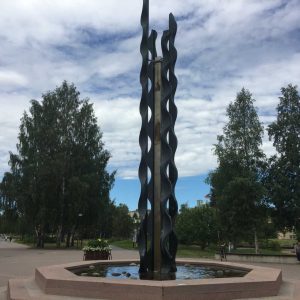
Fountains and their volume are ideal for modeling different geometric bodies. While many of the fountains have a rectangular or circular shape and can thus be approximated as cuboid or cylinder, in the current “Task of the Week” we present an octagonal fountain whose volume can be described by a prism with an octagonal area.


Task: Water in the Fountain (Task Number: 4295)

What is the approximate volume of water in this fountain? Assume that the average depth of the water is about 30 cm. Give the result in liters.


Even if the formula for an octagon is not known, the task can be solved by dividing the area or completing the area. For example, one can determine the area of the square enclosing the octagon. Then, for each corner which is calculated too much in the square, the area of a triangle must be substracted. The height is then used to calculate the volume.

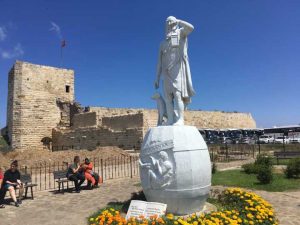
Doing mathematics surrounded by a fantastic setting – that promises the current Task of the Week to the statue of Diogenes of Sinope. Known as an influential Greek philosopher, he is said to have no permanent home and, instead, often spent the night in a barrel. This barrel is the core of our mathematical calculations.


Task: Diogenes and his barrel (task number: 4467)

Determine the volume of the barrel in which Diogenes lives. Give the result in liters.


How can the barrel best be described by known geometric bodies? Certainly different models are possible. A sufficiently accurate model is the use of two truncated cones, with each of the bases with the larger radius in the middle of the barrel abut each other.

The height is easily determined by measuring the height of the barrel divided by 2. By means of the circumference in the middle of the barrel and at the bottom / top each, the small and large radius can be determined. Hereby, the regular patterns on the barrel can help.

Using the formula for a truncated cone then results in the approximate volume for the entire barrel.

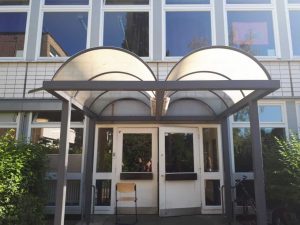
The classical geometric bodies and figures can be found numerously in the environment. However, real objects deviate from the ideal body and require modeling skills. In addition, composite bodies are not uncommon as in our current “Task of the Week”, which was created by Bente Sokoll, a student at the Johannes-Brahms-Gymnasium in Hamburg.


Task: Volume under the roof (Task number: 4194)

Calculate the volume under the roof (if the sides were closed). Give the result in m³.


To calculate the volume, the body is split into a cuboid and two semi (idealized) cylinders. For the cuboid, length, width and height must be measured and multiplied. For the cylinder, one needs the diameter (or the radius) and the height of the cylinder, which corresponds to the width of the cuboid. The necessary formulas give the sum of the individual volumes.

The task is also a nice example of how MathCityMap students can become authors themselves. In this case, students were asked to create assignments for younger grades. We are looking forward to the usage of the tasks!