In addition to a variety of geometric issues, combinatorial and stochastic problems also play an important role in MathCityMap. Today, we would like to introduce you to the most common generic tasks concerning combinatorics and probability. Two combinatorial questions that can be created quickly and easily with the Task Wizard are tasks asking for combination options of stairs and bike stands.
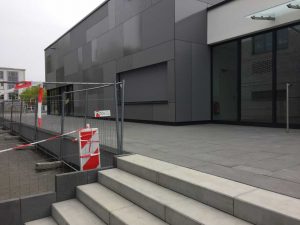
In how many ways can you climb the stairs by taking one or two steps?

There are various possibilities for solving the problem. On the one hand, it is possible to systematically record different combinations of 1 and 2 steps. In doing so, the students can use the stairs directly and conclude which combinations are possible. In another consideration, the fact that the last step comprises either one step or two steps is used. Leaving this last step, the number of possibilities for a staircase with n steps can be determined using the possibilities for n-1 and n-2 steps. This reasoning leads to the Fibonacci numbers, a recursive sequence in which a number results from the addition of its two predecessors.
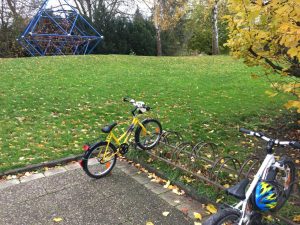
How many possibilities do you have to lock k bikes?

In this task, it is necessary to determine the number of possibilities to lock k bicycles at n spaces. For the first bike, there exist n possibilities to lock it. As this space is full afterwards, the number of possibilities to lock the second bike is n-1. Analogous, the possibilities for bike k is n-(k+1). This combinatorial problem is a situation where repetition is not allowed and order matters. With help of the possibilities’ product, one can calculate the total number of possibilities.

It is important to formulate the tasks precisely and to make clear which object or which part of the object is concerned (for example, in the case of a very long staircase, the lowest part). The activity of the task solver initially refers to the counting of the stairs or parking spaces of the bicycles. Therefore, when photographing, it should be noted that this number can not already be taken from the photo.

Further, probabilities can be realized by MCM, for example, the question for the probability of arriving at a traffic light during a green phase or to wait at a bus stop less than 5 minutes for the next bus. Both types of tasks focus on the Laplace probability (favorable events divided by all possible events).

We have compiled both emphases for you in the following document with detailed mathematical background and hints.

Icon

Combinatorics and Probability 758.34 KB 72 downloads

...

The present Task of the Week leads to Münster and contains a question from the probability calculation.


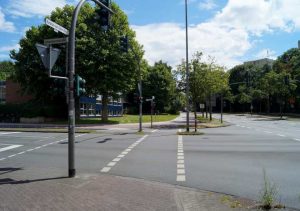
Task: Red or Green? (Task number: 428)

The city of Münster is trying everything to make road traffic as smooth as possible. There is even a traffic light hotline, where you can make suggestions for improvement. Despite all the good planning, walkers often come to red traffic lights. Often, the red traffic lights are noticed more often than the green traffic lights. Estimate how often a traffic light shows “green” if one passes the traffic light 100 times.


In order to solve the problem, students should first measure the duration of a green phase, as well as the duration of a red phase. The duration of a total phase then results over the length of a green phase and a red phase. In order to determine the probability of reaching the traffic light at green, the duration of the green phase is divided by the duration of a complete traffic light. Subsequently, the expectation value can be formed with a 100-time passing.

This approach leads to a theoretical solution which, however, should be questioned critically. The result as well as the randomness of the arrival can be influenced depending on the traffic light circuit and any traffic lights which have been traversed previously. However, the problem is a successful application of the probability calculation in everyday life and can be used with the first elaborations of the probability concept.

It has been a bit longer since there was a bigger update of the MCM web portal. But now it is time and it brings two major innovations with it.

Task Wizard

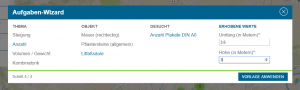
The Task Wizard allows you to create complete tasks with a few clicks. The author has to find a suitable object in his environment, take a picture of it and collect the necessary measurement data. The remaining entries, such as the sample solution and notes, are automatically generated and inserted by the wizard. At first, a set of 12 task templates from the topics slope, number, volume / weight and combinatorics are available. The templates originate from our collection of blueprint tasks and can be formulated on objects which, according to experience, occur almost everywhere:

• Handrail of a Staircase

• Ramp

• Stone Wall

• Paving Stones

• Advertising Pillar

• Large Stones

• Wooden Trunk

• Water basin / fountain.

The task wizard will be expanded step by step. Suggestions for new task templates from the community are gladly taken up! To start the wizard, you just have to click on “New Task” in the portal, then select the magic wand and afterwards you can start.

For a time-consuming, but still good trail, we recommend about 5 own tasks, which are individual and unique for the place, mixed with 5 tasks from the task wizard.  

Quality Traffic Light

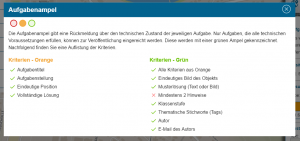
Tasks and routes now have a so-called “Quality Traffic Light” which reflects the technical quality of the element. The traffic light is located in the area where the picture is displayed. By clicking on the traffic light, you can see which criteria are already fulfilled and which can be improved. To ensure that our public tasks and trails continue to be of a high quality, only tasks and routes that show the green light can be submitted for publication.  

Further changes:

• In the route view, the path within the route is also displayed. The starting task is marked with a blue circle.

• Tasks can now be added / removed to a route using a button (“Add / Remove”) in the task preview. This should facilitate routing.

• Quotation marks and line breaks in hints, sample solutions and task texts are now displayed correctly.