Today’s Task of the Week focuses a geometric question at the Aasee in Münster. More specifically, the surface content of a hemisphere is calculated by the students.


Task: Mushroom (task number: 1400)

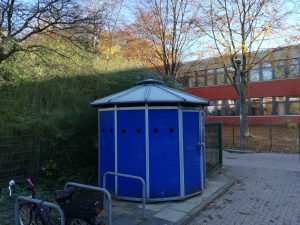
Determine the area of ​​the mushroom. Give the result in dm². Round to one decimal.


In order to solve the problem, the students have to approach and recognize the shape as a hemisphere. They then need the formula for the calculation of the spherical surface or here the hemispherical surface. For the determination, only the radius of the hemispheres is required. Since it can not be measured directly, this can be determined with help of the circumference.

The task requires knowledge of the circle and of the sphere and can therefore be applied from class 9 onwards.

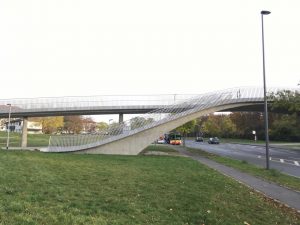
 Many of the tasks in the MCM portal are based on mathematical knowledge from secondary level I. Today’s Task of the Week shows that knowledge of secondary level II can be integrated in tasks as well. The task “Hubland Bridge I” is about the inflection point of a function as well as its properties.


Task: Hubland Bridge I (task number 684)

At which stair (counted from below) is the inflection point?


First, the bridge must be modeled as a function. For the visual determination of the inflection point, the students use the characteristics of the inflection point. In this case, the property can help to describe the inflection point here as the point with maximum slope and without curvature. In the presence of the device, the maximum slope can also be determined using a gradiometer (see Hubland Bridge II). The point of inflection as a point without curvature can be determined optically by looking for the point at which the graph resembles a straight line. After the turning point has been determined, the students have to count the steps up to the point. Ideally, this is done several times and the mean value is formed.

The task can be assigned to the topic of analysis, more precisely the differential calculus. With the development of the characteristics of the turning point of a function, the task can be used from class 11 onwards.

Today’s “Task of the Week” was created by Markus Heinze in the trail “Schillergymnasium” in Bautzen and combines percentage calculation with a geometric question.


Task: Percentage Calculation at the Entrance (task number: 1262)

Determine how many percent of the entrance doors are made of glass.
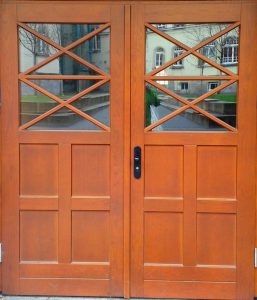

Mr. Heinze was kindly available for a short interview so that we can present his assessment and experience with the task. We would like to thank him very much!

How did you get the idea for this task?
I wanted to create different tasks for an 8th or 7th class. I had a free time but it rained right at that time. That’s why I stood at the entrance at first and thought about how to install the entrance door and so, the idea arose to connect triangular areas and percentage calculation.

Which mathematical skills and competencies should be addressed in the task?
On the one hand, of course, modeling and problem solving is of high importance, because I had noticed deficits in the competence test in this area among the students in the 8th class. But also the visual ability is strengthened, of course, since real objects are being worked with and the students receive an idea of ​​areas and percentages.

Has the task already been solved by pupils? If so, what feedback was given?
The task was solved by students of a 9th class and they found it relatively simple but interesting, but this is also because they had not worked with the app before and were generally enthusiastic about the matter. I think for a 7th or 8th class it is suitable.

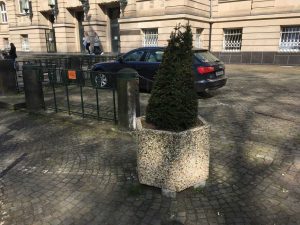
The present Task of the Week is about polygons and geometrical figures. In particular, the prism with a hexagonal base surface plays a role. The task can be found in this form in Cologne, but can be transferred to similar objects without problems.


Task: Flower Box (task number: 1189)

What is the volume of the flower box? You may assume that the floor is as thick as the edge of the box. Give the result in liters.


As already mentioned, the base area can be assumed to be a regular hexagon. To determine the area of ​​the base area, pupils can either use the formula for the area content of a regular hexagon or divide the area into suitable subspaces. They should note that the edge does not belong to the volume. The pupils then measure the height of the prism by subtracting the floor plate. Subsequently, the volume of the prism, which is converted into liters in the last step, is obtained by multiplication.

The task thus involves a geometric question, in which students can either apply their knowledge to regular polygons or to composite surfaces. In addition, spatial figures are discussed as well as the adaptation to real conditions by observing the edge. The task is recommended from grade 8 onwards.

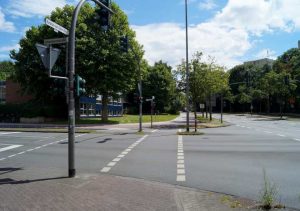
The present Task of the Week leads to Münster and contains a question from the probability calculation.


Task: Red or Green? (Task number: 428)

The city of Münster is trying everything to make road traffic as smooth as possible. There is even a traffic light hotline, where you can make suggestions for improvement. Despite all the good planning, walkers often come to red traffic lights. Often, the red traffic lights are noticed more often than the green traffic lights. Estimate how often a traffic light shows “green” if one passes the traffic light 100 times.


In order to solve the problem, students should first measure the duration of a green phase, as well as the duration of a red phase. The duration of a total phase then results over the length of a green phase and a red phase. In order to determine the probability of reaching the traffic light at green, the duration of the green phase is divided by the duration of a complete traffic light. Subsequently, the expectation value can be formed with a 100-time passing.

This approach leads to a theoretical solution which, however, should be questioned critically. The result as well as the randomness of the arrival can be influenced depending on the traffic light circuit and any traffic lights which have been traversed previously. However, the problem is a successful application of the probability calculation in everyday life and can be used with the first elaborations of the probability concept.

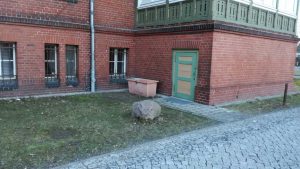
This week’s Task of the Week addresses, in particular, the modeling competence of the students. It is a question of approximating the weight of a stone as closely as possible by approximating the stone through a known body.


Task: Stone (task number: 1048)

What is the weight of the stone? 1cm³ weighs 2.8g. Give the result in kg.


In order to approach the object by means of a geometrical basic body, the students must refrain from slight deviations of the real object and the ideal body. In particular, a prism with a trapezoidal base side is suitable. If this step is done, the students determine the pages relevant to this body through measurements and then calculate its volume. The last step is the calculation of the weight with the given density as well as the conversion in kilograms.

With this task, it is especially nice to see that there is not always one correct result for mathematical questions. Through different approaches and measurements the pupils receive different results. In order to obtain the most accurate result as possible, the determined values ​​must be within a defined interval. Translating from reality into the “mathematical world” also plays a decisive role here in the sense of modeling competence.

The task requires knowledge about the basic geometrical bodies and in particular about the prism with a trapezoidal base surface. It is therefore to be classified in spatial geometry and can be solved from class 7.

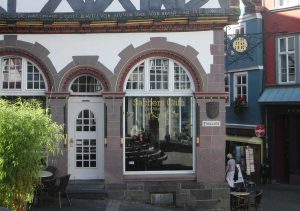
In the present Task of the Week, the Roman numerals are looked at more closely, a spelling for the natural numbers which arose in Roman antiquity. Particularly on old buildings, a marking of the year of construction in Roman numbers is usual. The task is located in Wetzlar’s inner city and can be found in the trail “Mathe in Wetzlar”. There the Roman numerals are incorporated into a slogan on a house facade.


Task: Alte Münz (task number: 545)

In the inscription on the house “Alte Münz” (Eisenmarkt 9) some letters are strikingly capitalized. Add the values ​​of the letters in the Roman numeric system.  


The students must recognize the larger Roman numbers and note how many times they occur. Subsequently, the various Roman numerals are translated into the Arabic notation and added. The Roman numerals as a spelling for the natural numbers are usually worked out in class 5 and can be used from this point onwards. Here, the rules for calculation with Roman numerals are less important than the translation of Roman and Arabic numbers.

While during the past few weeks we often presented tasks which can be solved from secondary level, the present Task of the Week shows that the MathCityMap project can already be used from primary school.


Task: Number of Windows (task number: 1191)

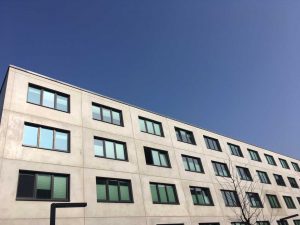
How many window panes can be seen on this front of the house?


To solve the problem, it is possible to count the window panes. However, this takes a long time so that the students at best have the idea to count only the panes in a row as well as the number of rows and solve the task by means of a multiplication. The basic representation of the multiplication is addressed as a repeated addition. Further, the students must be aware that the number of window panes and not the windows is asked. For a window, therefore, three panes must be submitted if the students firstly count the number of windows.

The task can be classified in the areas of multiplication and number and can be solved from class 4.

The present task of the week is about a geometric question. It involves the area calculation of the roof surface of the illustrated pavilion.


Task: Pavilion (task number: 665)

Determine the roof surface of the pavilion! Give the result in m².


For this purpose, the pupils should recognize that the roof surface consists of several isosceles triangles. It is therefore sufficient to measure the height and base of one triangle and to calculate the surface content using the formula for the area content of triangles. The total area can then be determined by multiplication by the number of triangles.

In order to solve the problem, the pupils must therefore be familiar with the area calculation for triangles. In the task, the “geometrical view” is trained by the triangular shape being recognized in a composite figure. Here, an essential aspect of outdoor mathematics is found, namely the recognition of mathematical concepts and objects in reality, as well as the use of mathematical knowledge to solve everyday questions. Solving the task is possible from class 6 onwards with the topic triangles.

The focus of today’s Task of the Week is a combinatorial question. In addition to the typical combinatorical question for the number of possibilities, an application of the Fibonacci numbers, which can be discovered by the students, is included as well.


Task: Combine Staircase (task number: 1199)

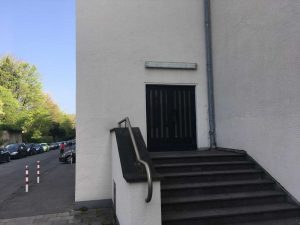
How many options are available to climb the stairs by climbing one or two steps per step? The steps can also be combined.


There are various possibilities for solving the problem. On the one hand, it is possible to systematically record different combinations of 1 and 2 steps. In doing so, the students can use the stairs directly and conclude which combinations are possible. In another consideration, the fact that the last step comprises either one step or two steps is used. Leaving this last step, the number of possibilities for a staircase with n steps can be determined using the possibilities for n-1 and n-2 steps. This reasoning leads to the Fibonacci numbers, a recursive sequence in which a number results from the addition of its two predecessors.

The task is therefore a successful example of “hidden” mathematics in simple everyday objects. It offers the possibility to go deeper into the topic Fibonacci numbers or to let the students discover them. At the same time, the problem can also be solved by systematic testing, so that it can be used from class 6. Its topic belongs to combinatorics.