Determine quantities and numbers – an issue that is already relevant at primary level. For getting started in determining numbers, one should use regularly arranged objects like windows on a (high-rise) building, paving stones on a sideway or stones at a wall.     

Determine the number of windows on the house

When determining windows on houses, in many cases you can count the number of windows per row and the number of rows and get the result by multiplication. It is important to make clear whether you ask for windows or window panes, and whether all the windows of the building are relevant or, for example, only windows on the southern front.     

Determine number of bricks

For walls and rectangular pavings there are several possibilities:    

1. One determines the number n of the stones per 1m² and projects that to the total area A.     

2. The length and height of the wall are determined in “stone units” and one counts the number of stones in length l and in width b.     

Circular arranged stones with a gap

The level of difficulty increases when deviating from rectangular areas and e.g. asking for circular arranged stones. In addition, it can be difficult to determine the number of objects in which the regularity is interrupted in some places and one is forced to choose special solution methods.

You will find a detailed overview of our generic tasks on Determining quantities in the deposited PDF document.

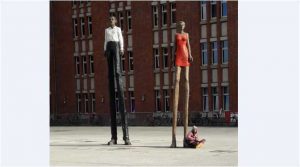
This week we would like to present the task “On a big Foot”. It is located close to the main railway station in Hamburg and is part of the trail “In and around St. Georg”.


Task: On large feet (task number: 647)

These figures are created by the contemporary German sculptor Stephan Balkenhol. I would like to know from you: What shoe size does the man have? For shoe sizes, there are four common systems worldwide. In Germany, European shoe sizes are the usual measure. They are based on the so-called “Parisian Stitch”. The stitch is a length measure with which a shoemaker specifies the length of a stitch and thus also the shoe size of the complete shoe. A French stitch or Parisian stitch is ⅔ centimeters long. The shoe last is a piece of wood, plastic or metal which is modeled on the shape of a foot and used to build a shoe. Since the feet should have some space, the length of the shoe last corresponds approximately to the foot length + 15 mm.


For the task, the pupils first measure the length of the man’s shoe and calculate the length in “stitches” so that the European shoe size can be specified. A major component of the task is the measurement and conversion of quantities. In doing so, the unity of the stitch, which should be unknown to most students, is used. It can be used from class 6 onwards. In addition, the first proportional basic ideas can be formulated for the conversion and could be a suitable transition to the proportionality and the rule of three.

The task was created by Dunja Rohenroth. She has already been able to test this task with her students and sees in this task the special advantage that the result cannot be solved by means of an internet search. The aspects of the presence and activity of the pupils are thus particularly emphasized.