Fountains and their volume are ideal for modeling different geometric bodies. While many of the fountains have a rectangular or circular shape and can thus be approximated as cuboid or cylinder, in the current “Task of the Week” we present an octagonal fountain whose volume can be described by a prism with an octagonal area.


Task: Water in the Fountain (Task Number: 4295)

What is the approximate volume of water in this fountain? Assume that the average depth of the water is about 30 cm. Give the result in liters.
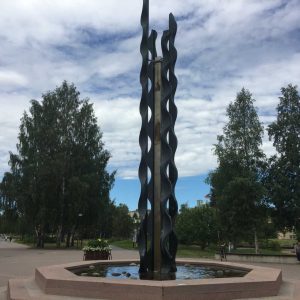

Even if the formula for an octagon is not known, the task can be solved by dividing the area or completing the area. For example, one can determine the area of the square enclosing the octagon. Then, for each corner which is calculated too much in the square, the area of a triangle must be substracted. The height is then used to calculate the volume.

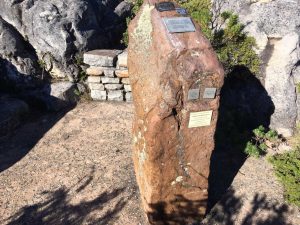
As a few weeks ago, the Task of the Week leads us to the African continent, more precisely to the approximately 1000-meter-high Tafelberg in Cape Town. There you can find a monument of stone, which is also an ideal object for a MCM task.


Task: Tafelberg’s Monument (task number: 1791)

Calculate the mass of the stone monument. Give the result in kg. 1 cm³ of granite weighs 2,6 g.


First, the shape of the stone has to be considered more closely. When choosing a suitable model, a prism with a trapezoidal base can be used. For this, it is necessary to ignore minor deviations from the ideal body as well as to operate with the stone mentally. The required data are then determined and the required weight of the stone is obtained by means of the area content formula of a trapezoid, the volume formula of a prism and the given density.

The task shows that over the last few years, MCM has developed into an international platform for authentic “outdoor” mathematic tasks and has already been set up in many prominent places. We are looking forward to further tasks and are looking forward to the countries and regions in which new MCM tasks will emerge.

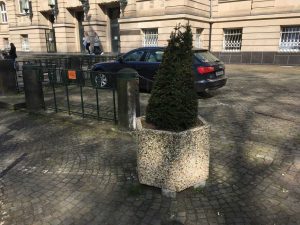
The present Task of the Week is about polygons and geometrical figures. In particular, the prism with a hexagonal base surface plays a role. The task can be found in this form in Cologne, but can be transferred to similar objects without problems.


Task: Flower Box (task number: 1189)

What is the volume of the flower box? You may assume that the floor is as thick as the edge of the box. Give the result in liters.


As already mentioned, the base area can be assumed to be a regular hexagon. To determine the area of ​​the base area, pupils can either use the formula for the area content of a regular hexagon or divide the area into suitable subspaces. They should note that the edge does not belong to the volume. The pupils then measure the height of the prism by subtracting the floor plate. Subsequently, the volume of the prism, which is converted into liters in the last step, is obtained by multiplication.

The task thus involves a geometric question, in which students can either apply their knowledge to regular polygons or to composite surfaces. In addition, spatial figures are discussed as well as the adaptation to real conditions by observing the edge. The task is recommended from grade 8 onwards.

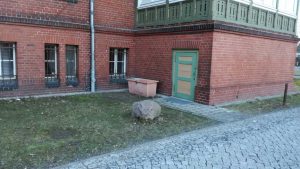
This week’s Task of the Week addresses, in particular, the modeling competence of the students. It is a question of approximating the weight of a stone as closely as possible by approximating the stone through a known body.


Task: Stone (task number: 1048)

What is the weight of the stone? 1cm³ weighs 2.8g. Give the result in kg.


In order to approach the object by means of a geometrical basic body, the students must refrain from slight deviations of the real object and the ideal body. In particular, a prism with a trapezoidal base side is suitable. If this step is done, the students determine the pages relevant to this body through measurements and then calculate its volume. The last step is the calculation of the weight with the given density as well as the conversion in kilograms.

With this task, it is especially nice to see that there is not always one correct result for mathematical questions. Through different approaches and measurements the pupils receive different results. In order to obtain the most accurate result as possible, the determined values ​​must be within a defined interval. Translating from reality into the “mathematical world” also plays a decisive role here in the sense of modeling competence.

The task requires knowledge about the basic geometrical bodies and in particular about the prism with a trapezoidal base surface. It is therefore to be classified in spatial geometry and can be solved from class 7.