Our new Task of the Week is located in the United States. On the campus of the University of California Santa Cruz the PhD student for mathematics education Julianne Foxworthy created the task “So many stairs!”. She gave us an interview about this task and her usage of MathCityMap.

How did you get in contact with MathCityMap? How do you use MCM?

I discovered the app when I met Iwan Gurjanow [MCM team of the Goethe University Frankfurt] at PME in Sweden last year. I used to teach math to 10-13 year-olds, and I used math trails with them (low-tech version!) and they loved them.

I created the “MBAMP Math Trail“ that this task is a part of for a professional development program for teachers of young students (6-9 year-olds). The teachers were all very interested in using math trails with their students. In the future, I’m planning on creating a series of math trails for various ages at our town’s famous beach boardwalk, so look out for that one!

Please describe your task. How could it be solved?

“So many stairs!” is a very simple task aimed at very young children. The question is, how many steps will you climb altogether, if you and two friends decide to race up the stairs all the way to the door of the library.

The problem solver needs to count all the stairs leading to the library and then, and this will be the tricky part for the youngsters, determine how many stairs will be walked by themselves and their friends.

The teachers who tried the task gave me very helpful feedback about being very clear with my language. The word “step” could be a stair (that’s what I intended) or it could mean a step taken by a person. The second meaning could result in a different answer (e.g., what if a person took the stairs two at a time?).

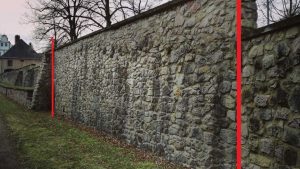
Today’s Task of the Week is an example of a task that you can create with minimal effort using the Task Wizard. It is about determining the number of stones in a given rectangular area. The object here is a wall, but similar objects can also be pavements.


Task: The Wall (task number: 1077)

Determine the number of stones of the wall front in the marked area.


In order to solve the problem, the students can proceed in various ways. On the one hand, it is possible to determine the number of stones in one square meter and to measure the length and height of the rectangular wall. In this solution, the accuracy can be increased by counting several square meters and then taking the mean value. On the other hand, the students can count the stones in terms of length and height and approximate the total number by means of a multiplication.

When you create such a task with the Task Wizard, you only have to enter the length and height and the number of stones in a square meter as well as add a photo and the location. The Task Wizard then automatically creates notes and a sample solution.

The task requires knowledge about the rectangle. It can be classified in the field of geometry and can be used from class 6 onwards.

While during the past few weeks we often presented tasks which can be solved from secondary level, the present Task of the Week shows that the MathCityMap project can already be used from primary school.


Task: Number of Windows (task number: 1191)

How many window panes can be seen on this front of the house?


To solve the problem, it is possible to count the window panes. However, this takes a long time so that the students at best have the idea to count only the panes in a row as well as the number of rows and solve the task by means of a multiplication. The basic representation of the multiplication is addressed as a repeated addition. Further, the students must be aware that the number of window panes and not the windows is asked. For a window, therefore, three panes must be submitted if the students firstly count the number of windows.

The task can be classified in the areas of multiplication and number and can be solved from class 4.