This week our presented task is located in Ireland. At the campus of the Dublin City University (DCU) our MoMaTrE partner Christian Mercat created the task “The weight of DCU” and gave us an interview about this task and the value of using the MathCityMap app.

What´s the topic of the task?

On the campus you can find a huge DCU solid rock sign. I really wondered how much that could weight! So I investigated and figured out that one could estimate the surface of the letters and the depth of the sculpture.

How could you solve this problem?

You have to estimate the average width of the letters and their lengths. For example, C is a 2/3 portion of a circle of diameter 2 m and average with 30 cm. So is has a surface of 1.2 m². The modelling of D and U happens equally. Totally the sculpture has a surface of 4.5 m². The depth of the stone is 50 cm, which leads to a total volume of 2.25 m³. The density of the stone being 2.4 (that’s given in the first hint), the total weight of the sculpture is around 5400 kg. The estimation of the surface being tricky, I actually checked again by taking a picture from a distance and estimating numerically the total surface with the help of my computer. 
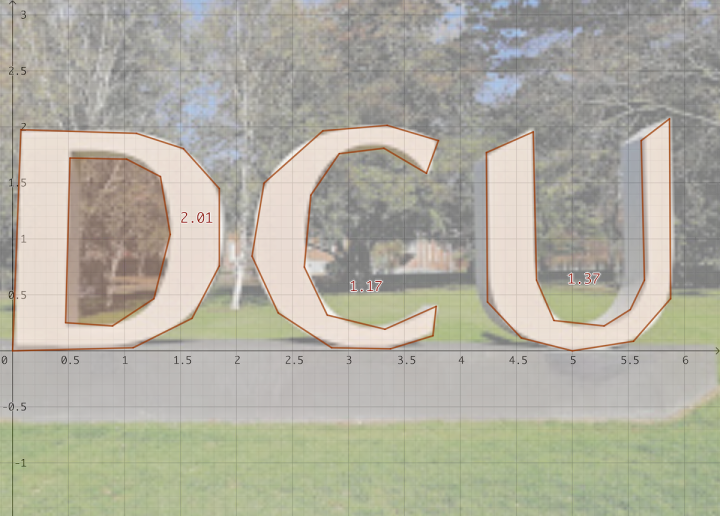
Estimation of the sculptures` surface.

What´s the didactic aim of the task?

Clearly, I want here to get first the students to have a rough estimation of the degree of magnitude, is it around hundreds of kg, a few tons or tens of tons. I give a broad « orange » zone between 3000 and 7500 kg for those trying to figure out by simply bracing their arms around the sculpture to get a sense of the volume, which I find fair enough for an answer. But then, trying to model each letter as simpler geometric shapes is really the main focus of this task. It can not be done exactly, the average width of each letter is a matter of debate, which is good. The « green » zone might be a little bit too tight (between 5000 and 6000) which is only a 20% width around the expert estimation, but the depth is without any doubt 1/2 meter so the uncertainty really is on the surface estimation.

Why do you use MathCityMap?

I love taking the pretext of a MathCityMap trail in order to stroll around on a campus or in a park, appreciating the scenery from this very specific perspective of looking around for objects that tickle my mathematical inclination, keeping open the scientific eye in me.

Today´s task of the week is located in Lüneburg, Germany, where the teacher trainee Jennifer Oppermann created the task “The green ear”. She gave us an interview about this task, mathematic modelling and the MathCityMap project.

What´s the topic of the task?

The question is, how tall the human being would be, the green ear belongs to. To solve the task students first have to measure the sculpture of the green ear, followed by measuring an ear of a student. In addition, the body size of this students should be identified.

Afterwards the quotient of the length of the green ear and the students´ ear is multiplicated with the body height of the student. Thereby the size of the human being, to whom the green ear would belong, can be estimated.

What´s the didactic aim of the task?

While working on the task, students should improve their competences in mathematic modelling. Modelling means to link the reality and the mathematic and to solve a given problem through a mathematic calculation. Thus, MathCityMap is a helpful tool to observe the connection between environment and mathematics and to exert mathematical strategies.

How do you use MathCityMap?

To discover our near environment out of a mathematical perspective, we created a math trail through the Hanseatic town of Lüneburg. The MathCityMap project enables mathematic interested people to solve our tasks around Lüneburg and to increase their mathematical competences.

The current “Task of the Week” from the trail “La Doua” in Lyon, France, shows that the MathCityMap project is already implemented internationally. Originally, the task is in French and will be translated for the Analysis.


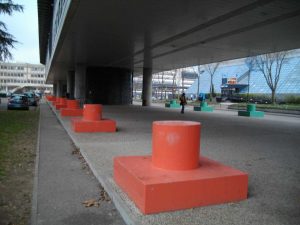
Task: Weight of the Quai 43 (Task Number: 855)

The building “Quai 43” has the shape of an ocean liner, which is built on ten concrete columns. Determine the weight of the building in tons (reinforced concrete weights 2.5t/m³).


To approximate the weight, it is necessary to calculate the volumes of the individual walls and floor slabs. To do so, the length and width of the building are determined through measuring. Afterwards, the area and the perimeter of the building (idealized as a rectangle) can be calculated. The building includes two floors and therefore the area can be counted three times. To determine the volume of the walls and floor slabs, it is further necessary to determine the height of the building and the thickness of a wall/floor slab. Afterwards, the students can calculate the different volumes through the formula of a cuboid. With help of a multiplication with the density, the approximate weight of the building can be found.

This task is a geometric and architectural problem which includes measuring of lengths as well as determining of field volumes. Especially modelling is in the center as the form of the building is approximated to a cuboid. Afterwards, the students have to consider which walls and floor slabs are relevant for the building’s weight. The task can be used from grade 7, especially in the context of cuboids and compound fields.

This task is only one of many examples which show that the MathCityMap project is an international project which stands out due to its universal use at several locations.

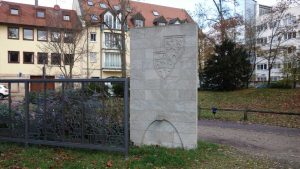
This time, the “Task of the Week” is part of the trail “Rund um den Erlangener Schlosspark”. It is called “Monument Erlangen /Brüx” with task number 704. Thematically, the task can be integrated into the topic parables and is therefore suitable from grade 9.


Task: Monument Erlangen/Brüx

Examine whether the “curve” in the lower quarter of the stone monument is a parable y= -ax². If not, enter a=0 as solution, otherwise enter the calculated value of a.


The task was written by Jürgen Hampp. In the following interview, he gives an insight into the idea behind the task and the aim of the task. At this point, we would like to take the opportunity to thank Mr. Hampp for his answers.

What made you consider including this task into the trail?

My concern was to develop a trail which is on the one hand easy to access in walking distance from our school, the Christian-Ernst-Gymnasium in Erlangen, and on the other hand leads through mostly car-free areas. Of course, the possible objects are limited. Under this perspective, the monument Erlangen/Brüx has an optimal position, the measuring is riskless – one does not have to climb etc. – and only simple resources are needed.

Where do you see the characteristic of the task? Which skills and ideas are especially supported?

I want to train the “mathematical view”, e.g. the recognition of mathematical objects in everyday life, and the activity with these objects with help of the methods which are known from class. This object mainly supports the competence branch K3 “Mathematical modelling”. Here, quadratic functions (topic in grade 9) present themselves. I did not want to use the common tasks with water fountains as they might be out of use, the water pressure may vary and the measuring is difficult. For me, the special attraction of this task is that a plain solution – as for usual schoolbook exercises – does not exist. Inaccurate measuring at the object or discrepancies at the object require skillful forming of averages and approximated values.