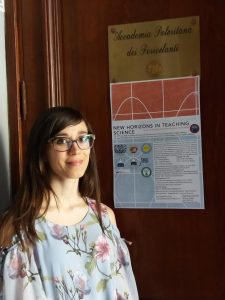
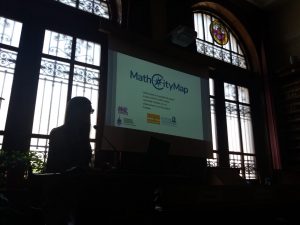
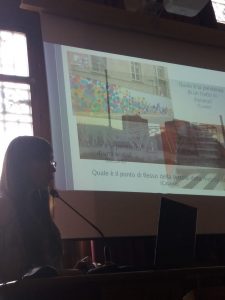
Today’s Task of the Week will be presented in an interview with Virginia Alberti, who uses and supports MathCityMap in Italy. We say thank you for the interview and the numerous Italian tasks!
Task: Capacità per la fontana della Minerva – Capacity of the Minerva fountain (Task number: 2452)
How many liters fit into the Minerva fountain?
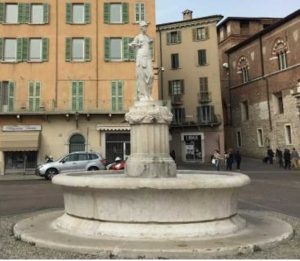
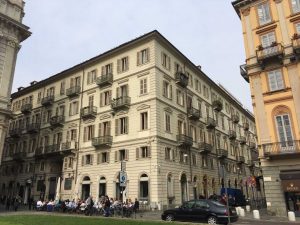
This task concerns the calculation of the capacity of a fountain tub placed in a square of my city center. To answer the question of the activity, the students have to model the fountain basin and calculate the volume.
At a first sight, the calculation could be trivial, but in reality, it requires observation, analysis and skill in the choice of the model to be applied with certain conditions and approximations related to:
- the particularity of the shape of the tub (2 cone trunks),
- the presence of a base in the center that supports the statue,
- the choices on measurement methods not taken for granted.
I have thought, designed, and created this task to propose it in a collaborative learning mode for a small group, and I identified myself with the actions that my students could use their knowledge to estimate the capacity.
I found it intriguing that in the group the students could:
- talk about math for creating the model,
- activate and compare the skills for solving a real problem,
- choose a shared solution strategy with different measurement opportunities,
- make conjectures and then have different ways to verify them without finding ideas in the network.
I think MathCityMap is a tool that allows:
- supporting the pursuit of mathematical and digital skills as well,
- facilitating a conscious and educational use of mobile devices and recovering some skills and practices of use that millenials mature in informal learning,
- supporting what is defined as laboratory teaching,
- facilitating an active role of the student by stimulating creativity in the approach to the resolution strategy with respect to the questions of the task,
- opening up the possibility of other methods of teaching approach such as the flipped lesson or PBL.
Furthermore, I think MathCityMap for teachers is:
- a challenge to innovation towards an educational proposal that facilitates the social and collaborative learning of mathematics;
- a reactivation of a new project towards those that are the learning requests of the 21st century (I am thinking of the STEM field);
- an activation to a role of less transmissive teacher, but more as tutor, from facilitator, …