At the beginning of the month, Iwan Gurjanow presented the MathCityMap project in Sweden at the PME conference. Of course, around the location, different tasks were created as our current Task of the Week.


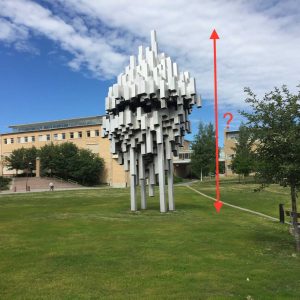
Task: Height of the Statue (Task Number: 4303)

How high is this statue? Give the result in meters.


The task can be solved via different approaches. On the one hand, it is possible to estimate how often a person with a known height fits into the heigth of the statue.

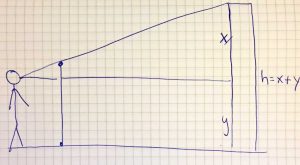
A more elaborated approach is the application of the intercept theorem, which is shown in the hint picutre. One can use the folding ruler as object of reference.


Created during a teacher training in Erfurt, today’s Task of the Week fokuses on the topic Archway. The topic allows different questions and problems. Some weeks ago, we already presented an archway task on the weight of an archway’s stones. Today, the maximal height of an archway is focused.


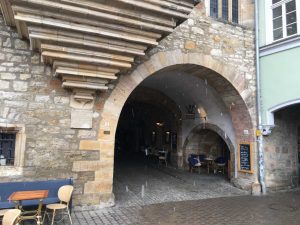
Task: Archway (Task Number: 3090)

Determine the maximal height of the archway at the Krämerbrücke. Give the result in meters with two decimals.


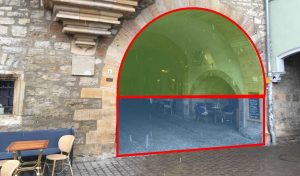
The most elegant solution of this task is to divide the archway into a rectangle and a semi-circle.

With this hint, it is necessary to determine the point at which the semi-circle begins and the rectangle ends. With the height of the rectangle and the radius of the semi-circle (best determined through the diameter), the height of the archway results. In case the topic circle should be highlighted even more, it is possible to ask for the circumference of the archway. Here, the relation of diameter and circumference is further focused.

After we opened the first MATHE.ENTDECKER (math explorer) trails at Stuttgart’s stock exchange at the 12th of April (read more here), we want to present you one of the included tasks. The object is the sculpture “Thinker”, a  prominent symbol of Stuttgart.


Task: Sculpture “Thinker” (Task number: 2018)

Determine the height of a person with this head size. Give the result in meters.


An interesting question with forces the creativity of the students as the propotion of head size and body size might be unclear. The students can determine this proportion at their own bodies, at best with all group members and the mean. Afterwards, the head size of the sculpture is measured and related to former values. A previous estimation in comparison to the real height might be surprising.

Today we would like to introduce you to our generic tasks concerning the height of buildings. This topic offers the opportunity to do math for different grades.

The height of buildings can already be determined with grade 5 students if regularities and patterns are identified: https://mathcitymap.eu/en/portal-en/?show=task&id=2045

These may e.g. be bricks, glass panes or plates, of which one or more can be measured to determine the total height by means of the total number.

Such a question thus trains the mathematical view on regularities and patterns in the environment.

The difficulty of the task increases as soon as the building has no regularities. The height can then be determined with the help of the intercept theorems.

https://mathcitymap.eu/en/portal-en/?show=task&id=3171

There are various possible solutions for this, for example using the sun’s position in suitable weather conditions, using smaller objects (such as lanterns) or using the folding rule. In this case, it is particularly helpful to make a preliminary sketch of the situation in order to facilitate the application of the intercept theorems.

Important in both cases is a marking in the task or image, which makes it clear to what point the height should be determined, for example, if you want to ignore a front building.

The document Height of Buildings contains our detailed description of both types of tasks.

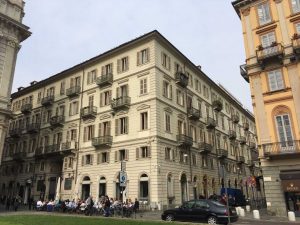
Through cooperation with the MOOC Working Group of the University of Turin, we are looking forward to the first MCM tasks in Italy, which is part of today’s Task of the Week.


Task: Height of the Building (task number: 2045)

Determine the height of the building. Give the result in meters.


The height can be approximated in various ways, e.g. by estimation or the intercept theorems. The task can be solved elegantly by looking for structures and patterns in the building facade. In this building, the horizontal strips, which can be found up to the roof, are noticed directly. For the total height, it is therefore only necessary to determine the height of a horizontal strip, as well as to count the number of strips. Minor deviations from the pattern can be approximated using estimates.

With this method, the task can already be solved by class 6 students. In the case of older pupils, the different solutions can be discussed and assessed with regard to simplicity and accuracy.