A special task on the subject of trigonometric functions will be presented this week within our category “Task of the Week”.


Task: Sine Gate and Cosine (Task Number: 4554)

The cemetery is accessible through a curved gate. The upper end can be approximated by a cosine function ƒ(x) = a⋅cos(b⋅x). Give the product of a and b as the result (x and y axis in cm).
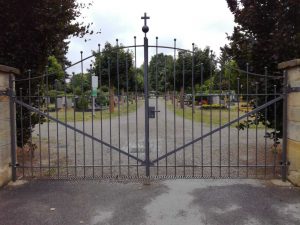

First, the gate must be tranferred to a suitable coordinate system. In order to be able to solve the problem, it must then be clarified which influcences a and b have on the function and how they can be determined. a is the amplitude and is half the difference between the maximum and minimum y-values. The gate is exactly one period long. The stretching factor is thus calculated by the width of the gate along the x-axis with b = 2π ÷ (width of the gate). In this case, the solution is validated using the product of a and b. Alternatively, it would also be possible to use multiple choice.

 Many of the tasks in the MCM portal are based on mathematical knowledge from secondary level I. Today’s Task of the Week shows that knowledge of secondary level II can be integrated in tasks as well. The task “Hubland Bridge I” is about the inflection point of a function as well as its properties.


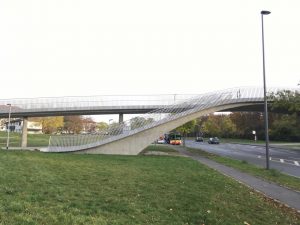
Task: Hubland Bridge I (task number 684)

At which stair (counted from below) is the inflection point?


First, the bridge must be modeled as a function. For the visual determination of the inflection point, the students use the characteristics of the inflection point. In this case, the property can help to describe the inflection point here as the point with maximum slope and without curvature. In the presence of the device, the maximum slope can also be determined using a gradiometer (see Hubland Bridge II). The point of inflection as a point without curvature can be determined optically by looking for the point at which the graph resembles a straight line. After the turning point has been determined, the students have to count the steps up to the point. Ideally, this is done several times and the mean value is formed.

The task can be assigned to the topic of analysis, more precisely the differential calculus. With the development of the characteristics of the turning point of a function, the task can be used from class 11 onwards.