On Monday, May 14th, 45 primary students, who are interested in math and take part in an enrichment program, were able to discover the Campus Westend of Goethe University. In the beginning, the weather was thundery, nevertheless the motivated students were able to go on a math trail with their parents and university students. The trail was a combination of combinatory puzzles and measuring tasks which were solved by the participants in cooperation.


Task: Connected Trees (Task Number: 3485)

How many ropes are needed to connect every tree with all the other trees?
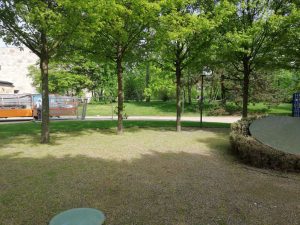

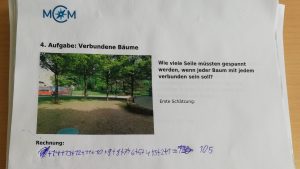
The students had a lot of fun while solving the problems. Especially while solving the tree task, they were able to build on prior knowledge from the enrichment program. Here, a similar task with shaking hands was questioned. The solution that the first of the 15 trees is connected with 14, the second with 13 and so on led quickly to the right solution.
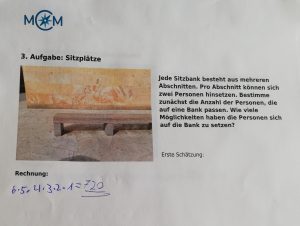
Also the questions on the number of possibilities for 6 persons to take a seat, and the number of possiblities to go upstairs a stair with single, double and triple steps could be solved by the children through calculation and testing.
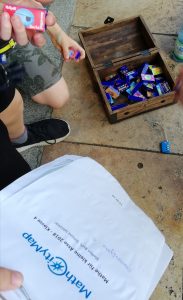
A special highlight was a task whose correct answer opened the lock to a treasure chest with small surprises in it.
In addition to a variety of geometric issues, combinatorial and stochastic problems also play an important role in MathCityMap. Today, we would like to introduce you to the most common generic tasks concerning combinatorics and probability. Two combinatorial questions that can be created quickly and easily with the Task Wizard are tasks asking for combination options of stairs and bike stands.

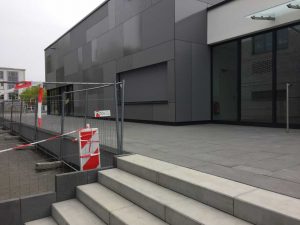
In how many ways can you climb the stairs by taking one or two steps?

There are various possibilities for solving the problem. On the one hand, it is possible to systematically record different combinations of 1 and 2 steps. In doing so, the students can use the stairs directly and conclude which combinations are possible. In another consideration, the fact that the last step comprises either one step or two steps is used. Leaving this last step, the number of possibilities for a staircase with n steps can be determined using the possibilities for n-1 and n-2 steps. This reasoning leads to the Fibonacci numbers, a recursive sequence in which a number results from the addition of its two predecessors.

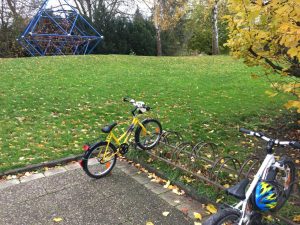
How many possibilities do you have to lock k bikes?

In this task, it is necessary to determine the number of possibilities to lock k bicycles at n spaces. For the first bike, there exist n possibilities to lock it. As this space is full afterwards, the number of possibilities to lock the second bike is n-1. Analogous, the possibilities for bike k is n-(k+1). This combinatorial problem is a situation where repetition is not allowed and order matters. With help of the possibilities’ product, one can calculate the total number of possibilities.

It is important to formulate the tasks precisely and to make clear which object or which part of the object is concerned (for example, in the case of a very long staircase, the lowest part). The activity of the task solver initially refers to the counting of the stairs or parking spaces of the bicycles. Therefore, when photographing, it should be noted that this number can not already be taken from the photo.

Further, probabilities can be realized by MCM, for example, the question for the probability of arriving at a traffic light during a green phase or to wait at a bus stop less than 5 minutes for the next bus. Both types of tasks focus on the Laplace probability (favorable events divided by all possible events).

We have compiled both emphases for you in the following document with detailed mathematical background and hints.

Icon

Combinatorics and Probability 758.34 KB 72 downloads

...

With a task from the Christmas Trail, we would like to present the last “Task of the Week” this year and draw attention to the possibility of addressing probabilities in the context of MCM.


Task: Packing Station in the Westend (task number: 779)

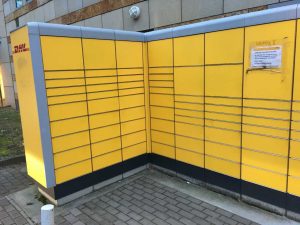
You should pick up two packages for the boss. You do not know their size. You guess behind which of the yellow boxes they could be (in each box can only be one package). What is the likelihood that the packages will really be behind the ones you picked?


First of all, it has to be clarified how many boxes there are. Then one can calculate the probability of picking the first box and the second box correctly. In this case, combinatorial considerations are necessary as to whether the order plays a role. As answer format, multiple choice was chosen for this task, whereby the correct solution can be expressed in terms of two possible answers: once as a fraction and once as an estimate with percent, which underlines the equivalence of both forms. The task is recommended from grade 9 onwards.

With this task, the MCM team says goodbye to the Christmas break and wishes all users a Merry Christmas and a Happy New Year. We are curious to see how we can further develop the MCM project in the new year and look forward to an exciting time!

The focus of today’s Task of the Week is a combinatorial question. In addition to the typical combinatorical question for the number of possibilities, an application of the Fibonacci numbers, which can be discovered by the students, is included as well.


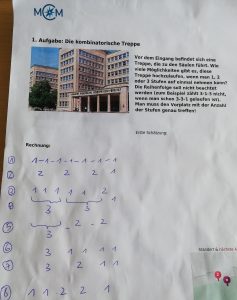
Task: Combine Staircase (task number: 1199)

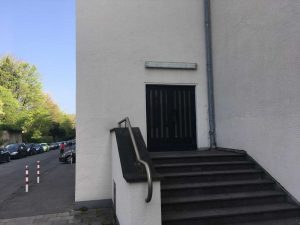
How many options are available to climb the stairs by climbing one or two steps per step? The steps can also be combined.


There are various possibilities for solving the problem. On the one hand, it is possible to systematically record different combinations of 1 and 2 steps. In doing so, the students can use the stairs directly and conclude which combinations are possible. In another consideration, the fact that the last step comprises either one step or two steps is used. Leaving this last step, the number of possibilities for a staircase with n steps can be determined using the possibilities for n-1 and n-2 steps. This reasoning leads to the Fibonacci numbers, a recursive sequence in which a number results from the addition of its two predecessors.

The task is therefore a successful example of “hidden” mathematics in simple everyday objects. It offers the possibility to go deeper into the topic Fibonacci numbers or to let the students discover them. At the same time, the problem can also be solved by systematic testing, so that it can be used from class 6. Its topic belongs to combinatorics.

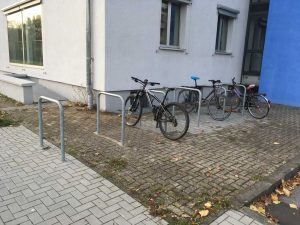
In this week, the focus of the “Task of the Week” is on a stochastic problem. The task is called “Permutation at the Bicycle Stand” and is included in the trail “Hubland Nord” located in Würzburg. The task number is 680.


Task: Permutation at the Bicycle Stand

Four bicycles should be locked at the bicycle stands. The bicycles can be locked on the left or on the right side of each stand. How many possibilities exist to lock four bicycles at the stands? You do not have to distinguish whether the bikes are locked “forwards” or “backwards”. You can assume that all stands are free.


In this task, it is necessary to determine the number of possibilities to lock four bicycles at the bicycle stands. Altogether, there are eight stands and therefore 16 possible spaces. On the picture, not all spaces can be seen in order to guarantee the criterion of the students presence (the task can only be solved at this location). For the first bike, there exist 16 possibilities to lock it. As this space is full afterwards, the number of possibilities to lock the second bike is 15. Analogous, the possibilities for bikes three and four amount 14 and 13. This combinatorial problem is a situation where repetition is not allowed and order matters. With help of the possibilities’ product, one can calculate the total number of possibilities.

This task enables a suitable embedding of a combinatorial problem into the reality. It belongs to probability calculus and can be used from grade 8 with first combinatorial considerations. Further, it can be especially used in stochastics in grade 12/13 as a repetition of basic combinatorial considerations. Moreover, the task can be transferred easily to similar situations (e.g. parking spaces).