On Monday, May 14th, 45 primary students, who are interested in math and take part in an enrichment program, were able to discover the Campus Westend of Goethe University. In the beginning, the weather was thundery, nevertheless the motivated students were able to go on a math trail with their parents and university students. The trail was a combination of combinatory puzzles and measuring tasks which were solved by the participants in cooperation.


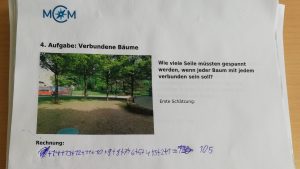
Task: Connected Trees (Task Number: 3485)

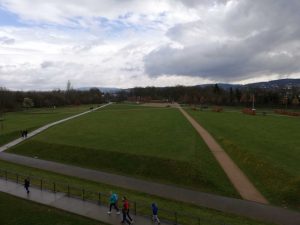
How many ropes are needed to connect every tree with all the other trees?
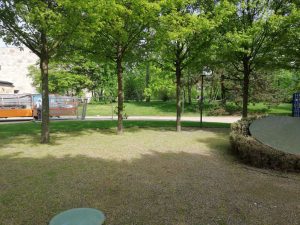

The students had a lot of fun while solving the problems. Especially while solving the tree task, they were able to build on prior knowledge from the enrichment program. Here, a similar task with shaking hands was questioned. The solution that the first of the 15 trees is connected with 14, the second with 13 and so on led quickly to the right solution.
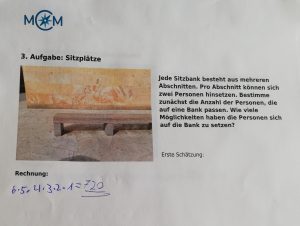
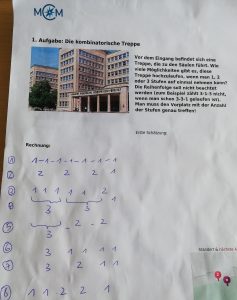
Also the questions on the number of possibilities for 6 persons to take a seat, and the number of possiblities to go upstairs a stair with single, double and triple steps could be solved by the children through calculation and testing.
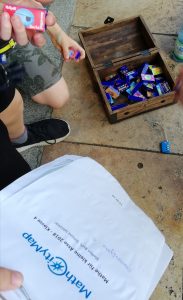
A special highlight was a task whose correct answer opened the lock to a treasure chest with small surprises in it.
Created during a teacher training in Erfurt, today’s Task of the Week fokuses on the topic Archway. The topic allows different questions and problems. Some weeks ago, we already presented an archway task on the weight of an archway’s stones. Today, the maximal height of an archway is focused.


Task: Archway (Task Number: 3090)

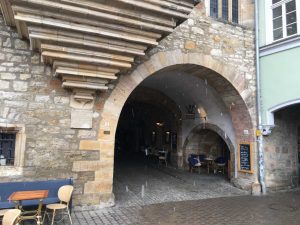
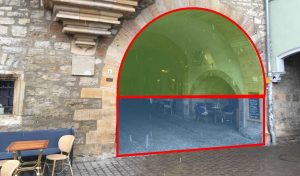
Determine the maximal height of the archway at the Krämerbrücke. Give the result in meters with two decimals.


The most elegant solution of this task is to divide the archway into a rectangle and a semi-circle.

With this hint, it is necessary to determine the point at which the semi-circle begins and the rectangle ends. With the height of the rectangle and the radius of the semi-circle (best determined through the diameter), the height of the archway results. In case the topic circle should be highlighted even more, it is possible to ask for the circumference of the archway. Here, the relation of diameter and circumference is further focused.

In a further article on our category Generic Tasks, we want to present you determinations of volume and mass. The focus will be on the bodies Cuboid and Cylinder. Further bodies will follow in future articles. We start with these forms as they occur in the environment very often and can be realised very quickly with our Task Wizard.

Objects that can be described with help of cuboids are for example concrete blocks or stones. Here, the difficulty varies according the unevennesses of the object, which can be balanced through averadged values. With benches, the difficulty can be increased as well, as they have to be described through different cuboids.

Cylinders are very suitbale to determine the volume of a tree trunk. Furthermore, many fountains are circular and therefore a good basis for calcualtions with the cylinder.


Especially with stones and tree trunks, the question of the object’s weight seems adequate through a given density. The mathematical background, as well as popular densities can be found in the following document Generic Tasks Volume 1.

Have you already tested our GPS tasks with help of the task wizard? They give you the opportunity to create interesting problems with the own position and the GPS signal of the smartphones.

The following objects can be created at the moment:

  • Line Segment AB without direction
  • Line Segment AB with direction
  • Equilateral Triangle ABC
  • Square ABCD
  • Equal distance to 2 points
  • Equal distance to 3 points
  • Linear function through 2 points

For the GPS task, an active GPS signal is needed. Further, the tasks should be created with distance to higher buildings in order to imporve the exactness. For creating, a big place or lawn is needed which allwos to walk a longer line or the asked object completely, e.g. in the example Walk a Line with Direction.

This task allows different solutions as the problem solver can choose starting and ending point. Solely the direction (north-south) and length (50m) are given. In contrast, the tasks on equal distance and linear function define points or a coordinate system which are presented by the smartphone.

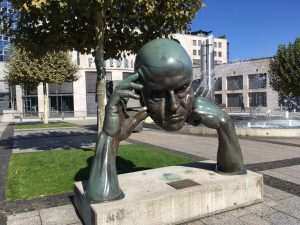
After we opened the first MATHE.ENTDECKER (math explorer) trails at Stuttgart’s stock exchange at the 12th of April (read more here), we want to present you one of the included tasks. The object is the sculpture “Thinker”, a  prominent symbol of Stuttgart.


Task: Sculpture “Thinker” (Task number: 2018)

Determine the height of a person with this head size. Give the result in meters.


An interesting question with forces the creativity of the students as the propotion of head size and body size might be unclear. The students can determine this proportion at their own bodies, at best with all group members and the mean. Afterwards, the head size of the sculpture is measured and related to former values. A previous estimation in comparison to the real height might be surprising.

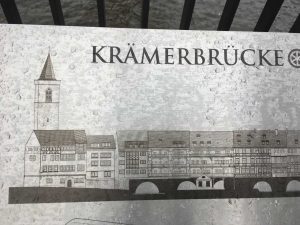
We all know them: city and site maps, illustrations and drawings that depict a real object to scale. Especially at sights, they offer the chance to calculate this scale, as in our Task of the Week at the Krämerbrücke in Erfurt.


Task: Scale of the Krämerbrücke (Task number: 3108)

Determine the scale 1: x in which the Krämerbrücke is drawn (engraved) on this steel plate. Give the number x.


First, it has to be clarified how the scale is defined: One unit of length corresponds to x units of length in reality. In this example, the real length of the Krämerbrücke is indicated on the plate, so it is only necessary to measure their length on the plate and to compare the two values. Of course, the task can also be formulated on objects where the actual size or length has to be measured.

By the way: Do you already know the new metadata function “About this object”? This allows you to enter interesting sidefacts about sights and objects, so that cultural-historical references can be realized.

Today we would like to introduce you to our generic tasks concerning the height of buildings. This topic offers the opportunity to do math for different grades.

The height of buildings can already be determined with grade 5 students if regularities and patterns are identified: https://mathcitymap.eu/en/portal-en/?show=task&id=2045

These may e.g. be bricks, glass panes or plates, of which one or more can be measured to determine the total height by means of the total number.

Such a question thus trains the mathematical view on regularities and patterns in the environment.

The difficulty of the task increases as soon as the building has no regularities. The height can then be determined with the help of the intercept theorems.

https://mathcitymap.eu/en/portal-en/?show=task&id=3171

There are various possible solutions for this, for example using the sun’s position in suitable weather conditions, using smaller objects (such as lanterns) or using the folding rule. In this case, it is particularly helpful to make a preliminary sketch of the situation in order to facilitate the application of the intercept theorems.

Important in both cases is a marking in the task or image, which makes it clear to what point the height should be determined, for example, if you want to ignore a front building.

The document Height of Buildings contains our detailed description of both types of tasks.

Today’s Task of the Week will be presented in an interview with Virginia Alberti, who uses and supports MathCityMap in Italy. We say thank you for the interview and the numerous Italian tasks!


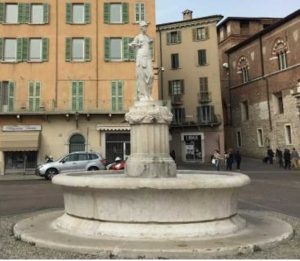
Task: Capacità per la fontana della Minerva – Capacity of the Minerva fountain (Task number: 2452)

How many liters fit into the Minerva fountain?


This task concerns the calculation of the capacity of a fountain tub placed in a square of my city center. To answer the question of the activity, the students have to model the fountain basin and calculate the volume.

At a first sight, the calculation could be trivial, but in reality, it requires observation, analysis and skill in the choice of the model to be applied with certain conditions and approximations related to:

  • the particularity of the shape of the tub (2 cone trunks),
  • the presence of a base in the center that supports the statue,
  • the choices on measurement methods not taken for granted.

I have thought, designed, and created this task to propose it in a collaborative learning mode for a small group, and I identified myself with the actions that my students could use their knowledge to estimate the capacity.

I found it intriguing that in the group the students could:

  • talk about math for creating the model,
  • activate and compare the skills for solving a real problem,
  • choose a shared solution strategy with different measurement opportunities,
  • make conjectures and then have different ways to verify them without finding ideas in the network.

I think MathCityMap is a tool that allows:

  • supporting the pursuit of mathematical and digital skills as well,
  • facilitating a conscious and educational use of mobile devices and recovering some skills and practices of use that millenials mature in informal learning,
  • supporting what is defined as laboratory teaching,
  • facilitating an active role of the student by stimulating creativity in the approach to the resolution strategy with respect to the questions of the task,
  • opening up the possibility of other methods of teaching approach such as the flipped lesson or PBL.

Furthermore, I think MathCityMap for teachers is:

  • a challenge to innovation towards an educational proposal that facilitates the social and collaborative learning of mathematics;
  • a reactivation of a new project towards those that are the learning requests of the 21st century (I am thinking of the STEM field);
  • an activation to a role of less transmissive teacher, but more as tutor, from facilitator, …


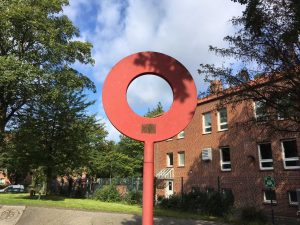
Today’s Task of the Week focuses on the circular ring. The idea behind is to determine the desired surface area by the difference of two surfaces, which can be calculated easily.


Task: Ciruclar Ring (Task number: 1943)

Calculate the area of ​​the circular ring. Give the result in cm².


The area of the circular ring can be calculated by determining the radius of the entire circle, as well as the radius of the small “missing” circle. In this case, the easiest way is to measure the diameters of both circles. Then one calculates the wanted area either with the formula of the area of the circular ring, or one calculates the area of ​​the entire circle and deducts the small circular gap. In both cases, the wanted area results.

A similar task can be created by means of traffic signs, e.g. the passage prohibited sign and the question of the proportion of red color. In both cases, the circle plays a thematic main role, so that the topic can be used from class 9 onwards.

Determine quantities and numbers – an issue that is already relevant at primary level. For getting started in determining numbers, one should use regularly arranged objects like windows on a (high-rise) building, paving stones on a sideway or stones at a wall.     

Determine the number of windows on the house

When determining windows on houses, in many cases you can count the number of windows per row and the number of rows and get the result by multiplication. It is important to make clear whether you ask for windows or window panes, and whether all the windows of the building are relevant or, for example, only windows on the southern front.     

Determine number of bricks

For walls and rectangular pavings there are several possibilities:    

1. One determines the number n of the stones per 1m² and projects that to the total area A.     

2. The length and height of the wall are determined in “stone units” and one counts the number of stones in length l and in width b.     

Circular arranged stones with a gap

The level of difficulty increases when deviating from rectangular areas and e.g. asking for circular arranged stones. In addition, it can be difficult to determine the number of objects in which the regularity is interrupted in some places and one is forced to choose special solution methods.

You will find a detailed overview of our generic tasks on Determining quantities in the deposited PDF document.