In Karlsruhe, Germany, we find our new task of the week. Here the student teachers Jessica Milde and Lea Berner have created the task „Volumen der Gründer-Schmiede“ (engl.: “Volume of the Founder’s Building”), in which the volume of a building is to be modelled by using two cuboids.

How did you discover the MathCityMap project?

We, Jessica Milde and Lea Berner, are studying high school teaching (mathematics) in the 6th semester at the Karlsruhe Institute of Technology (KIT). Last winter semester we visited the didactics seminar “Digital Tools for Mathematics Teaching”, where each student of the seminar was supposed to present a digital tool in their lecture.

In our double lecture we introduced the MathCityMap App and took a closer look at the background of the website and the App. In our internship our fellow students could create their own tasks and run the trail “Digital Tools WS 19/20” (available in the app via code: 562251).

Describe your task. How can it be solved?

The task is a composite body and the SuS should determine the volume of this body by means of modelling.

What didactic goals do you pursue with the task?

You have to realize that there are two cuboids and that the terrace is not part of the volume of the building. There are small pitfalls built in because the building has rounded corners.


More Math Trails in Karlsruhe, Germany:

After launching our new web portal three weeks ago, we now celebrate our new MathCityMap App Update! In the following we present the new features:

New features:

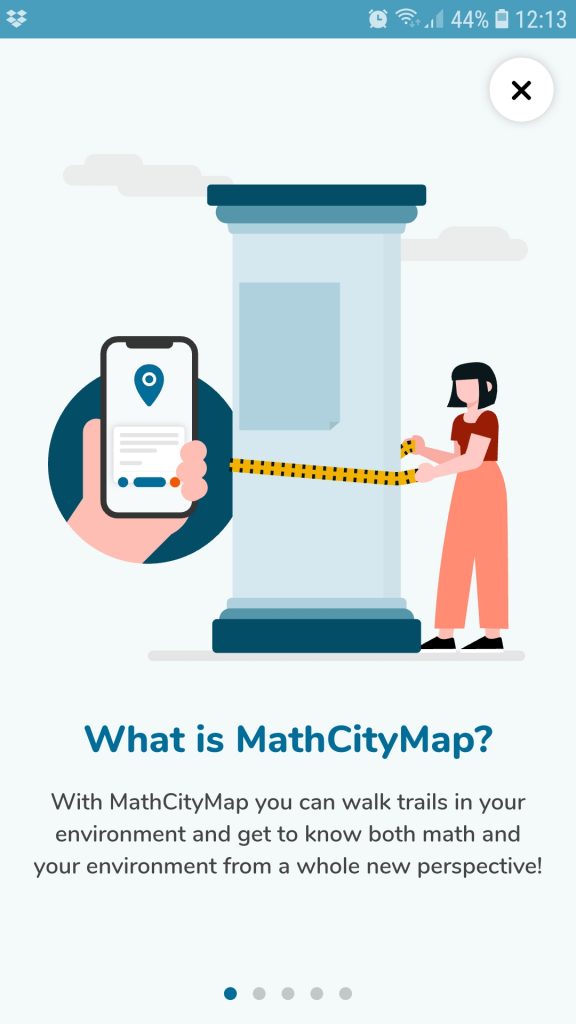
  • Our onboarding introduces the system with just a few clicks: With the help of our explanations the start into the world of MathCityMap is now even easier (photo 1).
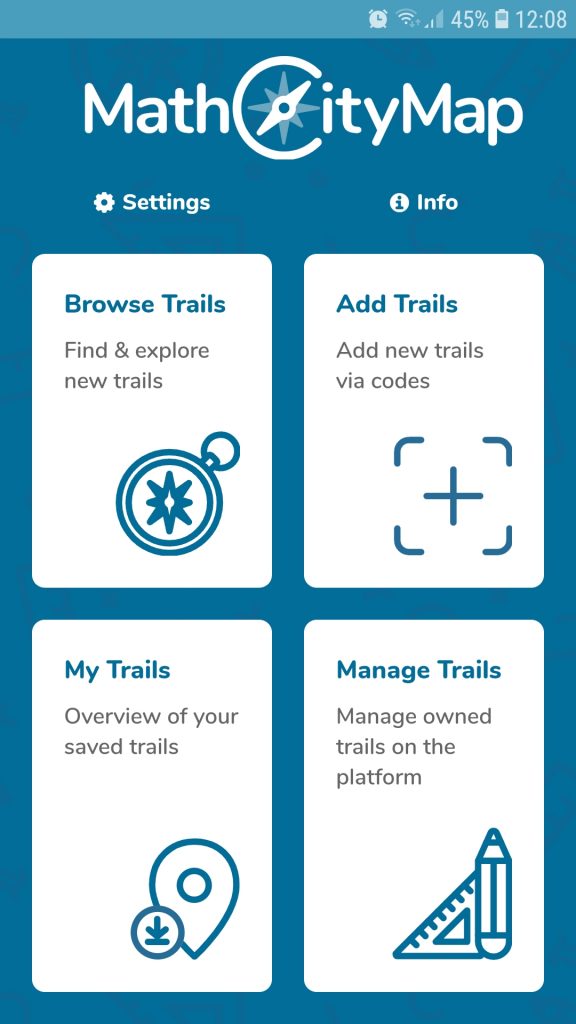
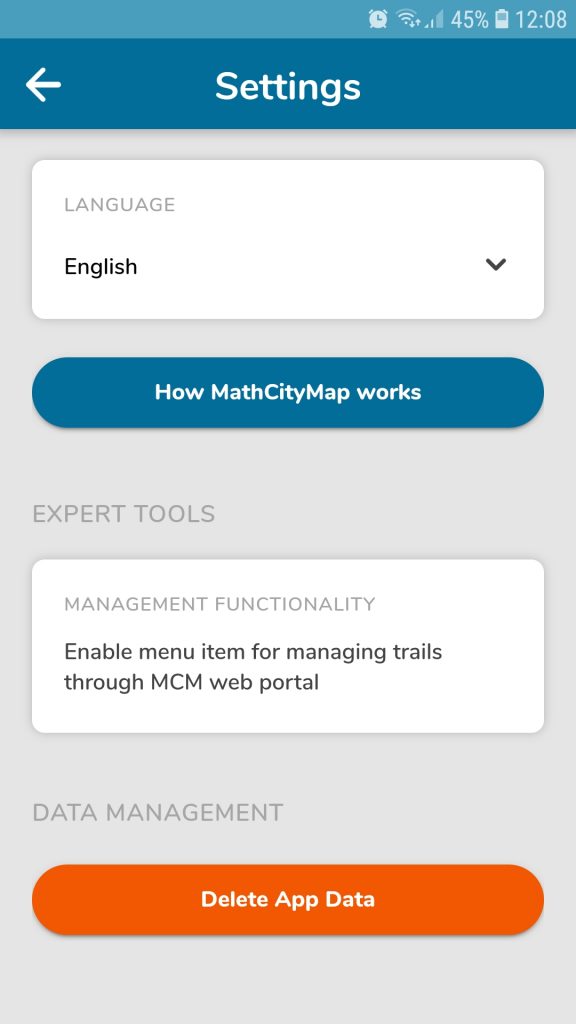
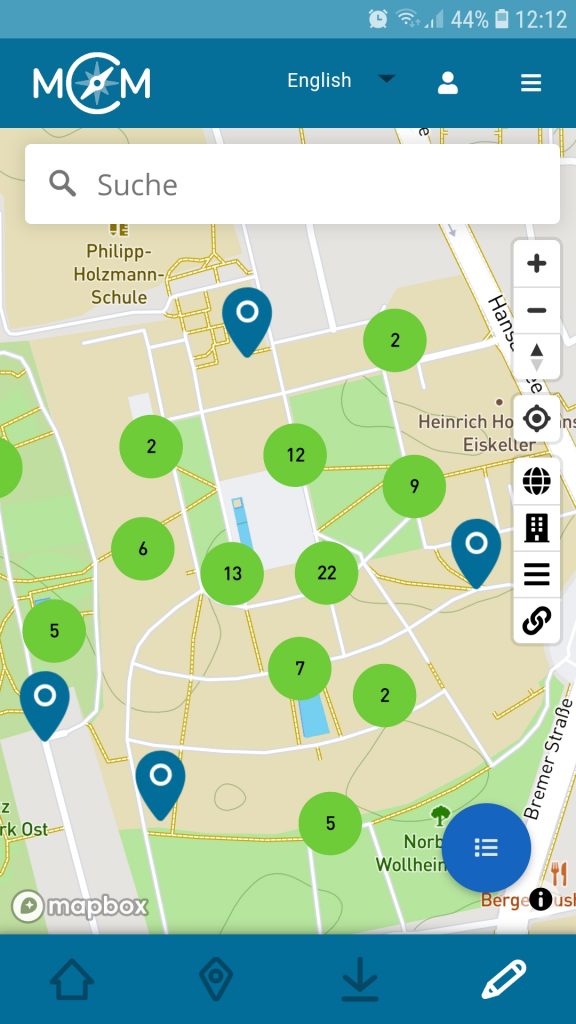
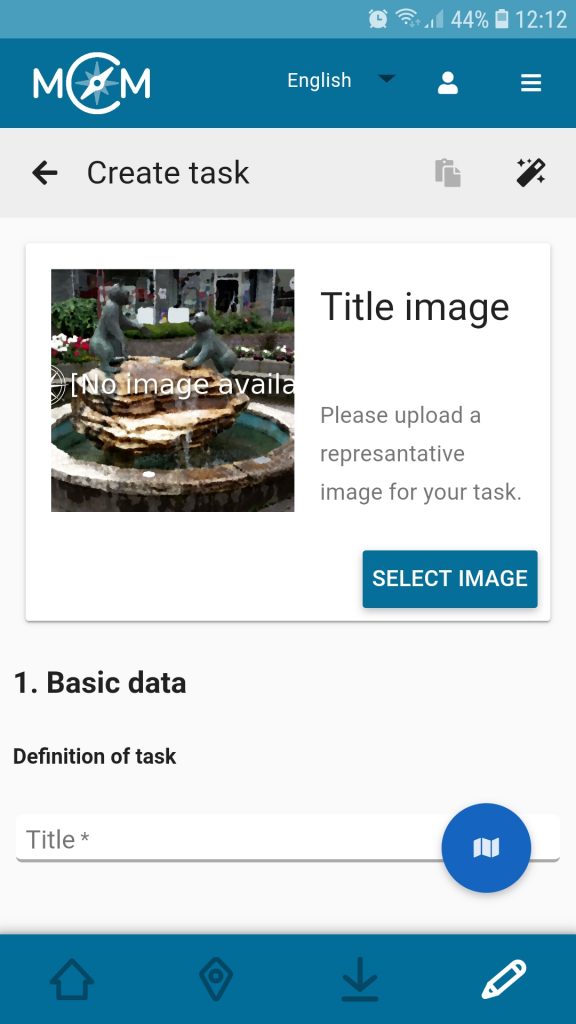
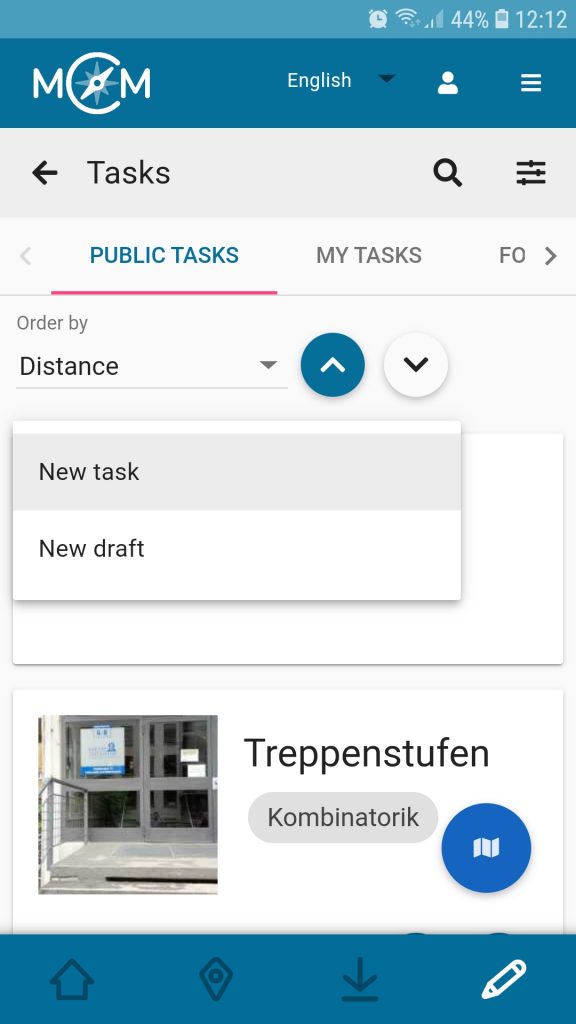
  • The author area is now available: With the MathCityMap app, registered users can create tasks while on the go via smartphone or tablet. Here it is possible to either create a complete task analogous to the web portal or to prepare a short draft which can be edited later at any time (photos 2 to 6).
  • The chat in the Digital Classroom was extended: Now it is also possible to send voice messages or pictures besides classic text messages. This allows teachers to support learners even better and more specifically via chat.

The new app version can be downloaded here for Android (Google Play Store) or here for Apple iOS. We hope you enjoy the new functions!

The MathCityMap idea:

With the MathCityMap app, students, teachers and individuals can rediscover their own environment from a mathematical perspective: Mathematical hiking trails, so-called maths trails, can be followed all over the world with the help of the MathCityMap App. After all, there are a multitude of mathematically interesting objects everywhere!

MathCityMap combines the editing of mathtrails with the possibilities of modern technologies such as GPS localization for orientation purposes, a support system through stepped hints and a feedback system. Mathtrails, once downloaded, can also be used in offline mode. The app is available in eleven different languages, including German, English, Spanish, Italian and French.

On our website you can become active yourself after a free registration and create your own tasks and mathtrails.

Webportal & App are developed by the working group MATIS 1 at the Institute for Didactics of Mathematics and Computer Science at the Goethe University Frankfurt am Main. Due to funding within the framework of the Erasmus+ projects MoMaTrE and MaSCE³ we can provide the app free of charge and free of advertising as well as conforming to data protection regulations.

Melanie Kujath, math teacher in Berlin, came into contact with MathCityMap at a Congress two years ago. Today, she presents her math trail „Schadow-Gymnasium Berlin“ (retrievable via the MathCityMap app with the code 231075).

How did you get in contact with MathCityMap? How do you use MCM?

In 2018 I participated together with a colleague in a MathCityMap workshop by Matthias Ludwig, head of the MCM team Frankfurt, at the MNU Congress in Berlin.

Thereupon we created a math trail for our students. By searching for interesting tasks, we oriented ourselves on those task types presented in the workshop. So far we worked on the trail with 10th graders to repeat and deepen their mathematical knowledge. In addition, we have used several of the tasks for the math education of our 8th graders. With the help of our students we were able to adopt our expected solutions, especially the solution intervals.

What is special about your trail? Which didactic goals you want to stimulate?

The special aspect of our trail is that it was created on our school yard of the Schadow-Gymnasium. This way the students discover that they are surrounded all day long by mathematical objects that can be explored by students of different ages. They experience mathematics from a different perspective and gain a practical approach to math teaching.

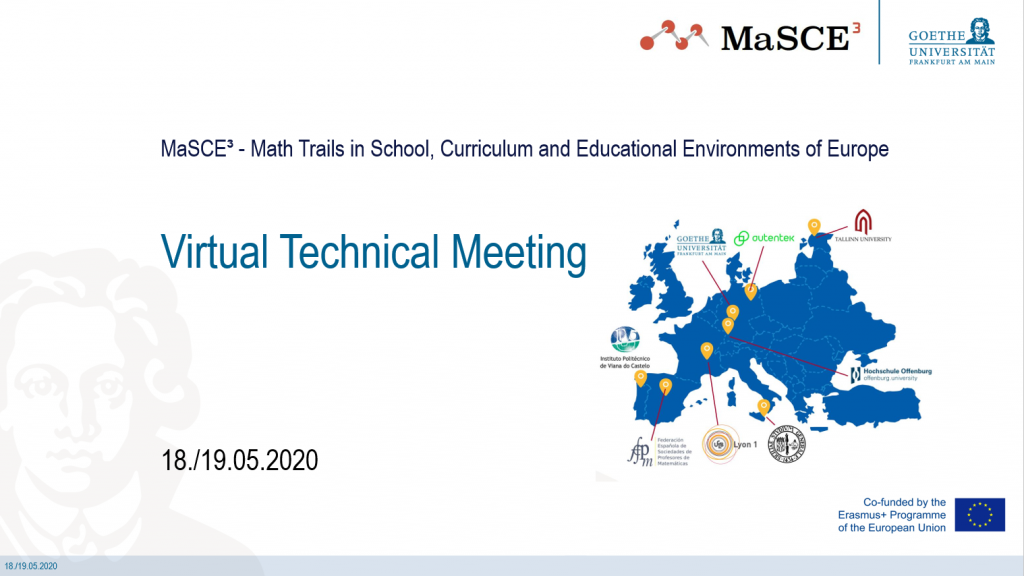
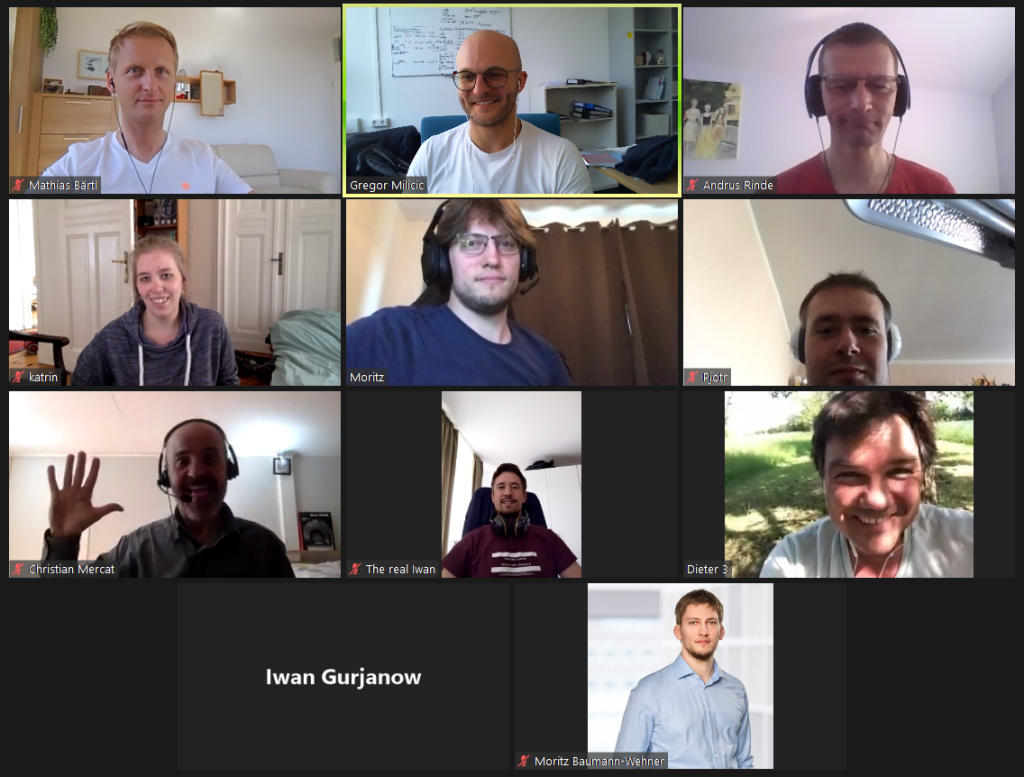
On the 18th and 19th of May we conducted our technical meeting of the MaSCE³ project. Unfortunately, due to the restrictions about personal contacts and international travelling, we had to more our meeting into the virtual space.

Apart from the MathCityMap team from Goethe University Frankfurt, our project partners from the universities of Lyon (France), Tallinn (Estonia) and the university of applied Sciences Offenburg (Baden-Wuerttemberg) also took part. Furthermore, we were actively supported by representatives of the the Berlin app developer from autentek.

 The development of the digital classroom as one of the intellectual outputs of the MaSCE³ project is nearly finished. The digital classroom provides the teachers with the possibility to create a time wise limited learning environment for their students. Apart from the e-portfolio, where all of the during the conduction of a math trail occurring events are stored and displayed, the chat functionality proofed to be a very useful tool for teachers. Especially during the corona crises and therefore the spatial separation of teachers and students, the digital classroom was often used for MathCityMap@home.

During the group works, we discussed the next steps of implementing also augmented elements into the MathCityMap system, as well as to define new task formats. By using augmented elemtns, it would be possible to pose completely new tasks and create problems for a variety of mathematical topics. For example, it could be possible for the teacher to attach virtual information to a real object. The students can discover and use that information by scanning the environment of the object with the camera of their smartphone inside the MathCityMap app. Furthermore, we also want to implement subtasks as a new format for tasks. Using subtasks, it would be possible to structure complex tasks and divide them into smaller, easier to solve problems. The students could then verify their solutions step by step.

The mandatory mathtrail had to be postponed. However, we hope to have soon the possibility to meet again face-to-face and will of course run again a mathtrail together!

We would like to thank all partners for the productive project meeting!

The current task of the week is located in Lichtenfels, Germany. In this Franconian town the teacher Jörg Hartmann created the task “Der schöpfende Dümpfelschöpfer“ [engl. “The scooping ‘Dümpfelschöpfer’”] and answered several questions about it.

How did you get in contact with the MathCityMap project?

I first discovered the MathCityMap idea through a teacher training by Matthias Ludwig, head of the MCM team Frankfurt. During a project week at my school, the Meranier-Gymnasium in Lichtenfels, I offered a course on MCM trails.

Supported by six students of the nineth to the eleventh grade I created the math trail “Bergauf und Bergab, über Stock und Stein in Lichtenfels” [engl. “Uphill and downhill, over rough and smooth in Lichtenfels”], which contains the tasks “Der schöpfende Dümpfelschöpfer“. Subsequently I worked several times with different classes on the trail. A preparation of 20 minutes is suitable for this; the pupils then run the trail for two or three school lessons. The joy of the pupils is enormous, while the pupils experience mathematics in the open air – and the pupils learn an amazing amount.

Please describe your task. How can it be solved?

The famous sculpture in Lichtenfels, the so-called “Dümpfelschöpfer”, represent a man scooping water from an irregularly shaped pool. In the task I ask how often the man have to scope until the pool is empty. To solve the task, the students have to divide the problem into smaller subtasks, e.g. what the volume of the pool is or how units can be converted.

Which didactic goals do you want to promote?

I would like to encourage students which work on the math trail to perceive their environment from a mathematical perspective as well as to recognize the connection of school math and the real world. They might ask themselves which mathematical object has a similar shape to the bucket and how to convert a volume in m³ in litres.

Furthermore, I want students to do mental arithmetic and make rough estimation. By working on this task, they should realise how useful rough calculation is in everyday life.

Do you have any further commentary of MathCityMap?

I am enthusiastic about the idea of outdoor mathematics, and my students really enjoy to run a math trail. A lot of mathematical creativity is required to create a math trail. To be honest, at school the time to foster students’ mathematical creativity is limited – unfortunately I think the creation of a trail together with students is only possible during a project week.

Overall, the MathCityMap project is great! I really hope that some other users create trails around Lichtenfels, because I would definitely enjoy working on a “foreign” trail to get new ideas for math trail tasks.

The task of the week is back! After the Corona contact restrictions have been eased in most countries, we are looking forward to start the new outdoor mathematics season. Summer is MathCityMap time! And so, we eagerly await many new MathCityMap tasks.


The current Task of the Week is located in the Pyrenean village Arignac in the south of France, where the math teacher Sonja Rembert has created the task “Les nombres sur Castella” [Numbers on the tower].

How did you get to know MathCityMap?

I discovered the wonderful MathCityMap project through a publication on APMEP, a French website for math teachers (click here to see the article about MathCityMap on APMEP). In my teaching, I try to use approaches that are as interesting and varied as possible. Therefore, I was immediately enthusiastic about the Mathtrail idea!

In the first math trail I created, I want to lead the students out of the classroom and get them to get to know their surroundings or our village from a mathematical perspective.

Please describe your task. How could you solve it?

I have created the task “Les nombres sur Castella” in the small village Arignac in the south of France. The task is about an ordinary tower, as you often find in this region: A Castella. My 8-year-old pupils are asked to answer the following question: “Find all the numbers that can be seen on the tower and add them up! So, the goal is to add up all the numbers you can find on the tower. This can be tricky because there are numbers on a clock and there is a clock on each side of the tower. You can also read other numbers on two information boards on the tower.

Which didactic goals do you want to promote with this task?

The children should take a closer look at the familiar tower and recognise that they can find numbers everywhere, even “in real life”. In our daily life we are surrounded by numbers!

Do you have any further comments on MathCityMap?

I think the MathCityMap project is very useful to motivate students for math lessons! Therefore, I will create more math trails soon. Thank you very much for developing the great MathCityMap platform!

Adi Cahyono, our MCM Educator of Indonesia, and Matthias Ludwig, head of the MCM Team Frankfurt, present how an augmented reality mobile math trails program can provide opportunities for students to engage in meaningful mathematical modelling activities. Therefore, an explorative study was conducted involving two mathematics teachers and 30 eight grades in Semarang, Indonesia. The students worked on several math trail tasks using an Augmented Reality Mobile Math Trails App, which was specifically created for this study.

The findings indicate that a mobile app with augmented reality features is helpful for students as a tool that bridges the gap between real-world situations and mathematical concepts in problem-solving following the mathematical modelling cycle.

The article „Learning mathematical Modelling with Augmented Reality Mobile Math Trails Program: How can it work?” was published in the Journal on Mathematics Education. The full text is available online here. The cover pictures are taken from this article.

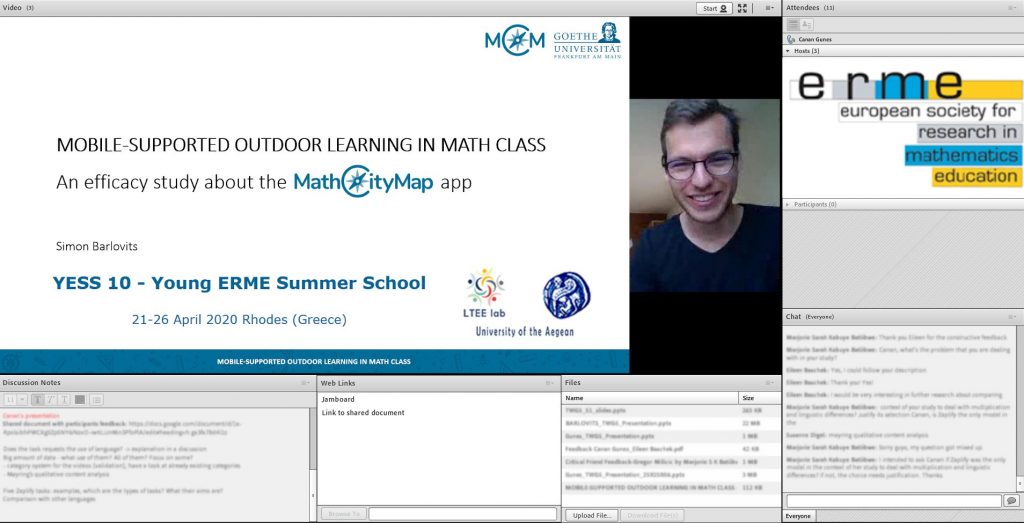
At the YESS10 conference last week, Simon presented his upcoming study about students’ learning progress using the MathCityMap app. Of course, the YESS10 (YERME Summer School) took place online.

The MathCityMap idea was enthusiastically received by the participants of the conference. For example, the Israeli High-school Math teacher and researcher Eli Netzer, who analyzes Hebrew educational video (Link to Eli’s website), gave us this feedback:

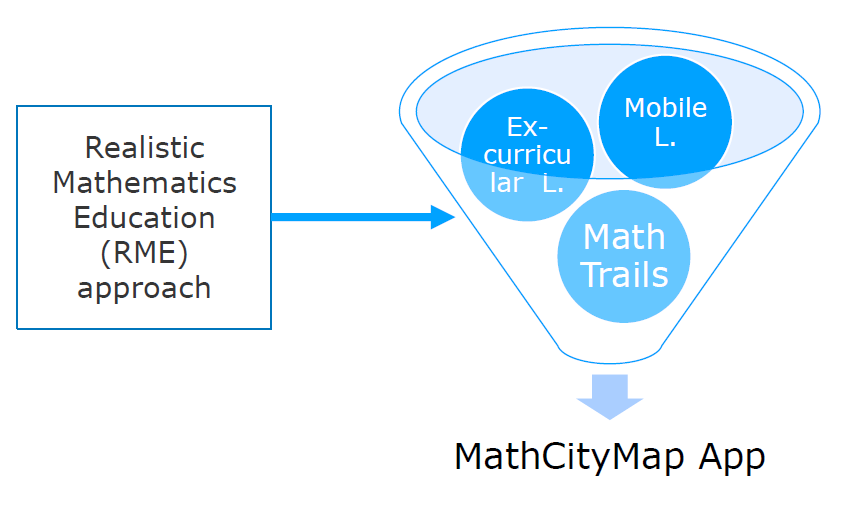
I believe that MathCityMap is a valuable project for extracurricular mathematics learning. The project affords profound mathematical learning since it is based on three strong aspects: social, mobile and real mathematics learning.
I am looking forward to using the project site with my students, explore and add new mathematical interesting tasks and Math trails in the Tel-Aviv city.

In addition, Eli created this really cool illustration about the theoretical framwork of MathCityMap (left picture).

The usage of MathCityMap math trails is well-tested for the revision of various learned topics. However, math trails can also be used – as so-called Theme-based Trails – for the aimed work on one specific curricular topic.

Possible topics are proportion, fractions, linear functions, parabolas and quadratic functions as well as the intercept theorem. Click here to see an example for a Theme-based Trail about stereometry.

Theme-based Trails could be used for learning mathematics at home during the Corona breakdown: According to the motto MCM@Home, we prepared several trails in five languages which could be solved from home [click here to see all MCM@Home trails]. Two of them deal with only one topic. In other words, our MathCityMap team created two Theme-based Trails for MCM@Home. One is about linear functions and suitable for 8th graders. The other one treats quadratic functions and could be solved by 9th grade students. We also created Theme-based Trails for students from grade 3 up to grade 6 which deal with sequences & series as well as basical combinatorics.


Have fun by working on our Theme-based Trails!