The student teacher Jill Groos created the task “Ahoy sailors!” in Stadtbredimus, Luxembourg, which we present today as the new Task of the Week. In our interview Jill Groos explains how the task can be solved and gives us insights into her teacher training.

How did you get to know MathCityMap?

I am a student at the University of Luxembourg in the Bachelor of Teacher Education. The MathCityMap project was presented to me by our professors at the university. In this summer semester, in the subject “Didactics of Mathematics”, our semester project was to design a math trail with MathCityMap.

Please describe your task. How could you solve it?

My task is about first and second graders building a paper boat. Then the boat is let into the water on one side of the bridge and students are asked to count how long the boat takes to come out on the other side of the bridge. The task is solved by counting, to be more precisely by counting seconds.

Which didactic goals do you want to promote with this task?

The children should take a closer look at the familiar tower and recognise that they can find numbers everywhere, even “in real life”. In our daily life we are surrounded by numbers!

Do you have any further comments on MathCityMap?

The didactic goals of this task are in the areas of learning to count, problem solving and learning to tell time. It is important that the children can work out a solution for an existing problem, learn how to count seconds and learn to count in total.

Our current task of the week leads us to Switzerland. Noah Gass, student of primary education, created the MathCityMap task “Rathaus” (engl. “town hall”) in Liestal near Graz. He answered us some questions about the MathCityMap app.

How did you get in contact with the MathCityMap app?

I am a student for primary education at the Pädagogische Hochschule Nordwestschweiz in Basel. I take part in a didactics seminar about teaching mathematics using digital media for which I created a MathCityMap mathtrail.

Please describe your task. How could students solve the task.

To answer the task, students have to find out how many hours the town hall is opened per week. Except for two days, the opening hours differ from day to day. For example, on one day the town is closed during a lunch break, on others it is opened continuously. First, the students have to calculate the daily opening hours. Then, they can figure out how long the town hall is opened weekly by adding those daily opening hours.

Which didactic aims are stimulated through your task?

To answer the questions, the students have to calculate with full and half hours – they need decimal numbers. Another difficulty is that the time is given in a scale of 24 units. However, speaking about time differs from the “written” digital time – to calculate the opening hours from half past 7 a.m. to 2 p.m. the students have to find out the time period between 7:30 and 14:00 o’clock.

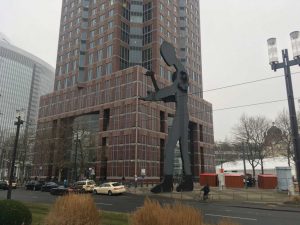
Today’s “Task of the Week”  focuses on the “Hammering Man”, a symbol of Frankfurt’s fair. The “Hammering Man” comes to one’s attention through his continuous hammering motion. The task is part of the “Weihnachtstrail” with task number 784.

__

Task: Hammering Man

The “Hammering Man” hammers continuously. How many hammer blows does the “Hammering Man” carry out in the month December?

__

To solve this problem, it is necessary to observe the motion of the “Hammering Man” and measure the duration of a blow (in seconds). This can be done through measuring the time for 10 cycles. Afterwards, the number of seconds for one day and for the month December should be determined. With help of a division, the number of hammer blows can be calculated for the month December.

In this task, the main part is to determine the frequence of a periodic motion through measuring. Therefore, the task can be seen as an examplary task which can be adapted to further locations where things move periodically. The focus is especially on the time units second, day and month, as well as their conversion. Further, the arithmetic operations multiplication and division are included. Therefore, the task is in connection with school mathematics and can be used from grade 4.

The task is very suitable, because it requires the presence and activity (measuring of the duration of a blow) of the pupils. Further, it is a realistic problem, which can be solved without special aid. The task offers the possibility to differentiate as the pupils can ask for help if needed. The sample answers can be found with the task in the portal.