Adrian Schrock, math teacher at the Weibelfeldschule in Dreieich (Germany), has created our new Trail of the Month. The tasks of the math trail aim at the topics Theorem of Pythagoras and the Intercept Theorem. By this example we want to show how you can create so-called theme-based math trails with close curricular links. In this interview Adrian Schrock talks about his experiences with MathCityMap.

How do you use MCM and why? What is special about your trail?

I currently use the trail „Unseren Schulhof mit Mathe entdecken“ (engl.: “Discovering our schoolyard by doing maths”) in my 9th grade in the subject area “Pythagorean theorem” and ” Intercept theorems” and would like to increase the motivation for problem solving in class.

What is special about my trail is that all the tasks are in the schoolyard and combine the topics “Pythagorean theorem” and “Intercept theorems”. Not only inaccessible variables like the height of the school building can be calculated, but also by reversing the theorems both the 90° angle and the parallelism can be checked using objects in the schoolyard.

The first task is explicitly intended as an introduction to working with the Mathtrail and should be carried out in small groups in the classroom. I have already tested this successfully in class and had the advantage that the SuS first get to know the app and possible questions can be clarified directly in the plenum.

In order to increase the relevance of the tasks, a short story is formulated in my descriptions “About the object”, which shows why the question could be interesting. For example: “Between the columns a screen for a stage set can be hung up. A teacher wants to know for a performance of the Performing Play in an open-air theatre whether the screens are parallel to each other”. The stories are, of course, made up, but may answer the question of the students “Why would you want to know that?”.

What didactic goals do you pursue?

On the one hand, the trail aims to specifically promote motivation for problem solving in the 9th grade. On the other hand, by focusing on the selected topics, the trail has the additional purpose of being able to apply the teaching content to real objects and thus deepen the knowledge. The advantage of this is that it is clear from the starting situation of the SuS that previous knowledge is required for the trail. A disadvantage is, of course, that if you work on other class levels, your motivation might be lower, because you don’t see any connection to your current lessons.

Further remarks about MCM?

Small wish to the MCM team… the Task Wizard lacks task types to determine heights or to check for example parallelism or something similar to my trail. Maybe you could add some more topics here.

I find the structure of the website and especially the feedback to the created tasks very good – thanks a lot to the MCM team!

Henrik Müller, a grade 12 student, created some MathCityMap tasks in Geiselwind, Germany. One of them – the task “Kletternetz” [eng. “climbing net”] – is our new task of the week

How did you get to know the MathCityMap idea?

I am a grade 12 student at a German Gymnasium. There I participated at the seminar “mathematics in sports and gaming”, where the MathCityMap idea was presented. As part of my seminar paper, I created one trail consisting of five tasks in the German town Geiselwind. Additionally, I examined the aspects of mathematical modelling in school.

Please describe this task type. How the age of the tree could be ascertained?

The task is about the climbing net, which exhibits some complex geometric structures und solids. Especially, the regular base, circles, one pyramid and one cylinder attract attention. We can model the hole solid as one pyramid with a base in shape of an octagon, which is penetrated by a cylinder. By using the formula for the volume of solids and by applying the theorem of Pythagoras the task can be solved.

What are the results of your analysis of school-based modelling?

In my seminar paper, I compared the usage of realistic and traditional tasks. Therefore, one group worked on conventional tasks in the classroom, while another group handled my created MathCityMap tasks. Both groups consisted out of eight students of the 11th grade. The results of my experiment indicate that solving a MathCityMap tasks leads to an increase of modelling competencies as well as to an improved visual thinking. In my opinion, the project could get a fixed part of modelling pedagogy for the reason that using MathCityMap conduce the mathematical understanding of students.

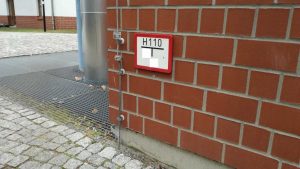
The current “Task of the Week” is about the hydrant sign, which might have been noticed frequently in everyday life. By means of them, hydrants can be quickly and precisely located, e.g. for fire-fighting operations. But how exactly is such a sign read? With this question, the students are confronted in the task “Hydrant sought” from the trail “Campus Griebnitzsee” in Potsdam.


Task: Hydrant sought (task number: 1047)

On the house is a reference to the next hydrant attached (red-white sign). How far is the hydrant from the sign in meters? Determine the result to the second decimal place. 


In order to solve the problem, the sign must at first be interpreted correctly. If the students do not know it, the hints help them. The indication on the sign is to be read so that one runs a certain length in meters in one direction (left/right) and then turns at right angles and again runs the length of the second number in meters. The situation can thus be described and solved using a right-angled triangle. The two indications on the hydrant sign (in the picture, they are made unrecognizable in order to ensure the presence of the pupils) are the cathets, while the direct distance corresponds with the hypotenuse. This can be determined by means of the Theorem of Pythagoras. Further, the solution can be determined and valued through measuring the distance to the hydrant. The problem is therefore to be assigned to geometry and can be used as a practical application for this from class 9 onwards with the development of the Theorem of Pythagoras. Since hydrant signs can be found in many places, the task can easily be transferred to other sites and allows mathematical operations in the environment in an easy way.