In a further article on our category Generic Tasks, we want to present you determinations of volume and mass. The focus will be on the bodies Cuboid and Cylinder. Further bodies will follow in future articles. We start with these forms as they occur in the environment very often and can be realised very quickly with our Task Wizard.

Objects that can be described with help of cuboids are for example concrete blocks or stones. Here, the difficulty varies according the unevennesses of the object, which can be balanced through averadged values. With benches, the difficulty can be increased as well, as they have to be described through different cuboids.

Cylinders are very suitbale to determine the volume of a tree trunk. Furthermore, many fountains are circular and therefore a good basis for calcualtions with the cylinder.


Especially with stones and tree trunks, the question of the object’s weight seems adequate through a given density. The mathematical background, as well as popular densities can be found in the following document Generic Tasks Volume 1.

Have you already tested our GPS tasks with help of the task wizard? They give you the opportunity to create interesting problems with the own position and the GPS signal of the smartphones.

The following objects can be created at the moment:

  • Line Segment AB without direction
  • Line Segment AB with direction
  • Equilateral Triangle ABC
  • Square ABCD
  • Equal distance to 2 points
  • Equal distance to 3 points
  • Linear function through 2 points

For the GPS task, an active GPS signal is needed. Further, the tasks should be created with distance to higher buildings in order to imporve the exactness. For creating, a big place or lawn is needed which allwos to walk a longer line or the asked object completely, e.g. in the example Walk a Line with Direction.

This task allows different solutions as the problem solver can choose starting and ending point. Solely the direction (north-south) and length (50m) are given. In contrast, the tasks on equal distance and linear function define points or a coordinate system which are presented by the smartphone.

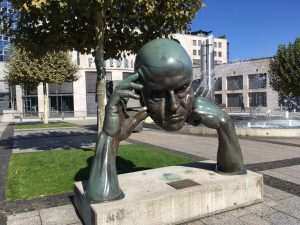
After we opened the first MATHE.ENTDECKER (math explorer) trails at Stuttgart’s stock exchange at the 12th of April (read more here), we want to present you one of the included tasks. The object is the sculpture “Thinker”, a  prominent symbol of Stuttgart.


Task: Sculpture “Thinker” (Task number: 2018)

Determine the height of a person with this head size. Give the result in meters.


An interesting question with forces the creativity of the students as the propotion of head size and body size might be unclear. The students can determine this proportion at their own bodies, at best with all group members and the mean. Afterwards, the head size of the sculpture is measured and related to former values. A previous estimation in comparison to the real height might be surprising.

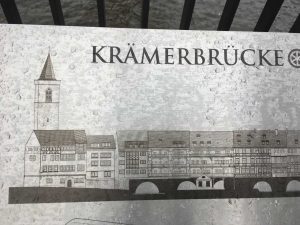
We all know them: city and site maps, illustrations and drawings that depict a real object to scale. Especially at sights, they offer the chance to calculate this scale, as in our Task of the Week at the Krämerbrücke in Erfurt.


Task: Scale of the Krämerbrücke (Task number: 3108)

Determine the scale 1: x in which the Krämerbrücke is drawn (engraved) on this steel plate. Give the number x.


First, it has to be clarified how the scale is defined: One unit of length corresponds to x units of length in reality. In this example, the real length of the Krämerbrücke is indicated on the plate, so it is only necessary to measure their length on the plate and to compare the two values. Of course, the task can also be formulated on objects where the actual size or length has to be measured.

By the way: Do you already know the new metadata function “About this object”? This allows you to enter interesting sidefacts about sights and objects, so that cultural-historical references can be realized.

Today we would like to introduce you to our generic tasks concerning the height of buildings. This topic offers the opportunity to do math for different grades.

The height of buildings can already be determined with grade 5 students if regularities and patterns are identified: https://mathcitymap.eu/en/portal-en/?show=task&id=2045

These may e.g. be bricks, glass panes or plates, of which one or more can be measured to determine the total height by means of the total number.

Such a question thus trains the mathematical view on regularities and patterns in the environment.

The difficulty of the task increases as soon as the building has no regularities. The height can then be determined with the help of the intercept theorems.

https://mathcitymap.eu/en/portal-en/?show=task&id=3171

There are various possible solutions for this, for example using the sun’s position in suitable weather conditions, using smaller objects (such as lanterns) or using the folding rule. In this case, it is particularly helpful to make a preliminary sketch of the situation in order to facilitate the application of the intercept theorems.

Important in both cases is a marking in the task or image, which makes it clear to what point the height should be determined, for example, if you want to ignore a front building.

The document Height of Buildings contains our detailed description of both types of tasks.

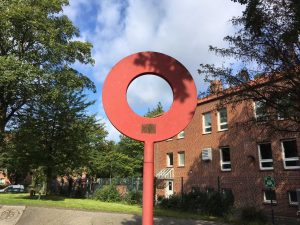
Today’s Task of the Week focuses on the circular ring. The idea behind is to determine the desired surface area by the difference of two surfaces, which can be calculated easily.


Task: Ciruclar Ring (Task number: 1943)

Calculate the area of ​​the circular ring. Give the result in cm².


The area of the circular ring can be calculated by determining the radius of the entire circle, as well as the radius of the small “missing” circle. In this case, the easiest way is to measure the diameters of both circles. Then one calculates the wanted area either with the formula of the area of the circular ring, or one calculates the area of ​​the entire circle and deducts the small circular gap. In both cases, the wanted area results.

A similar task can be created by means of traffic signs, e.g. the passage prohibited sign and the question of the proportion of red color. In both cases, the circle plays a thematic main role, so that the topic can be used from class 9 onwards.

Also this week, we would like to introduce you to a task with help of an interview with the task author, Johannes Schürmann. We would like to thank him for creating the task and his time to answer our interview questions.


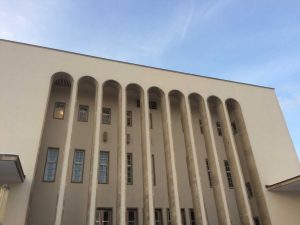
Task: Height of the Building (task number: 2339)

Determine the height of the Oetker hall! Give the result in meters.

How did you come up with the idea to create this task for MathCityMap? How did you find out about MathCityMap?

In my studies, I became aware of MCM through a seminar I attended. The lecturer, Prof. Dr. Rudolf vom Hofe, told us about the project and so the idea to write a final thesis about the topic was born. As a result, Joerg Zender was invited to Bielefeld University for a lecture and I was able to create a mathtrail with Joerg at the university. When creating the trail and in conversation with Joerg, the idea of ​​using MCM or digital media in teaching was strengthened. Thus, a school near the Bielefeld city center agreed on participating in a study and I was able to create a mathtrail adapted to the class content. So it turned out that I created the task.

Which competencies and topics play a role in solving the task?

The current topic which was taught in class were the intercept theorems. Accordingly, this should also be used in the task. However, the task is not so easy to solve with the intercept theorems, because of the local condition that the height differences are not easy to measure. Therefore, a second approach is given on the measurement and counting of the facade panels of the inner arches. Both approaches come up with a similar result. Space and form are the priority content with the skills problem solving, mathematical modeling as well as formal-technical work.

Have you tested the task with students or received any other feedback on the task?

I tested the task for my survey of the thesis with students, or rather, let the whole trail run by the students. The specification while running was that the students should work on certain tasks. In the evaluation of the individual groups of students, it turned out that not all had decided for this task. Reasons for this would be purely speculative.

Our Task of the Week was created by Vanessa Präg, student at Goethe University Frankfurt, as part of a mathematics didactic course. In a short interview, she will tell us about her experiences.


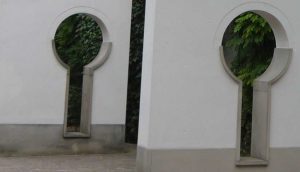
Task: Giant keyhole (Task number: 2550)

The city wants to close the keyholes. For this, the holes are filled with concrete up to the respective edges. How much does the concrete weigh in a keyhole when the density of the concrete is 2.1g/cm³? First estimate and then calculate the weight of the concrete in kg.


How did you come up with the idea to create this task for MathCityMap? How did you get to know MathCityMap?     

My lecturer, Mr. Zender, made me aware of MathCityMap. As part of a course, we as prospective teachers talked about what modeling in mathematics education means. For clarification, he let us run a small trail from MathCityMap and solve it, as well as create 2 tasks in MCM. I’ve been an avid geocacher for years and think it’s a good idea to set tasks which can be solved with mathematics at different places. If I have more time, I will certainly create more tasks.    

The task itself came to me as I walked through our city looking for unusual objects for MCM. The keyhole immediately jumped in my eye.

Which competencies and topics play a role in solving the task?

In this task, I see the competences “problem solving”, “modeling” and “working with mathematics symbols and techniques”. Communicating is also part of the task since on the one hand, the information from the task must be understood and implemented correctly, and on the other hand, the students should communicate with each other their solution proposals. Correct measurement of lengths, as well as the knowledge of the body and its volume play an important role. What surprised me was how heavy concrete is in a comparatively small volume. Therefore, I thought it would be interesting for the students, if they can assess the weight reasonably well.

Although the focus of many MCM tasks is on lower secondary maths, some upper secondary level tasks can also be realised. So our current Task of the Week, which was created in the context of a teacher training at the commercial schools Hanau.


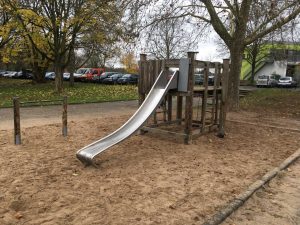
Task: Parabolic Slide (task number: 2241)

The shape of the slide is the part of a parabola. Determine the compression factor. 1m equals 1 unit of length. You can assume that the slide is almost horizontal at the end.


The slide is approximated according to the task with the help of the equation f (x) = ax² of a parabola. To solve the task, the students first have to transfer the situation to a suitable coordinate system. Since only the compression factor is asked, it is not necessary to specify this in the task. It makes sense to set the coordinate system so that the origin lies at the lower end of the parabola, but leaves out the horizontal end. Through such a choice, it is sufficient to determine another point on the slide, so the change in the x- and y-coordinate. By inserting this into the equation, the compression factor a results.

At the beginning of the year, MCM was successfully presented in Mumbai. Of course, in this context the first Indian Math Trail was created, from which our current task of the week originates.


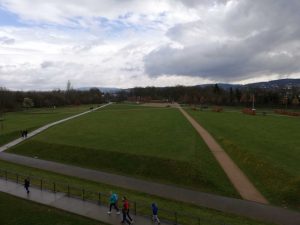
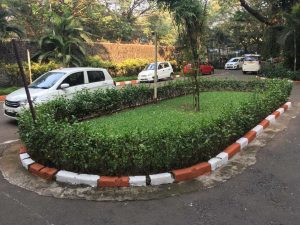
Task: Grass Field (Task number: 2459)

Calculate the area of the grass field. Give the result in m²!


First, a mathematical model has to be found that represents the area most accurately. This is best done by dividing the total area into several individual areas. The obvious choice is the division into two halfcircles and a rectangle. For this, the rectangular side lengths and the circle’s radius must be measured, the areas calculated and all partial areas added.

The task belongs to the topic of compound surfaces, whereby calculations on the circle must already be known in order to solve the task as exactly as possible. In the German school system, it would therefore be solvable from class 8.