Today’s best practice example in the Task of the Week focuses on composite geometric bodies with truncated cones and a sphere.


Task: Nine figures (Task number: 3780)

Determine the volume of one of those figures. Give the result in liters.
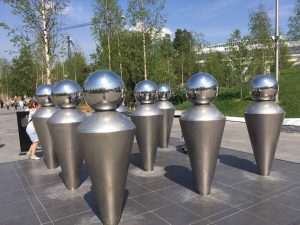

As mentioned, the figure can be divided into a large, a small truncated cone and a sphere. This step is an important step by ignoring smaller derivations and through the mental disassembly of the figure. Afterwards, a clever and accurate way to determine the respecitve heights and/or radii must be chosen. By adding the volumes, the total volume results. By specifiying four possible solutions via multiple choice, it is possible to determine the result by approaching and estimating.

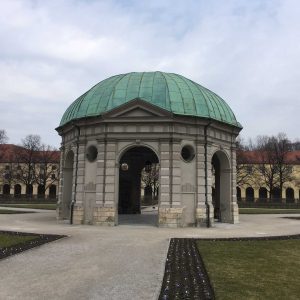
Our current Task of the Week was created during the MNU meeting in Munich. The city offers great architectural possibilities to use MathCityMap, for example the Diana Temple in the Hofgarten.


Task: Roof Dome of the Diana Temple (Task Number: 4513)

Determine the size of the roof dome of the Diana Temple. Give the result in m².


You can model the roof dome as a semi sphere and approximate the asked size by means of its surface. First, the radius of the semi sphere is determined using the diameter at the bottom. Using the formula for the surface of a sphere or divided by two of a semi sphere results the surface. Nevertheless, to approximate the result exactly, the stone triangles should be substracted. In total, there are four trinagles wholes surface area should be estimate due to the height and subtracted.

Today’s Task of the Week focuses a geometric question at the Aasee in Münster. More specifically, the surface content of a hemisphere is calculated by the students.


Task: Mushroom (task number: 1400)

Determine the area of ​​the mushroom. Give the result in dm². Round to one decimal.


In order to solve the problem, the students have to approach and recognize the shape as a hemisphere. They then need the formula for the calculation of the spherical surface or here the hemispherical surface. For the determination, only the radius of the hemispheres is required. Since it can not be measured directly, this can be determined with help of the circumference.

The task requires knowledge of the circle and of the sphere and can therefore be applied from class 9 onwards.