The current “Task of the Week” is about determining the mass of a concrete sculpture in Camps Bay near Cape Town, the capital of South Africa. The special feature of this sculpture is that it is a composite geometric figure whose components are modeled and calculated individually.


Task: Block of concrete at Camps Bay (task number: 1811)

Calculate the mass of this concrete sculpture. 1cm³ weighs about 2.8g. Enter the result in tons!
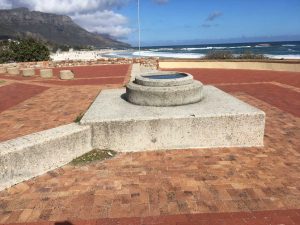

In order to solve the problem, it is necessary to divide the sculpture into three basic parts: a cuboid and two cylinders. Then, the necessary lengths are measured and the volumes of the bodies are calculated and added. In the last step, the total volume of the sculpture is multiplied with the density of concrete, which leads to the total weight of the sculpture.

This kind of task can easily be transferred to similar objects, whereby the degree of difficulty can be varied according to the composition of the figure. This type of task teaches the geometric view and understanding of composite bodies.

Today’s Task of the Week leads us to South Africa. Matthias Ludwig created three trails in Grahamstown as part of a teacher training course. You can learn more about the background here.

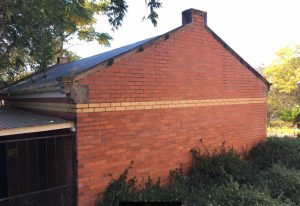
The task described is about determining a roof slope using a gradient triangle.


Task: Slope of the Roof (task number: 1697)

Calculate the slope of the roof. Give the result in percentage (%).


The task can be integrated in the topic of linear functions and their slope. The slope is determined by the quotient of vertical and horizontal length. For this purpose a suitable gradient triangle must be found. While the horizontal length can be determined by measuring, the height can be calculated using the number of stones. The task is therefore a successful combination of geometry and functions and can be used from class 8.

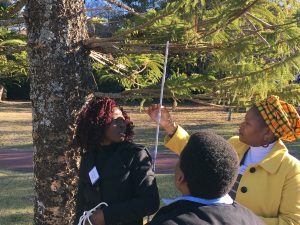
After all teachers had learned about the system, and the registration problems had been solved, the participants were able to create tasks by themselves. They found good objects to experience mathematics.

The problems came later back in the classroom. Again, it was experienced that a precise formulation, the creation of hints and sample solutions are not formulated easily. Of course, there were also technical problems since not all teachers had the appropriate IT knowledge to exchange images between two devices or to edit them (for example a 90° rotation). Nevertheless, each group was able to integrate a task into the system.

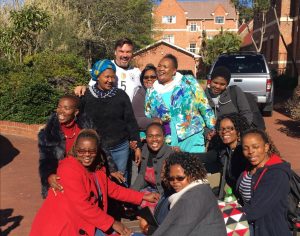
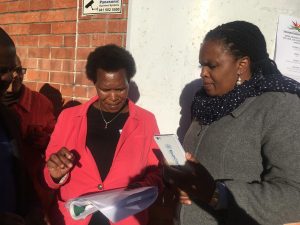
We, the MCM project team, are a little proud that our idea and system also works in South Africa! But the participants enjoyed it as well as the final photo shows. MCM says thanks to RUMEP (Rhodes University Math Education Project).

This week, we had the opportunity to present MathCityMap at a teacher training at Rhodes University in Grahamstown in South Africa.

Matthias Ludwig followed the invitation of Prof. Dr. Marc Schäfer (chair of mathematics education, Rhodes University) and accepted the challenge to present and test MCM in South Africa.

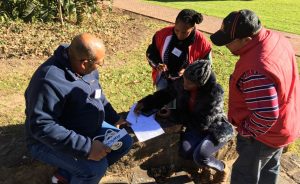
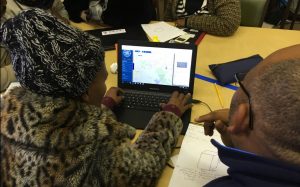
The area of ​​Rhodes University offers a variety of objects which are suitable for good MCM tasks. Three routes with 6-7 tasks could be created. On Monday, the theory of outdoor mathematics and the basic idea of ​​MCM were introduced. On Tuesday, almost all of the 50 teachers were able to install the MCM app on their Android smartphones. Some tried it with their Windows phones, but of course it did not work. None of the teachers owned an iPhone! Afterwards, it was time to solve the tasks, but it turned out that many participants were not able to navigate on a map at all. Some had not activated the GPS localization and searched the right direction. Thanks to the support of Clemens and Percy, we found the reason quickly.

It was a pleasure to observe the teachers during solving the tasks, and to see the joy when the MCM app rewarded a 100-point response and a green check. Overall, the concept of “doing mathematics outside” was completely new to the South Africans.

There was also a discussion about units, conversions and modeling. Especially the modeling process is relevant for MCM since one has to translate reality into a mathematical model to solve the tasks numerically.