Todays´ task of the week is located in Portugal, where our MoMaTrE partner Amélia Caldeira created the task “Rampa de Acesso” (engl. Acess Ramp). She answered us some questions about her task and the MathCityMap project.

How do you use MathCityMap?

I use MathCityMap to motivate students to learn mathematics. I want students to be happy to learn and apply mathematics. Through the usage of MathCityMap they can model shapes in the environment. At the same time, I reveal to their teachers a successful recipe for teaching math: technology and outdoor.

Please describe your task and the procedure of solution. What is the underlying problem of your task?

The question of my task “Rampa de Acesso” is, whether the ramp can be comfortably used by a wheelchair person or not. A ramp is rated as wheelchair-assessable, if its slope don`t exceed 6%. The aim of the task is to determine an approximate value for the ramp slope in percentage.

Therefore, the students have to model the ramp (gradient triangle). The slope of the ramp can be calculated as as a ratio between the length and the height of the ramp.

Good to know: MathCityMap provides a wizard task for calculation the slope of a ramp in percent or degree. Wizard tasks are prepared tasks, which can be created only by adding the measured data and a photo of the object.

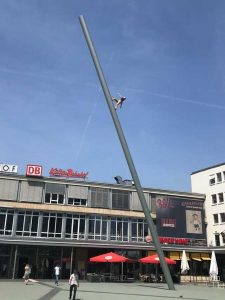
This week, we focus on a task that can be used to realize linear functions in the environment. It was created by Kim Biedebach in Kassel.

I became aware of MathCityMap during a didactics lecture as part of my teaching studies that I attended. The idea for the task actually came to me by chance. I am from Kassel and had in mind that I have to design a modelling task for the lecutre. When I passed the figure, I spontaneously decided that this might be a suitable task.


Task: Man walking to the Sky (Task Number 3832)

How many meters is the man on the pole above the ground?


For this, the pole on which the man steps up is interpreted as a linear function. The point at which the pole starts on the ground is chosen as point (0, 0) for the sake of simplicity. Now, the slope must be determined as the quotient of the change in vertical and the change in the horizontal. If one starts from the chosen origin, and walks e.g.one meter to the side and measures the height there, the slope can be determined.

Afterwards, the slope can be used to determine the equation of function. Then the distance from the origin to the human on the ground has to be determined (corresponds to the x-coordinate). This is best done by positioning oneself under the man and measuring the distance to the origin. By inserting into the function equation the height can be calculated.

The task makes the linear relationship of x and y coordinates particularly clear. Also the slope concept is discussed. Of course, alternative approaches can be chosen, such as using the intercept theorems.

Our first focus on generic tasks, meaning tasks that can be created in any location with similar objects, is on the subject of slopes. This topic has relevance for math lessons in different grades up to the upper secondary level.

In particular, the slope of a straight line or linear function makes it possible to determine the slope of various objects, such as ramps or handrails, with mathematics from lower secondary school. The result can be expressed either in percent or in degrees, including trigonometric relationships.

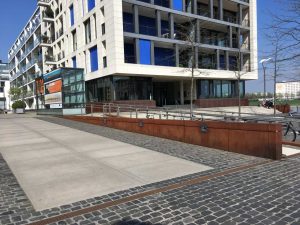
The mathematical basis is the definition of the slope as a quotient of vertical and horizontal difference, or in practical terms: the use of a gradient triangle. This can e.g. be implemented on ramps, especially if the horizontal length is easy to measure:  

Example of a ramp where both, horizontal and vertical changes are easy to detect.

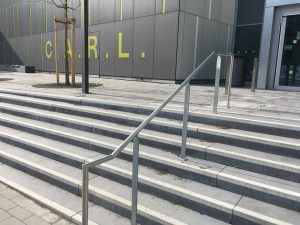
More difficult is the calculation of the slope of handrails, where one should use a water level for the difference in horizontal and vertical change:

Example of a handrail, where the result without a level can be inaccurate.

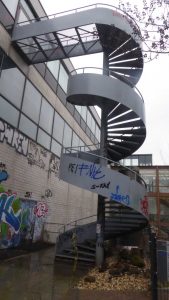
Even more complex is the slope on the railing of a spiral staircase or on objects that do not rise linearly:  

The spiral staircase takes the topic of slopes to a more complex level and requires imagination and transfer knowledge.

For non-linearly rising objects, one may ask for the maximum slope or the slope at a particular point, e.g. as a preparation for the concept of tangent.

Attached you will find our extensive collection of frequently occurring generic tasks on the subject of slopes, the mathematical background as well as hints, compiled by Matthias Ludwig: 

Icon

Slope 373.45 KB 45 downloads

...

By the way: With our Task Wizard you can create the tasks for ramps and handrails with just a few clicks and transfer them to suitable objects in your area!

Today’s Task of the Week leads us to South Africa. Matthias Ludwig created three trails in Grahamstown as part of a teacher training course. You can learn more about the background here.

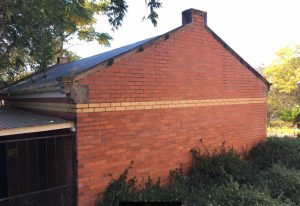
The task described is about determining a roof slope using a gradient triangle.


Task: Slope of the Roof (task number: 1697)

Calculate the slope of the roof. Give the result in percentage (%).


The task can be integrated in the topic of linear functions and their slope. The slope is determined by the quotient of vertical and horizontal length. For this purpose a suitable gradient triangle must be found. While the horizontal length can be determined by measuring, the height can be calculated using the number of stones. The task is therefore a successful combination of geometry and functions and can be used from class 8.

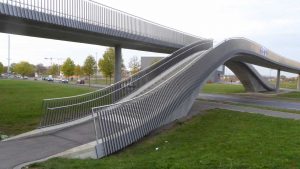
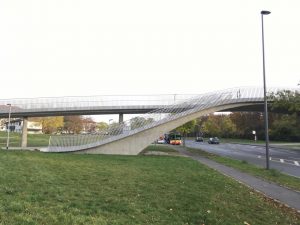
 Many of the tasks in the MCM portal are based on mathematical knowledge from secondary level I. Today’s Task of the Week shows that knowledge of secondary level II can be integrated in tasks as well. The task “Hubland Bridge I” is about the inflection point of a function as well as its properties.


Task: Hubland Bridge I (task number 684)

At which stair (counted from below) is the inflection point?


First, the bridge must be modeled as a function. For the visual determination of the inflection point, the students use the characteristics of the inflection point. In this case, the property can help to describe the inflection point here as the point with maximum slope and without curvature. In the presence of the device, the maximum slope can also be determined using a gradiometer (see Hubland Bridge II). The point of inflection as a point without curvature can be determined optically by looking for the point at which the graph resembles a straight line. After the turning point has been determined, the students have to count the steps up to the point. Ideally, this is done several times and the mean value is formed.

The task can be assigned to the topic of analysis, more precisely the differential calculus. With the development of the characteristics of the turning point of a function, the task can be used from class 11 onwards.

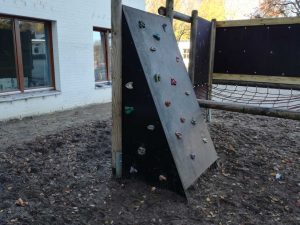
Today’s “Task of the Week” leads to Hamburg, more precisely to the school Am Heidpark. Here, one can find the trail “Am Heidpark” which is a good example to show that already a schoolyard can be made for a MathCityMap trail. The selected “Task of the Week” is called “Climbing Wall” with task number 668.


Task: Climbing Wall

Determine the slope of the climbing wall in percent.


The task enables a suitable embedding of the topic slope of linear functions. The slope of the climbing wall can be determined by recourse of the gradient triangle. In the coordinate system, the slope of a linear function can be calculated with help of two points on it. It is necessary to determine the difference of the y-coordinates (dy) and the difference of the x-coordinates (dx) and divide them afterwards. Corresponding in the real context, it is necessary to measure the height difference (dy) as well as the difference in length (vertical; dx). Afterwards, the slope can be calculated with help of a division and the conversion into percent. The task can be used from grade 8 and supports a basic understanding of the slope of a linear function and its determination with help of a gradient triangle. The task is especially suitable in the beginning of the topic as it already “predefines” a right-angled gradient triangle. Further tasks could for example involve the slope of a stair handrail. The task is a connection of algebra and geometry and can be related to the branches measuring and functional correlation.