Todays´ task of the week is located in Portugal, where our MoMaTrE partner Amélia Caldeira created the task “Rampa de Acesso” (engl. Acess Ramp). She answered us some questions about her task and the MathCityMap project.

How do you use MathCityMap?

I use MathCityMap to motivate students to learn mathematics. I want students to be happy to learn and apply mathematics. Through the usage of MathCityMap they can model shapes in the environment. At the same time, I reveal to their teachers a successful recipe for teaching math: technology and outdoor.

Please describe your task and the procedure of solution. What is the underlying problem of your task?

The question of my task “Rampa de Acesso” is, whether the ramp can be comfortably used by a wheelchair person or not. A ramp is rated as wheelchair-assessable, if its slope don`t exceed 6%. The aim of the task is to determine an approximate value for the ramp slope in percentage.

Therefore, the students have to model the ramp (gradient triangle). The slope of the ramp can be calculated as as a ratio between the length and the height of the ramp.

Good to know: MathCityMap provides a wizard task for calculation the slope of a ramp in percent or degree. Wizard tasks are prepared tasks, which can be created only by adding the measured data and a photo of the object.

Our first focus on generic tasks, meaning tasks that can be created in any location with similar objects, is on the subject of slopes. This topic has relevance for math lessons in different grades up to the upper secondary level.

In particular, the slope of a straight line or linear function makes it possible to determine the slope of various objects, such as ramps or handrails, with mathematics from lower secondary school. The result can be expressed either in percent or in degrees, including trigonometric relationships.

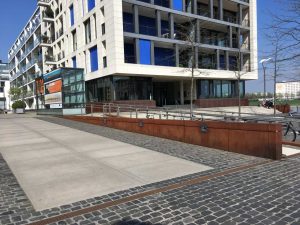
The mathematical basis is the definition of the slope as a quotient of vertical and horizontal difference, or in practical terms: the use of a gradient triangle. This can e.g. be implemented on ramps, especially if the horizontal length is easy to measure:  

Example of a ramp where both, horizontal and vertical changes are easy to detect.

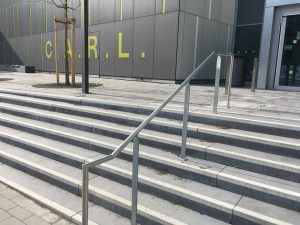
More difficult is the calculation of the slope of handrails, where one should use a water level for the difference in horizontal and vertical change:

Example of a handrail, where the result without a level can be inaccurate.

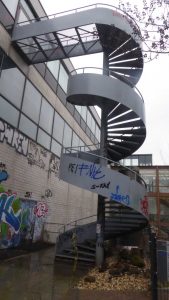
Even more complex is the slope on the railing of a spiral staircase or on objects that do not rise linearly:  

The spiral staircase takes the topic of slopes to a more complex level and requires imagination and transfer knowledge.

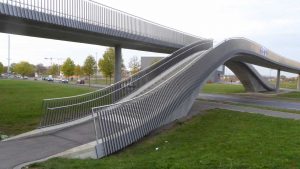
For non-linearly rising objects, one may ask for the maximum slope or the slope at a particular point, e.g. as a preparation for the concept of tangent.

Attached you will find our extensive collection of frequently occurring generic tasks on the subject of slopes, the mathematical background as well as hints, compiled by Matthias Ludwig: 

Icon

Slope 373.45 KB 45 downloads

...

By the way: With our Task Wizard you can create the tasks for ramps and handrails with just a few clicks and transfer them to suitable objects in your area!