The focus of today’s Task of the Week is a combinatorial question. In addition to the typical combinatorical question for the number of possibilities, an application of the Fibonacci numbers, which can be discovered by the students, is included as well.


Task: Combine Staircase (task number: 1199)

How many options are available to climb the stairs by climbing one or two steps per step? The steps can also be combined.
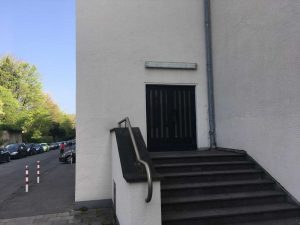

There are various possibilities for solving the problem. On the one hand, it is possible to systematically record different combinations of 1 and 2 steps. In doing so, the students can use the stairs directly and conclude which combinations are possible. In another consideration, the fact that the last step comprises either one step or two steps is used. Leaving this last step, the number of possibilities for a staircase with n steps can be determined using the possibilities for n-1 and n-2 steps. This reasoning leads to the Fibonacci numbers, a recursive sequence in which a number results from the addition of its two predecessors.

The task is therefore a successful example of “hidden” mathematics in simple everyday objects. It offers the possibility to go deeper into the topic Fibonacci numbers or to let the students discover them. At the same time, the problem can also be solved by systematic testing, so that it can be used from class 6. Its topic belongs to combinatorics.

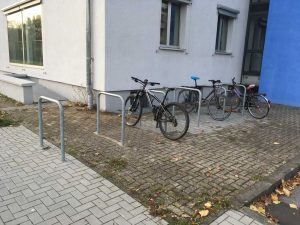
In this week, the focus of the “Task of the Week” is on a stochastic problem. The task is called “Permutation at the Bicycle Stand” and is included in the trail “Hubland Nord” located in Würzburg. The task number is 680.


Task: Permutation at the Bicycle Stand

Four bicycles should be locked at the bicycle stands. The bicycles can be locked on the left or on the right side of each stand. How many possibilities exist to lock four bicycles at the stands? You do not have to distinguish whether the bikes are locked “forwards” or “backwards”. You can assume that all stands are free.


In this task, it is necessary to determine the number of possibilities to lock four bicycles at the bicycle stands. Altogether, there are eight stands and therefore 16 possible spaces. On the picture, not all spaces can be seen in order to guarantee the criterion of the students presence (the task can only be solved at this location). For the first bike, there exist 16 possibilities to lock it. As this space is full afterwards, the number of possibilities to lock the second bike is 15. Analogous, the possibilities for bikes three and four amount 14 and 13. This combinatorial problem is a situation where repetition is not allowed and order matters. With help of the possibilities’ product, one can calculate the total number of possibilities.

This task enables a suitable embedding of a combinatorial problem into the reality. It belongs to probability calculus and can be used from grade 8 with first combinatorial considerations. Further, it can be especially used in stochastics in grade 12/13 as a repetition of basic combinatorial considerations. Moreover, the task can be transferred easily to similar situations (e.g. parking spaces).