Through the cooperation project MoMaTrE (Mobile Math Trails in Europe – www.momatre.eu), MathCityMap could be presented on an international level in various ways.

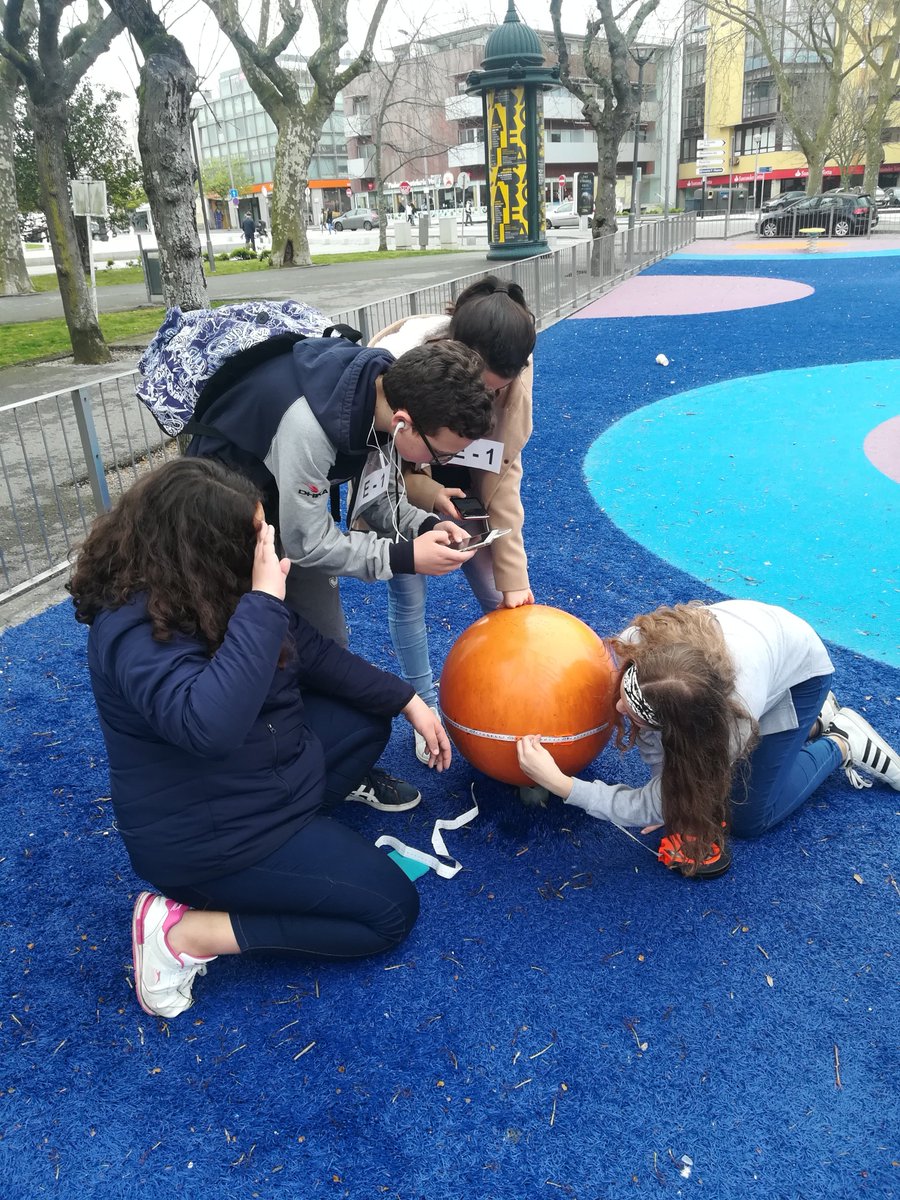
On 23.03., about 170 students at the age of 12-18 years took part in the activity “Mathematics goes to the Garden” which was organized by the MoMaTrE partners in Portugal and involved diverse MathCityMap tasks.

Special thanks to Amélia Caldeira for the photo, which shows a group while measuring. Further impressions can be found on our Twitter Account (@mathcitymap).

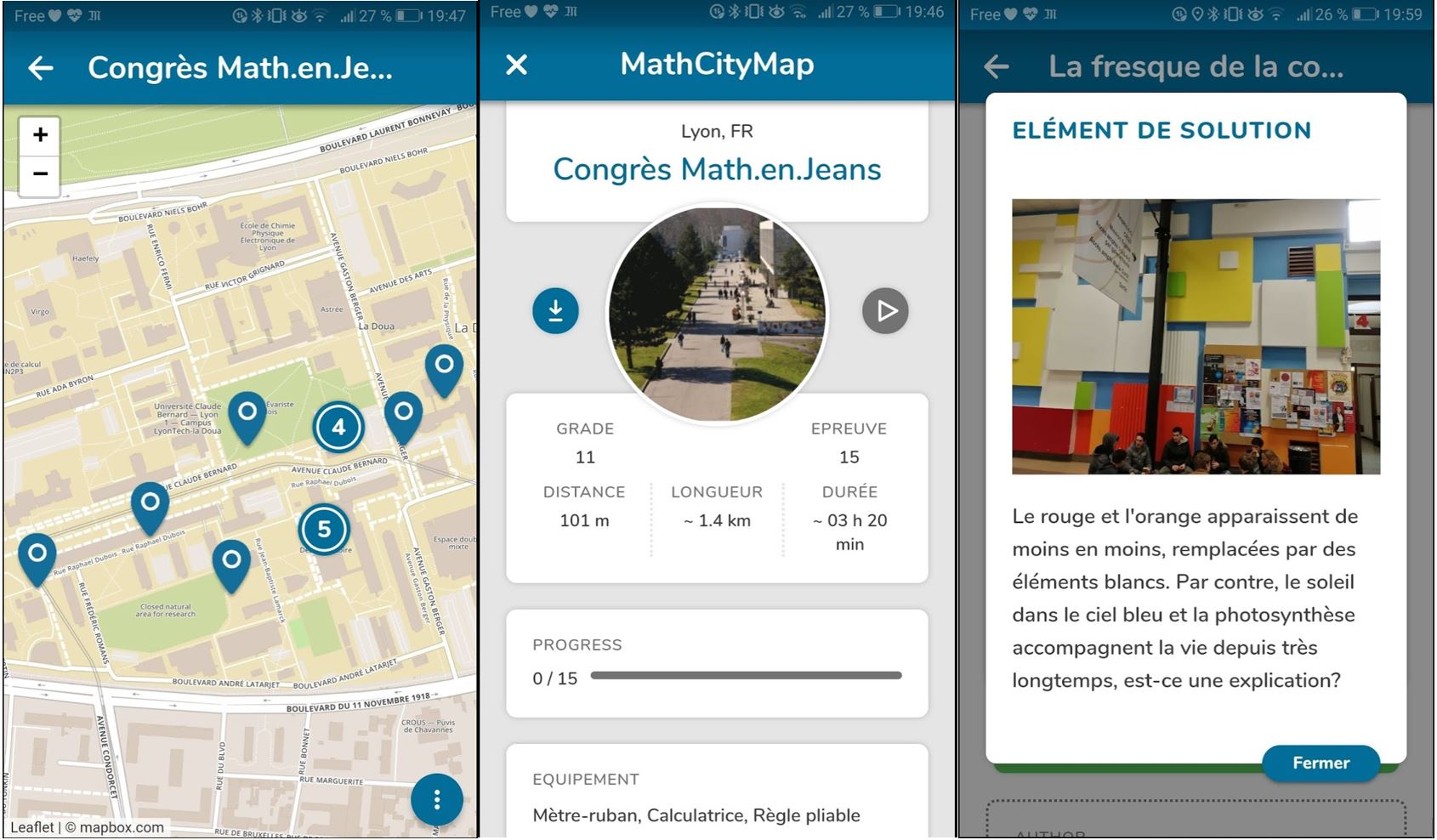
Also in Lyon, France, MathCityMap could be presented successfully at the beginning of the week as part of the congress Math en Jeans. Here a special thanks to Christian Mercat. The involved trail, which can be seen in the picture, can be found here.

After one year of preparation we managed it: MathCityMap is the heart of the Strategic Partnership MoMaTrE. MoMaTrE is an acronym for Mobile Math Trails in Europe. The working group MATIS I led the application for this Erasmus + project. Currently, seven institutions from five countries are participating:

  •  Goethe University, Frankfurt
  • Univerzita Konstantina Filozofa, Nitra, Slovakia
  • Université Claude Bernard, Lyon, France
  • Instituto de Engenharia de Sistemas e Computadores, Investigação e Desenvolvimento, Lisbon, Portugal
  • Instituto Superior de Engenharia, Porto, Portugal
  • Autentek GmbH, Berlin (software company)
  • Federación Española de Sociedades de Profesores de Matemáticas, Santander, Spain  

Within the next three years, the project has the following aims

  • Spread of mobile Math Trails across Europe
  • Further development of MathCityMap (including Gamification, mobile authoring tools, new task formats, educational Math Trail features)
  • Database for generic Tasks
  • Development and implementation of (international) training modules (shortterm curriculum)
  • Development and implementation of accredited seminars on outdoor mathematics (longterm curriculum)
  • Explore the use of mobile math trails and present the results at congresses and publications

Apart from the contentual reasons, the many supporting letters of our associate partners were responsible for the award. For example, we were able to convince the MNU, the Media Office of the DMV, Mathe im Leben, the DZLM, and the Stiftung Rechnen. From France are supported by the IREM, from Spain the Royal Spanish Society of Mathematics, from Portugal the Mathematicial Society as well as the Mathematics Teaching Association, and from Slovakia the Association of Slovak mathematicians and physicists.

The current “Task of the Week” from the trail “La Doua” in Lyon, France, shows that the MathCityMap project is already implemented internationally. Originally, the task is in French and will be translated for the Analysis.


Task: Weight of the Quai 43 (Task Number: 855)

The building “Quai 43” has the shape of an ocean liner, which is built on ten concrete columns. Determine the weight of the building in tons (reinforced concrete weights 2.5t/m³).
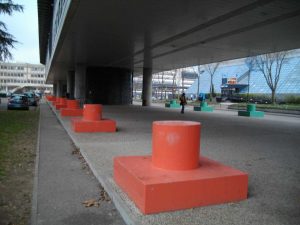

To approximate the weight, it is necessary to calculate the volumes of the individual walls and floor slabs. To do so, the length and width of the building are determined through measuring. Afterwards, the area and the perimeter of the building (idealized as a rectangle) can be calculated. The building includes two floors and therefore the area can be counted three times. To determine the volume of the walls and floor slabs, it is further necessary to determine the height of the building and the thickness of a wall/floor slab. Afterwards, the students can calculate the different volumes through the formula of a cuboid. With help of a multiplication with the density, the approximate weight of the building can be found.

This task is a geometric and architectural problem which includes measuring of lengths as well as determining of field volumes. Especially modelling is in the center as the form of the building is approximated to a cuboid. Afterwards, the students have to consider which walls and floor slabs are relevant for the building’s weight. The task can be used from grade 7, especially in the context of cuboids and compound fields.

This task is only one of many examples which show that the MathCityMap project is an international project which stands out due to its universal use at several locations.