During May, the MathCityMap Team created a trail in Zaryadye Parc in Moscow – in good time for the start of FIFA World Cup in June!

One of the included tasks is in the focus of the “Task of the Week”, not at the latest through the object’s impressive architecture.


Task: Distance (Aufgabennummer 3761)

Calculate the distance between the crosses at the top of the towers! Give the result in meters.
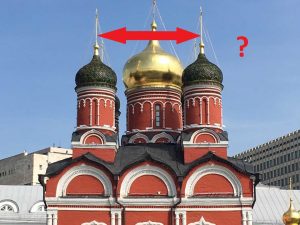

Already in the picture, it becomes obvious that the distance cannot be measured directly. Without the use of special measuring equipment, the task solvers have to develop a creative idea: The distance in the height can be projected on the ground.
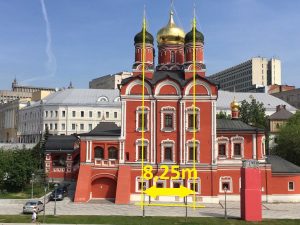
This happens best through marked points at the building, or as shown in the picture from a certain distance. With this idea, the beginning problem of the height of the building can be avoided and the task can be solved easily.

The current Task of the Week deals with one of the many landmarks of Frankfurt: the Europe tower, also known as “asparagus”. The related task is to estimate the own distance to the tower using the intercept theorems.


Task: Europe Tower (task number: 1595)

Determine the distance from your location to the Europe Tower. Give the result in meters. Info: the pulpit has a diameter of 59 m.


The first challenge is to find a suitable solution. With the aid of the intercept theorems, the task can be solved with the use of one’s own body. The arm and thumbs are streched so that the pulpit of the tower is covered with one eye opened. Afterwards the distance to the tower can be calculated with help of the thumb width and the arm length or distance from thumb to eye.

The task is a successful example of “outdoor mathematics” by using the theoretical formulas (here: intercept theorems) in an authentic application in the environment. To solve the problem, the students need knowledge about the intercept theorems. The task can thus be assigned to geometry and can be solved from class 9 onwards.

The current “Task of the Week” is about the hydrant sign, which might have been noticed frequently in everyday life. By means of them, hydrants can be quickly and precisely located, e.g. for fire-fighting operations. But how exactly is such a sign read? With this question, the students are confronted in the task “Hydrant sought” from the trail “Campus Griebnitzsee” in Potsdam.


Task: Hydrant sought (task number: 1047)

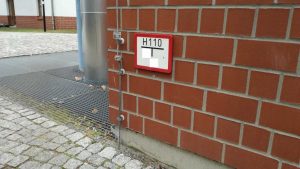
On the house is a reference to the next hydrant attached (red-white sign). How far is the hydrant from the sign in meters? Determine the result to the second decimal place. 


In order to solve the problem, the sign must at first be interpreted correctly. If the students do not know it, the hints help them. The indication on the sign is to be read so that one runs a certain length in meters in one direction (left/right) and then turns at right angles and again runs the length of the second number in meters. The situation can thus be described and solved using a right-angled triangle. The two indications on the hydrant sign (in the picture, they are made unrecognizable in order to ensure the presence of the pupils) are the cathets, while the direct distance corresponds with the hypotenuse. This can be determined by means of the Theorem of Pythagoras. Further, the solution can be determined and valued through measuring the distance to the hydrant. The problem is therefore to be assigned to geometry and can be used as a practical application for this from class 9 onwards with the development of the Theorem of Pythagoras. Since hydrant signs can be found in many places, the task can easily be transferred to other sites and allows mathematical operations in the environment in an easy way.