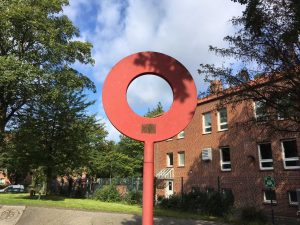
Dominik Enders, a student of the German grammer school (Gymnasium) in Bad Neustadt, created our new Task of the Week (the task “Ring”). In the interview, he explains why the students at his school create their own MCM tasks.


How do you use MCM and why?

I participate in a project, led by teacher Ms Gleichmann, in which we create math trails for pupils from younger classes, which you can tackle in your free time or on hiking days.

Describe your task. How can it be solved?

My problem is about a ring-shaped piece of sports equipment on a playground, of which you are supposed to find the area of the upper side. Assume that the edges of the ring are smooth, i.e. without indentations.

First you have to calculate the area of the circle up to the outer edge of the ring (tape measure/inch stick and pocket calculator are required) by determining the radius and then
calculate the area of the circle. Using the same procedure, calculate the smaller area of the circle enclosed by the inner edge of the ring. Then you only have to subtract the smaller area from the larger one to get the area of the top of the ring.

What didactic goals do you pursue with the task?

The task refers to the teaching content of the 8th grade and represents an application of the pupils’ knowledge on the topic of the area of a circle. The circle-ring is more demanding, but this can be mastered by using the area formula for two circles. The reference of mathematics in the 8th grade to a piece of sports equipment on a playground, which the pupils know from their everyday experience, should be motivating. By measuring lengths (radii), the topic of sizes from Year 5 is also addressed, as well as the importance of measuring accuracy.

Note: The task “Shoe size of the statue” was also created by a pupil of the Rhön-Gymnasium. It was the 15,000th task at MCM – great!

Our new task of the week takes us to Michelstadt in the beautiful Odenwald, Germany. Here math teacher Alexander Strache created the task “Altes Michelstädter Rathaus” (engl.: “Old City Hall of Michelstadt”). In the interview he talks about his experiences with MathCityMap.

How did you get to know MathCityMap project? How do you use MCM?

I came across MCM during my studies at the Goethe University Frankfurt. At first through flyers and “advertising” for it in a lecture, then through attending a seminar on it. At the university I also created my first two assignments for MCM. At the moment I am a teacher in the preparatory service and start to build the first math trail for my school.

Describe your task. How can it be solved?

The task is to estimate the area of the roof of the historical Michelstadt town hall as good as possible. On the one hand, many sizes cannot be measured directly, because the roof hangs far above the heads of the students, on the other hand, the dimensions of the ground plan can be walked/measured and other sizes can be estimated well (advanced students can even determine certain vertical distances quite well using a ray set figure). The comparison with neighbouring buildings and counting the floors can be helpful for a rough approximation. For the creation of the sample solution I worked with a craft sheet and looked at the respective surfaces as exactly as possible – on site working with triangles and rectangles is fully sufficient.

What didactic goals do you pursue with this task?

On the one hand, it is about training an eye for simple geometric figures in architecture and, if necessary, to abstract them to even simpler ones: the surface area of many trapezoids, but also general polygons can be approximated by parallelograms or rectangles. Of course, many simplifications have to be made for the small-scale roof surface, but here the mathematical modelling is trained: What can I neglect and simplify without distorting the overall result too much? It is a matter of cleverly estimating non-measurable quantities by “educated guesses”: If I know that the depth of the building is about 10m, how high could the roof be? And of course, as always by using MCM, interdisciplinary skills such as teamwork are trained.

Further comments on MCM?

I think it’s great that a digital tool has been developed here that doesn’t lead to children sitting in front of the screen longer and longer, but that exercise, fresh air, training in local knowledge and an eye for mathematical phenomena in the “real world” play a major role. Furthermore, the competence of modelling is in the foreground, which is very important for me. Even if the development of a good task takes some time and work, it can be used again and again. MCM is therefore ideal for a student council that develops tasks cooperatively.

Task of the Week: Cobblestones

This week our Task of the Week is located in Estonia. In the city of Tartu the German mathematics teacher Sascha Abraham created the task “Cobblestones”. In the following he describes his task and the Erasmus project “Making Technology Meaningful Through Digital Pedagogy”, for which he developed this interesting task.

How you get to know the MathCityMap project?

In march I participated in a workshop of MathCityMap. Unfortunately, I didn´t have enough time last school year to work with MCM in math class, but I am going to use the app in this school year. I want to use the tool in two ways. Firstly, I create trails to repeat the educational content before an exam or to illustrate the mathematical content. Secondly, I want that older students create MathCityMap tasks for younger students.

Please describe your task. Why did you create it? How could it be solved?

I created a mathtail and this task within the frame of the Erasmus project “Making Technology Meaningful Through Digital Pedagogy” in order to present MathCityMap to other teachers. The Erasmus project works on the question, how “new technologies” (e.g. electronical devices like tables or smartphones and available software) could benefit mathematical education. In my opinion, MathCityMap enables students to experience mathematical problems in the “real world outside the class room”.

The task cobblestone is an example for a counting task (How many cobblestones are placed in this area?). The task can be solved by calculating how many squared cobblestones at the rectangular area. However, there are two planted areas, wherefore students have to subtract the missing cobblestones. Lastly the students have to add the number of cobblestones, which are placed around the benches. The aim of the task is that students learn to observe their environment carefully in order to solve mathematical problems.

Why do you use wizard tasks?

Wizard tasks are mathematical standard problems, which can be identified nearly anywhere. Through the usage of the MathCityMap wizard users can created a small set of tasks very rapidly. In addition, wizard tasks demonstrate new users different possibilities for interesting mathematical problems.


Today’s Task of the Week focuses on the circular ring. The idea behind is to determine the desired surface area by the difference of two surfaces, which can be calculated easily.


Task: Ciruclar Ring (Task number: 1943)

Calculate the area of ​​the circular ring. Give the result in cm².


The area of the circular ring can be calculated by determining the radius of the entire circle, as well as the radius of the small “missing” circle. In this case, the easiest way is to measure the diameters of both circles. Then one calculates the wanted area either with the formula of the area of the circular ring, or one calculates the area of ​​the entire circle and deducts the small circular gap. In both cases, the wanted area results.

A similar task can be created by means of traffic signs, e.g. the passage prohibited sign and the question of the proportion of red color. In both cases, the circle plays a thematic main role, so that the topic can be used from class 9 onwards.

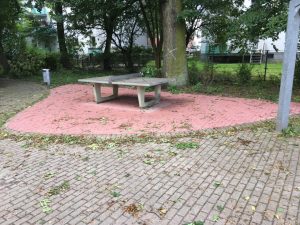
In this year’s autumn, numerous tasks were created in Wilhelmsburg, district of Hamburg. The tasks are very convincing – especially in the context of the MCM concept – through their interdisciplinary and thematic diversity, which we would like to illustrate exemplary in our current Task of the Week.


Task: Red area (task number: 1964)

Determine the red area on which the ping-pong table stands. Give the result in m².


It quickly becomes clear that the entire area can not be approximated by a single geometrical object, or that this is only possible with significant losses in accuracy. It is therefore appropriate to divide the area searched into disjoint subspaces, which can be calculated using formulas. This is best done using a drawing. A particular challenge are the curved edges, where estimations and approximations are necessary. According to measurements and calculations, the total area is obtained by adding the area contents of all partial surfaces.

The area can be described using rectangles and triangles. In addition, the principle of the decomposition and additivity of surface content is necessary for solving the problem. The task can be used from class 7 onwards.

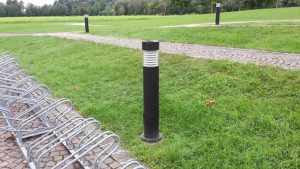
With two trails in Salzburg, we can now welcome Austria as the 9th country with a MCM Trail. The current task of the week presents a task in the field of the surface of a cylinder. It is located in the trail at the natural sciences faculty of the Paris-Lodron University in Salzburg.


Task: Lamp (task number: 1908)

How large is the black painted surface of a lamp without the base plate? Give the result in m². Round to two decimal places.


The pupils first recognize the lamp as cylindrical and then determine the black surfaces. For this, it is necessary to divide the lamp into two cylinders. For the upper small cylinder, the shell surface as well as the cover are calculated, for the lower cylinder only the shell surface. Height and radius need to be measured. Subsequently, the individual surfaces are added and the total painted surface area is obtained.

The task can be assigned to the subject area of ​​geometry and, in particular, geometrical bodies (cylinders) and can be used from class 9 onwards.

Today’s Task of the Week focuses a geometric question at the Aasee in Münster. More specifically, the surface content of a hemisphere is calculated by the students.


Task: Mushroom (task number: 1400)

Determine the area of ​​the mushroom. Give the result in dm². Round to one decimal.


In order to solve the problem, the students have to approach and recognize the shape as a hemisphere. They then need the formula for the calculation of the spherical surface or here the hemispherical surface. For the determination, only the radius of the hemispheres is required. Since it can not be measured directly, this can be determined with help of the circumference.

The task requires knowledge of the circle and of the sphere and can therefore be applied from class 9 onwards.

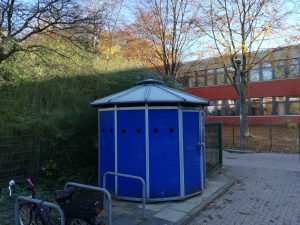
The present task of the week is about a geometric question. It involves the area calculation of the roof surface of the illustrated pavilion.


Task: Pavilion (task number: 665)

Determine the roof surface of the pavilion! Give the result in m².


For this purpose, the pupils should recognize that the roof surface consists of several isosceles triangles. It is therefore sufficient to measure the height and base of one triangle and to calculate the surface content using the formula for the area content of triangles. The total area can then be determined by multiplication by the number of triangles.

In order to solve the problem, the pupils must therefore be familiar with the area calculation for triangles. In the task, the “geometrical view” is trained by the triangular shape being recognized in a composite figure. Here, an essential aspect of outdoor mathematics is found, namely the recognition of mathematical concepts and objects in reality, as well as the use of mathematical knowledge to solve everyday questions. Solving the task is possible from class 6 onwards with the topic triangles.

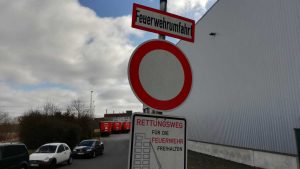
The current “Task of the Week” shows that many geometrical questions can be found in different traffic signs. This concerns the circular “passage prohibited” sign and, in particular, the question of the ratio of red and white surfaces.


Task: Passage prohibited (task number: 1102)

How many percent of the area of ​​the “passage prohibited” sign is red?


For the calculation, the pupils have to use their knowledge about the area of ​​the circle. In addition, it must be noted that the shield is not only white on the inside, but has a white edge as well, which must be considered for an exact calculation. The pupils measure the different radii, calculate the total area and the area of ​​the two white surfaces. By means of subtraction the surface content of the red ring is obtained. In the last step, the percentage of the red area has to be calculated.

The task can be classified in the area of ​​geometry, more specifically in circles and area contents, and is releasable from class 7 onwards. Other traffic signs can be integrated in a similar way into geometric questions, such as the “entrance prohibited” sign on a one-way street. In particular, the different flat figures on street signs (circle, triangle, rectangle, octagon) motivate different tasks.

The current “Task of the Week” from the trail “La Doua” in Lyon, France, shows that the MathCityMap project is already implemented internationally. Originally, the task is in French and will be translated for the Analysis.


Task: Weight of the Quai 43 (Task Number: 855)

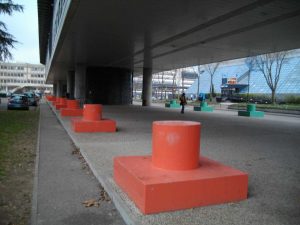
The building “Quai 43” has the shape of an ocean liner, which is built on ten concrete columns. Determine the weight of the building in tons (reinforced concrete weights 2.5t/m³).


To approximate the weight, it is necessary to calculate the volumes of the individual walls and floor slabs. To do so, the length and width of the building are determined through measuring. Afterwards, the area and the perimeter of the building (idealized as a rectangle) can be calculated. The building includes two floors and therefore the area can be counted three times. To determine the volume of the walls and floor slabs, it is further necessary to determine the height of the building and the thickness of a wall/floor slab. Afterwards, the students can calculate the different volumes through the formula of a cuboid. With help of a multiplication with the density, the approximate weight of the building can be found.

This task is a geometric and architectural problem which includes measuring of lengths as well as determining of field volumes. Especially modelling is in the center as the form of the building is approximated to a cuboid. Afterwards, the students have to consider which walls and floor slabs are relevant for the building’s weight. The task can be used from grade 7, especially in the context of cuboids and compound fields.

This task is only one of many examples which show that the MathCityMap project is an international project which stands out due to its universal use at several locations.