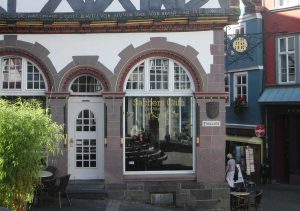
Our current task of the week leads us to Switzerland. Noah Gass, student of primary education, created the MathCityMap task “Rathaus” (engl. “town hall”) in Liestal near Graz. He answered us some questions about the MathCityMap app.
How did you get in contact with the MathCityMap app?
I am a student for primary education at the Pädagogische Hochschule Nordwestschweiz in Basel. I take part in a didactics seminar about teaching mathematics using digital media for which I created a MathCityMap mathtrail.
Please describe your task. How could students solve the task.
To answer the task, students have to find out how many hours the town hall is opened per week. Except for two days, the opening hours differ from day to day. For example, on one day the town is closed during a lunch break, on others it is opened continuously. First, the students have to calculate the daily opening hours. Then, they can figure out how long the town hall is opened weekly by adding those daily opening hours.
Which didactic aims are stimulated through your task?
To answer the questions, the students have to calculate with full and half hours – they need decimal numbers. Another difficulty is that the time is given in a scale of 24 units. However, speaking about time differs from the “written” digital time – to calculate the opening hours from half past 7 a.m. to 2 p.m. the students have to find out the time period between 7:30 and 14:00 o’clock.